Inscribe vs. Ocrolus: Which platform is right for document fraud detection?
Table of Contents
[ show ]- Loading table of contents...


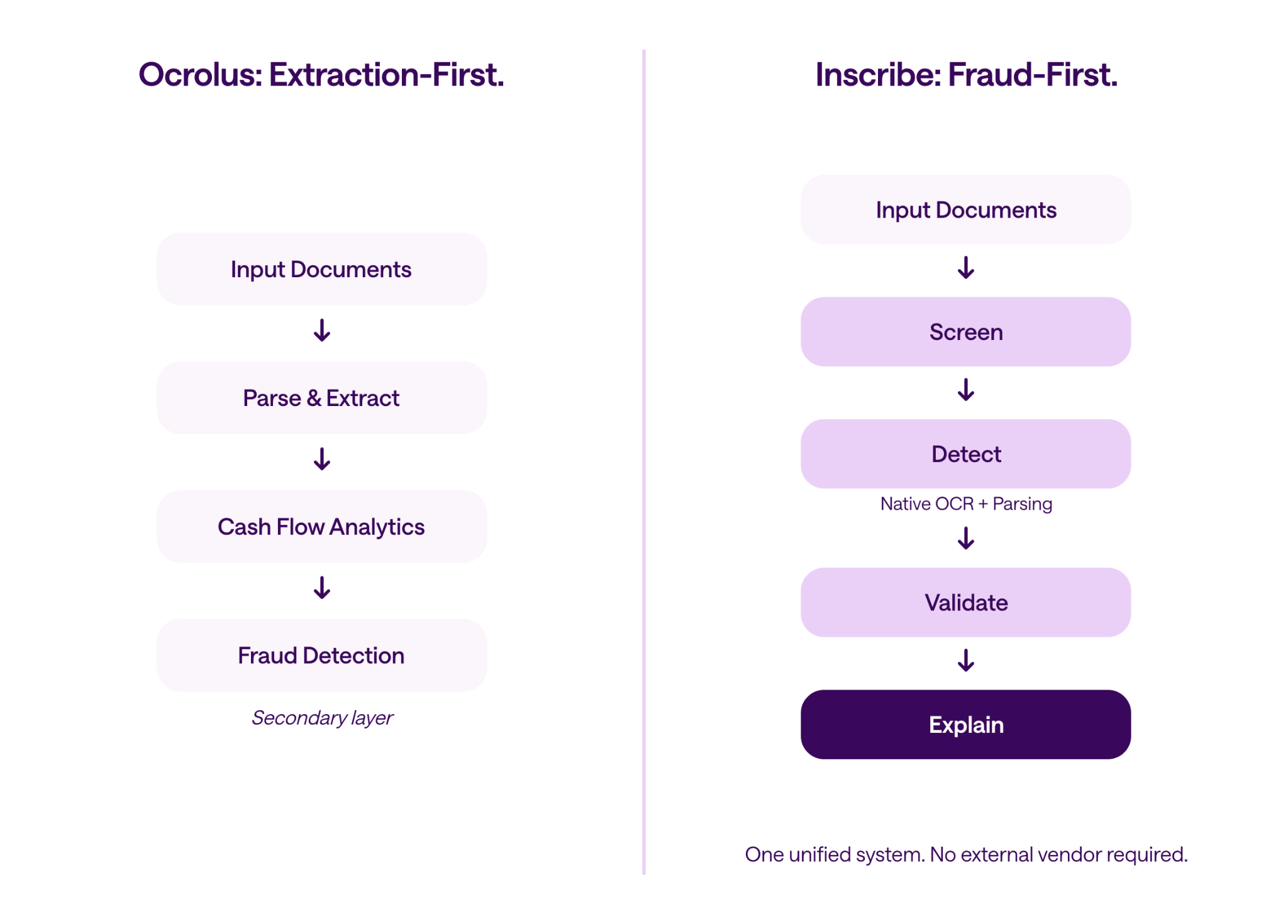
Inscribe and Ocrolus both work with customer-submitted financial documents, but they are built for different jobs. If you are evaluating document fraud detection for a bank, credit union, fintech, or lender, the core difference is straightforward. Ocrolus is primarily a document automation and cash flow analytics platform, with fraud detection as a secondary capability delivered through its Ocrolus Detect product. Inscribe is built specifically for document fraud detection, combining AI-driven forensic analysis with high-quality document parsing in a single workflow.
Every dollar lost to fraud now costs North American financial institutions more than $5 in total impact once operational, compliance, and reputational costs are counted, up 25% since 2021. According to Inscribe's 2026 Document Fraud Report, 1 in 16 documents show signs of fraud, meaning teams reviewing high volumes of bank statements, pay stubs, and tax forms are encountering fraudulent documents regularly, whether they catch them or not. As AI-generated forgeries become harder to spot manually, the difference between a workflow tool and a purpose-built fraud detection system affects fraud losses, onboarding speed, and how much analyst time gets consumed by manual review.
What's the core difference between Inscribe and Ocrolus document fraud detection software?
The primary distinction is straightforward: Ocrolus is a document automation and cash flow analytics platform that adds fraud detection. Inscribe is a fraud detection platform that also does document parsing.
This difference in origin shapes everything downstream: detection methodology, signal confidence, explainability, and how each platform fits into lending workflows.
Detection methodology: Inscribe uses forensic, network, semantic, and perceptual models across document structure, content, metadata, and visual details. Its AI analyzes document relationships to detect fraud, synthesizing cross-document intelligence and patterns across applications.Ocrolus's fraud layer, Detect, is a capability layered on top of its core automation platform. Detect combines forensic metadata analysis, algorithmic content checks, and screenshot detection. But fraud detection is secondary to Ocrolus's primary value proposition of data extraction and cash flow analytics.
Signal confidence: Across document fraud tooling generally, false positive volume is one of the most common reasons teams re-evaluate a vendor. When alerts fire too broadly, more applications get routed into manual review, which limits automation confidence and erodes trust in the signals themselves. Inscribe publishes a 99% precision rate for its Fraud Intelligence technology. Ocrolus does not publish a false positive or true positive benchmark for Detect. Teams should validate detection performance against their own document sets during evaluation, with either vendor.
Explainability and decision support: Document extraction is only part of the problem. Automating fraud decisions also requires explainable risk ratings, configurable thresholds, and review workflows built for straight-through processing. A risk score without contextual explanations forces underwriters back into manual investigation and makes it harder to escalate or prioritize high risk cases without sending every alert to manual review. This is where the platforms diverge most sharply: Inscribe provides plain-language summaries, X-Ray visualizations, and audit-ready documentation alongside every flag. Ocrolus offers reason codes and authenticity status bins, but with less emphasis on the decision-making layer that fraud teams and compliance teams need for informed decisions.
OCR and document parsing have become widely available, with dozens of vendors offering solid data extraction today. What's harder to find is a platform built specifically to detect fraud in financial documents that also parses at a high standard. Some fraud-focused tools cover detection well but skip native OCR, forcing teams to stitch together a separate parsing vendor. Inscribe's differentiation is forensic-grade fraud detection running alongside high-quality parsing in a single workflow.
What does strong document fraud detection look like?
Before comparing platforms, it helps to understand the verification layers that the best fraud detection software should cover, including the broader fraud and identity verification outcomes those layers support. Not every platform addresses each layer with equal depth, and the difference between basic checks and forensic-grade analysis determines whether your team can actually stop fraud at scale.
The layers buyers should evaluate:
- Pixel-level and image forensics. Detecting visual artifacts, layering, and manipulation in image files and pdf documents. When available in the review process, UV and infrared imaging can reveal hidden security features on documents. Digital manipulation detection tools uncover alterations that are invisible to human reviewers. Inconsistent typography can indicate document tampering, and deepfake documents now mimic real formatting and logos at a level that defeats visual inspection.
- Metadata examination and edit history. Missing author details in digital files can indicate tampering. Forensic analysis of file structure reveals hidden inconsistencies. Edit history, creation timestamps, and software signatures can surface suspicious activity even in visually clean documents.
- Structural analysis of layouts and formatting. AI models analyze documents for layout and digital inconsistencies. Anomaly detection across document types identifies deviations from known legitimate templates, catching counterfeit documents and fake documents that pass visual inspection.
- OCR, NLP, and data extraction. Optical Character Recognition converts images of text into machine-readable text, enabling automated verification. Automated document verification software cross-checks data against official databases, confirming transaction data, income figures, and identity signals.
- Cross-document reasoning across a full application. Cross-document analysis uncovers hidden risks across multiple documents. AI Agents validate claims against public data during cross-document analysis, and cross-document intelligence synthesizes patterns across applications. This layer is critical for catching fraud rings, synthetic identities, and mule accounts that only become visible when you analyze relationships between bank statements, pay stubs, and tax forms submitted by the same applicant.
- Detection methodology: rules-based vs. LLM-powered vs. AI Agents. Static rules catch known fraud patterns but miss novel fraud tactics. Machine learning models recognize behavioral patterns to detect forgeries, and LLM-powered systems can reason about document authenticity in ways that pattern recognition alone cannot. AI Agents represent the newest approach. These are autonomous systems that combine multiple detection layers, cross-reference information across multiple sources, and deliver results in seconds.
Platforms built primarily for automation approach these layers differently than platforms built specifically for fraud. When fraud detection programs produce a high volume of low-confidence signals, the operational burden shifts back to human reviewers. The bottlenecks that automation was supposed to remove come back with it.
When is Ocrolus the right choice?
Ocrolus is strongest when document automation, workflow efficiency, and cash flow analytics are the team's primary needs.
Best fit when:
- The primary need is document automation and structured data extraction, with fraud detection as a supporting layer rather than the core requirement
- The team needs deep mortgage-specific tooling and certifications for automation workflows, Ocrolus has more built-out content here.
- Structured data extraction and income verification are the core output, feeding decisioning models, cash flow analysis, or downstream analytics
- The existing stack already includes a separate fraud detection tool and the team is not looking to consolidate
Worth additional evaluation when:
- Document fraud detection is the primary requirement, not a secondary one
- High false positive rates are creating manual review bottlenecks and eroding confidence in automated signals
- The team needs explainable risk ratings and configurable thresholds for automated lending decisions
- LLM-powered or AI Agent-based detection methodology is required to keep pace with ai generated documents and evolving fraud patterns
- Applicant-level cross-document context is a core need, for example identifying anomalies across all documents in a single loan application
Ocrolus Detect currently supports fraud detection on bank statements, pay stubs, and W-2s, with other document types under expansion.
When is Inscribe the right choice?
Inscribe is strongest when document fraud detection is the primary requirement and the team needs forensic-grade signals, not just extraction.
Best fit when:
- Document fraud detection is the central problem to solve, and the goal is stopping fraud before it creates significant financial losses
- The team reviews high volumes of U.S. financial documents: bank statements, pay stubs, tax forms, invoices, utility bills, and identity documents
- Explainable risk ratings, configurable precision/recall thresholds, and review workflows for straight-through processing are required
- Native parsing and fraud detection need to live in one workflow, consolidating fraud detection and document processing into one platform rather than managing separate vendors
- Applicant-level context matters: cross-document signals across bank statements, pay stubs, and tax returns in a single application to detect fraud that only emerges when analyzing the full picture
- Pricing predictability at scale matters, including per-document pricing, unlimited users, and volume discounts
Worth additional evaluation when:
- The primary need is mortgage automation workflow tools rather than fraud detection
- The organization operates heavily outside the U.S., where document calibration may require additional validation
Inscribe's methodology differentiator is its AI Agent and LLM-powered detection approach. Rather than relying on static rules or isolated signal checks, Inscribe's AI agents cross-reference information across multiple documents, validate claims against public data, and analyze transaction patterns and behavioral analytics over time to surface anomalies that static checks miss. Inscribe's AI Agents average 72 seconds per document review, compared to 10–15 minutes for manual review, combining speed with the kind of contextual reasoning that can detect more fraud than manual review or rule-only systems, including sophisticated tactics like AI generated documents and template-based forgeries.
Side-by-side platform comparison
Where details are noted as "confirm with Ocrolus," readers should validate directly. Published information on those capabilities is limited.
What does platform choice mean for manual document review costs?
The financial impact of platform choice extends well beyond the subscription cost. It shows up in analyst hours, fraud losses, and the hidden tax of false positives.
Review speed. Manual review typically takes 10–15 minutes per document. Inscribe reduces that to approximately 72 seconds, roughly a 90% cut in review time for banks and credit unions. For fraud teams and compliance teams processing financial documents at scale, this difference compounds fast.
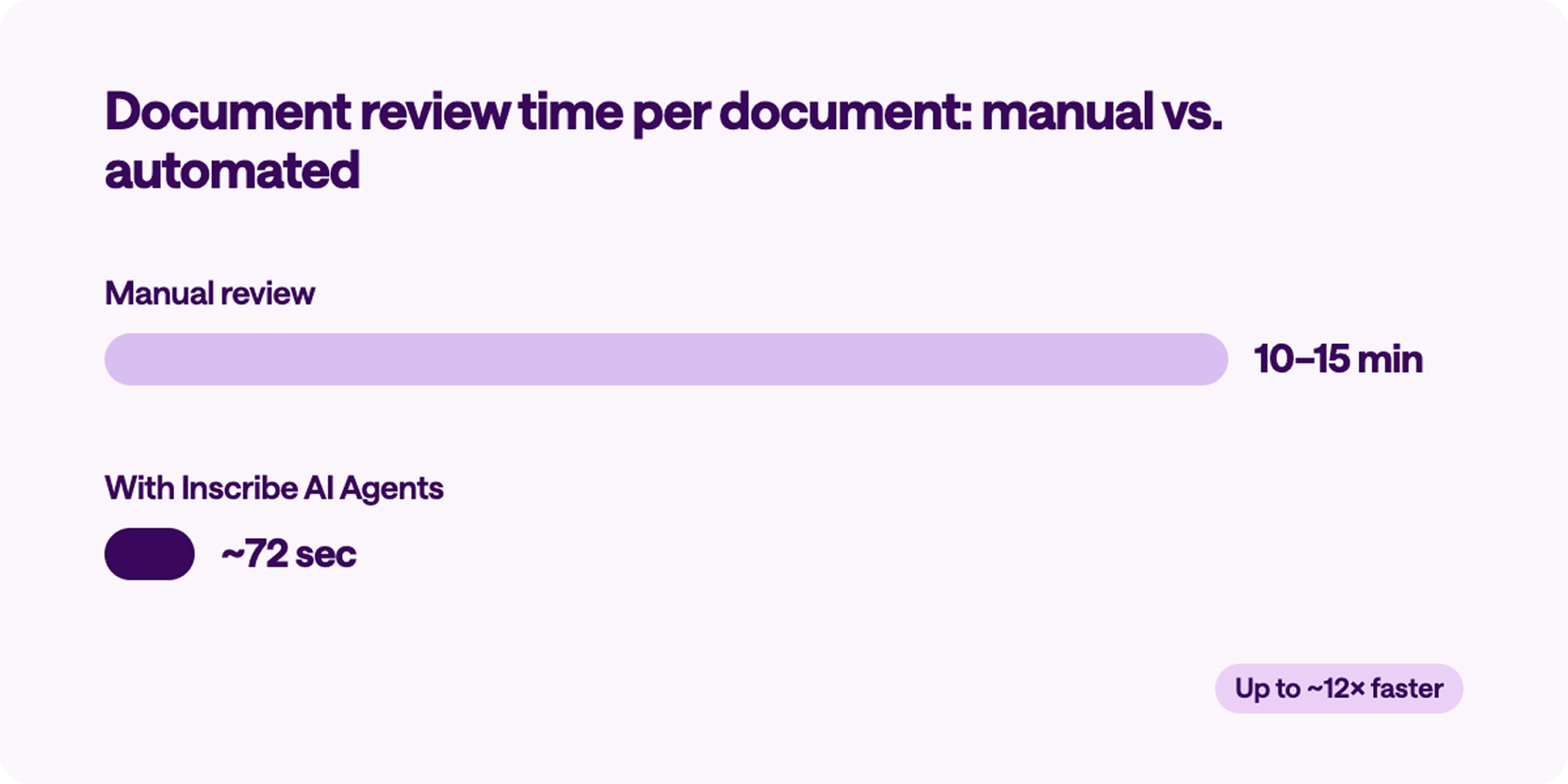
The 200-document example. A team processing 200 documents per day at 12.5 minutes average manual review spends roughly 41.7 hours of analyst time daily. With Inscribe at 72 seconds per document, that drops to approximately 4 hours, saving over 36 analyst-hours per day. Document fraud detection software can analyze millions of documents annually, making this kind of operational efficiency essential for financial institutions and payment providers handling volume.
The false positive tax. High false positive rates compound the problem. If fraud signals fire too broadly, more applications land in manual review, which offsets the automation benefit entirely. When legitimate customers are flagged unnecessarily, it slows the onboarding process, increases friction in the customer lifecycle, and erodes trust in the platform. Inscribe's configurable thresholds allow teams to align precision and recall with their risk appetite, reducing false positives without sacrificing accuracy in catching genuine fraud.
Vendor sprawl. Running fraud detection and document parsing on separate platforms means two contracts, two integrations, and two support relationships. Every additional vendor adds friction to existing workflows and increases the surface area for errors. Inscribe combines both in a single workflow, while Ocrolus's fraud detection is layered onto its parsing infrastructure.
Platform outcome data
The following outcome data comes from Inscribe's publicly stated customer results. These figures are sourced from Inscribe's own reporting and customer stories.
- Logix Federal Credit Union: Over $3 million in fraud prevented over eight months using Inscribe's document fraud detection platform. Matt Overin, who leads Fraud Risk Management at Logix, reported "potential loan fraud savings of over $3 million and countless ID theft saves" in the first eight months.
- BCU: $5.6 million in fraud prevented over nine months in 2025, according to Inscribe's 2026 Document Fraud Report.
- AI-generated document fraud: AI-generated document fraud increased 5x across Inscribe's network from April to December 2025. Deepfake documents now mimic real formatting and logos. AI-generated and template-based document fraud increased significantly across Inscribe's network in 2025, per the 2026 Document Fraud Statistics.
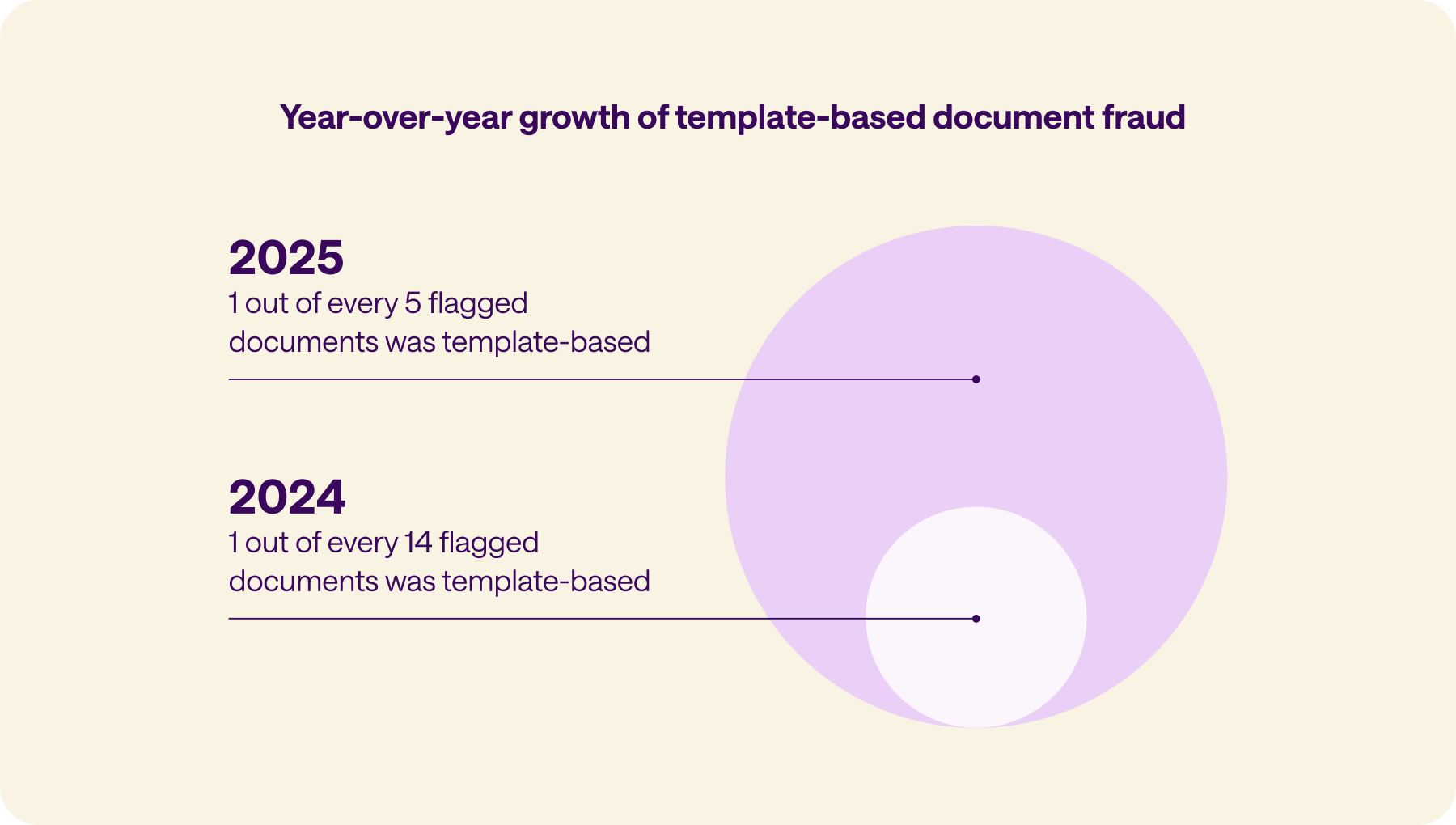
Inscribe's network processes millions of documents, which supports ongoing monitoring of emerging fraud tactics across altered bank statements, pay stubs, and tax forms. These documents are typically manipulated to misrepresent identity or financial position. Among flagged documents, 91.2% included altered financial details, either alone or combined with identity changes. In a survey of 90 fraud and risk leaders published in Inscribe's 2026 Document Fraud Report, 85.6% named bank statements as the document type most vulnerable to manipulation.
Ocrolus has published qualitative case studies but fewer publicly available dollar-denominated fraud prevention outcomes specific to its Detect product.
Which platform should you choose?
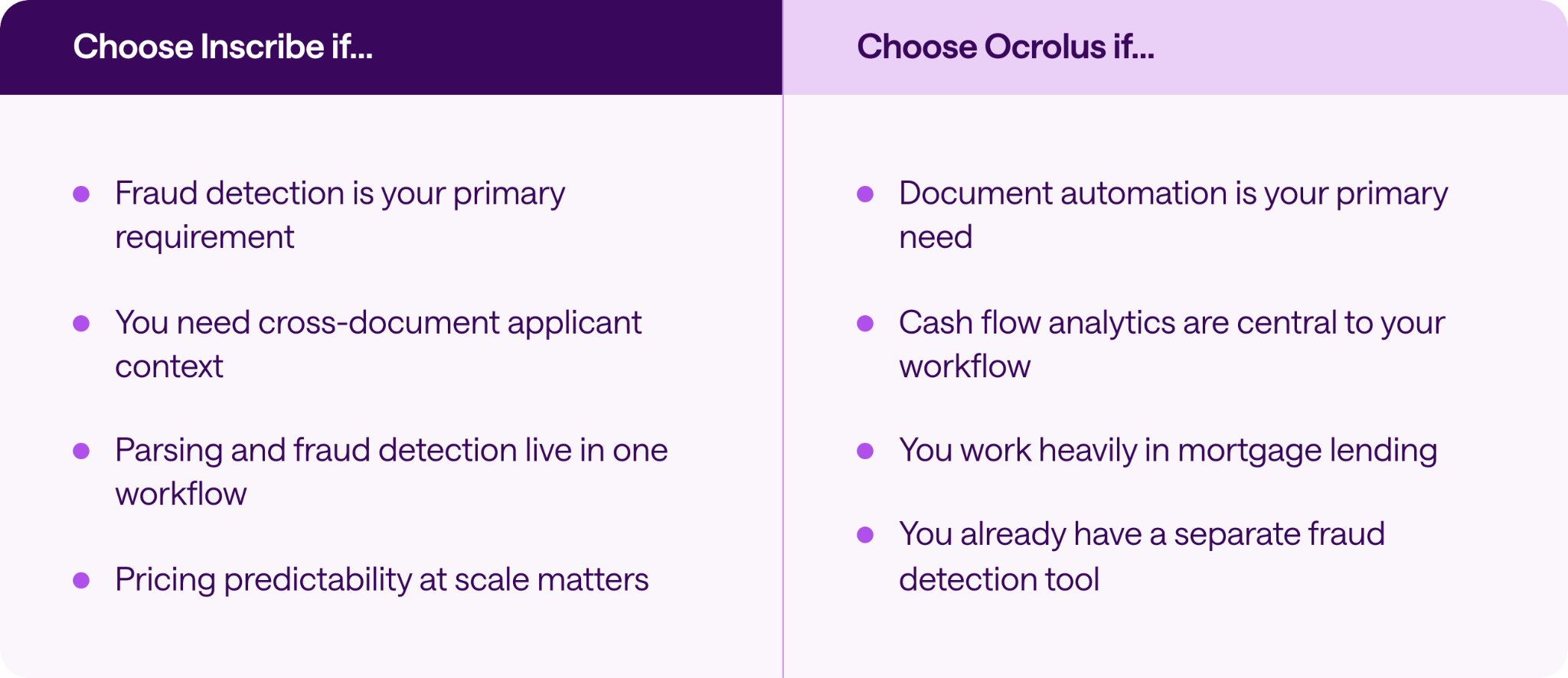
Choose Ocrolus if your team's primary need is document automation, structured data extraction, and cash flow analytics with fraud detection as a supporting layer. Ocrolus excels at parsing financial documents, feeding income verification models, and supporting mortgage lending workflows where automation and data accuracy are the central requirements.
Choose Inscribe if document fraud detection is your primary requirement and you need forensic-grade signal quality, explainable risk ratings, configurable thresholds, and document parsing in one workflow. Inscribe is purpose-built for stopping fraud across bank statements, pay stubs, tax forms, insurance claims, and identity documents, using cross-document reasoning, network intelligence, and AI Agents that identify anomalies human reviewers miss. Inscribe detects forged and AI-generated documents in seconds, with 99% precision and audit-ready explainability built into every risk score.
Leading organizations across lending, fintech, and credit unions use Inscribe to detect fraud, prevent significant financial losses, and protect genuine customers from the downstream impact of fraudulent activity.

Inscribe is a document fraud detection platform that uses AI Agents, LLM-powered detectors, and forensic/network/semantic/perceptual models to identify fraudulent documents. Ocrolus is a document automation and cash flow analytics platform that added fraud detection as a secondary capability through its Detect product. Inscribe is built for fraud-first workflows; Ocrolus is built for extraction-first workflows.
Yes. Ocrolus offers fraud detection through its Detect product, which includes forensic metadata analysis, screenshot detection, and algorithmic content checks. Currently, Detect supports bank statements, pay stubs, and W-2s. Ocrolus does not publicly disclose true positive or false positive rate benchmarks for Detect. Buyers should confirm detection performance figures directly with Ocrolus before committing.
Teams typically make the move when fraud detection stops being a supporting requirement and becomes the primary one. Common triggers include needing deeper cross-document reasoning across a full application, explainable risk ratings that hold up in an audit, configurable precision and recall thresholds, and broader document type coverage for fraud detection specifically. Alert volume is also a factor. When a detection layer produces more low-confidence signals than a team can work through, the manual review burden it was meant to remove comes back.
Inscribe uses LLM-powered detection and configurable precision/recall thresholds to minimize false positives. Its published 99% precision rate means that among flagged documents, nearly all are genuinely fraudulent. Teams can tune sensitivity to match their risk appetite, ensuring legitimate customers are not unnecessarily flagged while still catching suspicious patterns and hidden inconsistencies, which also helps preserve a smoother identity verification and onboarding experience for legitimate customers. Learn more about how Inscribe uses LLMs to reduce false positives at inscribe.ai/false-positives
It depends on your primary need. If your team's core requirement is document fraud detection with integrated parsing, Inscribe can replace Ocrolus and consolidate fraud detection and document processing into one workflow. If your primary need is cash flow analytics and mortgage-specific automation tooling, Ocrolus may remain the better fit for that function.
Ocrolus has deep mortgage-specific tooling, certifications, and workflow integrations that make it a strong fit for mortgage automation. Inscribe's strength is fraud prevention: detecting altered bank statements, forged pay stubs, fake identities, and other red flags in loan applications. Inscribe already serves mortgage lenders today, with fraud detection built directly into underwriting workflows. In short, Ocrolus is stronger on automation and vertical certifications. Inscribe is stronger on catching fraud before it reaches underwriting.
Inscribe uses a per-document pricing model with unlimited users and volume discounts. This gives teams pricing predictability as they scale, without per-seat costs that increase as fraud teams or compliance teams grow. Contact Inscribe directly for specific pricing based on your document volume and use case.
About the author
Stephanie Spangler is the Head of Product Marketing at Inscribe, where she covers AI-powered fraud detection, document risk, and how financial institutions are adopting agentic AI. She writes on the intersection of product and practice — translating what fraud detection technology does into what it means for the risk teams using it.
Learn More
Dive deeper into document fraud

What will our AI Agents find in your documents?
Start your free trial to catch more fraud, faster.