KYB Document Fraud Detection | Catch Forged Business Documents Before Onboarding
Most KYB platforms verify who is behind a business: matching identities, checking UBO databases, running sanctions screenings. But they don't verify whether the business documents themselves are authentic. Forged articles of incorporation, fabricated financial records, and manipulated invoices pass identity checks every day.
Table of Contents
[ show ]- Loading table of contents...


Inscribe is an AI-powered KYB document solution that closes the gap left by identity-first platforms like Alloy, Jumio, Sumsub, and Trulioo. Those platforms confirm who owns and controls a business by matching identities, checking UBO databases, and running sanctions screenings. Inscribe adds the layer they don't cover: verifying that the underlying business documents (articles of incorporation, business bank statements, beneficial ownership records, and other corporate filings) are genuine, unaltered, and consistent before anyone relies on them.
Purpose-built for document risk screening since 2017, Inscribe is trusted by leading financial institutions and backed by SOC 2 Type II and ISO 27001 certifications. While many KYB platforms focus on ownership and identity checks, Inscribe helps substantiate whether the submitted documents can actually be trusted.
Below, we break down the gap Inscribe closes in KYB workflows, the business documents it verifies, how the process works, and how to get started.
How does Inscribe fit into your KYB software stack?
Most KYB software stacks are built around identity. Platforms like Alloy, Jumio, Sumsub, and Trulioo verify who controls a business by matching identities, checking ultimate beneficial ownership (UBO) databases, and screening against sanctions and PEP lists. Inscribe isn't a replacement for that layer. It's the document authenticity layer identity-first KYB platforms don't provide.
In a typical KYB automation workflow, an identity platform confirms the people behind a business are who they claim to be. Inscribe runs alongside it, or downstream of it, to verify that the documents those people submitted haven't been forged, fabricated, or altered. A business can pass every identity check an Alloy or Sumsub workflow runs and still submit a template-forged certificate of incorporation. Inscribe is built to detect forged documents in KYB before they reach an underwriting or onboarding decision.
Most teams connect Inscribe via API alongside their existing KYB software, routing documents through Inscribe's forensic analysis before or in parallel with identity and UBO checks. The output (a Trust Score, fraud signals, and a plain-English explanation) feeds into the same underwriting or onboarding decision as the identity checks, so document risk and identity risk get reviewed together instead of in separate systems.
What problem does KYB document verification solve?
Identity Checks Alone Don’t Catch Forged Business Documents
Identity verification is necessary but insufficient. Confirming who owns a business entity doesn’t confirm that the documents it submits are real. A fraudster can pass UBO verification and sanctions screening with a legitimate identity and still submit forged incorporation papers or fabricated financial documents. Business verification that stops at identity leaves a critical blind spot in the KYB process.
Fraud targeting business entities is growing. Generative AI, professional editing tools, and template marketplaces make high-quality fraudulent documents accessible at scale. Articles of incorporation, financial statements, and invoices are the most commonly forged KYB documents. According to Inscribe’s 2026 Document Fraud Report, this is exactly the kind of fraud identity-only tools often miss.
Manual KYB document review doesn't scale. As onboarding volume grows, compliance teams face the same bottleneck: review is slow, inconsistent, and prone to missing sophisticated fraud. Processing time per document can reach 10 to 15 minutes for manual reviews, creating onboarding friction that slows decisioning, increases drop-off, and raises compliance risks.
KYB compliance requires more than a checkbox. Know Your Business (KYB) and anti-money laundering (AML) programs depend on verification decisions that are both explainable and auditable. Teams need evidence that can stand up to regulatory scrutiny. Inscribe provides that evidence: Trust Scores, fraud signals, revision history, and plain-language summaries that create a real audit trail. Learn more about fraud detection software.
KYB Fraud Detection Use Cases
Built for High-Stakes Business Onboarding Workflows
Business lending and credit underwriting. Verify financial statements, business filings, and incorporation documents during underwriting. Detect income manipulation, fabricated revenue figures, and forged entity documents before approving business loans. Reduce fraud risk at the point of origination.
Fintech and neobank merchant onboarding. Catch fake incorporation papers, forged invoices, and fabricated financial records used to create fraudulent merchant accounts. Automated business onboarding without giving up fraud controls or KYB compliance.
KYB, regulatory compliance, and enhanced due diligence. Authenticate business registration documents, articles of incorporation, and proof-of-address files as part of a stronger review process. Screen ultimate beneficial owners (UBOs) and politically exposed persons against global watchlists and sanctions databases. Effective KYB and AML programs start with verified documents and ongoing monitoring, not identity checks alone.
Marketplace, platform, and partner onboarding. Authenticate seller, business partner, or supplier documents during onboarding. Detect template reuse, forged registrations, and manipulated business histories before granting platform access. Learn more about Inscribe for banks, credit unions, and lenders.
What business documents does Inscribe verify during KYB checks?
For each document type, Inscribe uses document forensics and metadata analysis to assess authenticity, not just format validation. A file can look legitimate and still be manipulated. That added verification layer is what separates Inscribe from identity-only KYB platforms.
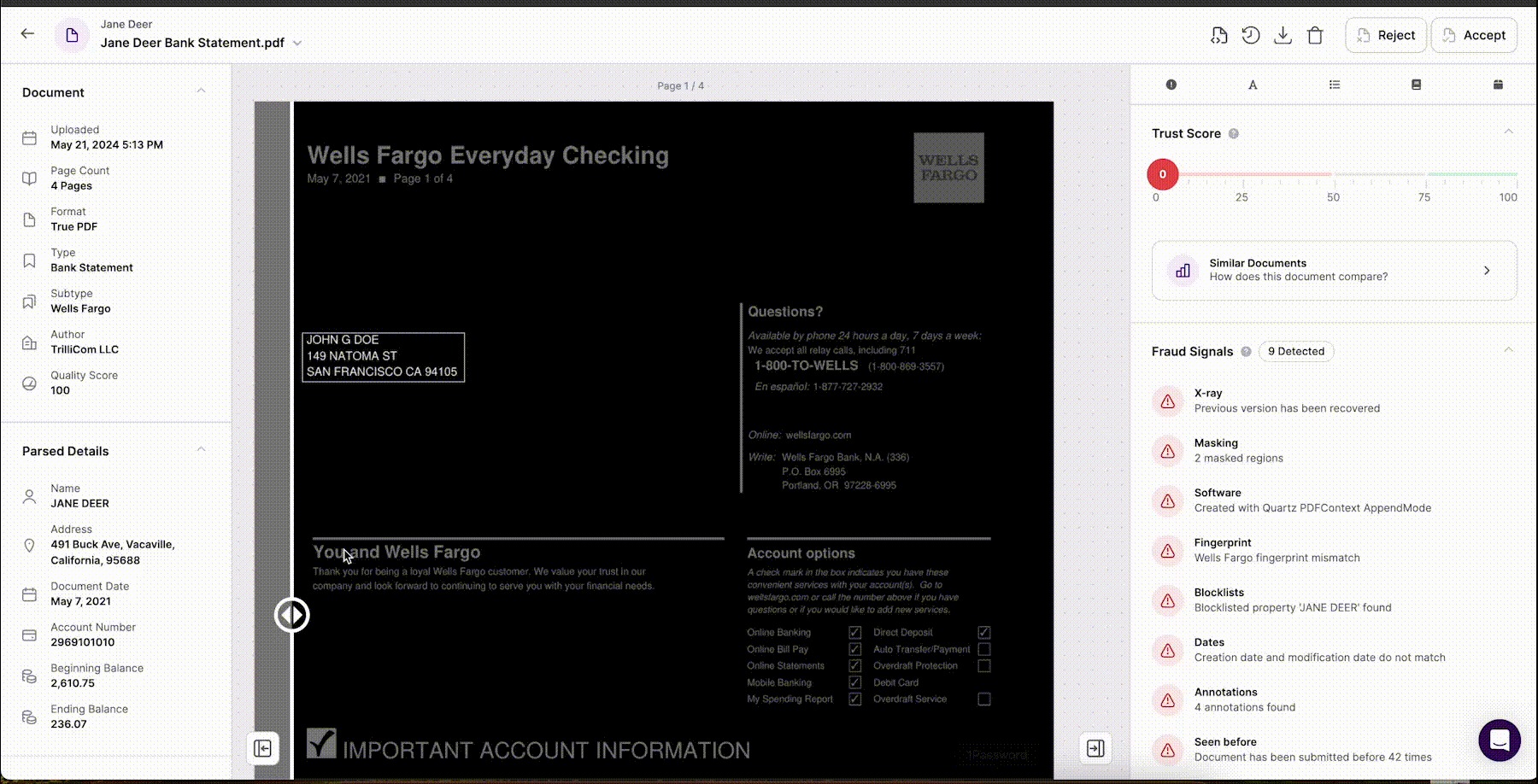
Articles of incorporation and certificates of formation. Also called a certificate of incorporation in some jurisdictions. Articles of incorporation verification catches template-based fabrications and forged entity details through structural consistency, metadata signatures, and formatting checks against known-good templates. Verifying businesses at the incorporation layer is the first step in preventing financial crime.
Business bank statements. Personal and commercial accounts. Business bank statement verification surfaces inflated balances, fabricated transaction histories, and AI-generated statements through forensic analysis and network comparison.
Business registration documents, operating licenses, and proof of address. Entity verification confirms that company registration details are consistent across official documents. Proof of address documents like utility bills and lease agreements are verified for consistency with the full submission.
Invoices and accounts receivable. Detects altered amounts, fabricated vendor details, and duplicated invoice templates submitted to inflate revenue claims. Contextual analysis flags discrepancies that indicate fraudulent activity.
Beneficial ownership and UBO documentation. UBO documentation is checked for formatting anomalies and metadata consistency across the submission set. This supports verification of ownership structures and surfaces mismatches that could indicate synthetic identity fraud or shell company creation.
Financial statements and business tax forms. P&L statements, balance sheets, business tax returns, and EIN confirmation letters are cross-referenced against other submitted documents for inconsistencies and data-entry errors.
How Does Inscribe's KYB Verification Process Work?
AI-Powered Document Verification in 4 Steps
1. Submit business documents. Upload directly to Inscribe's platform, connect via API to your existing KYB workflow, or use Inscribe's Secure Document Collection portal to request documents from business applicants. Capture-quality checks detect blur, cropped edges, and missing pages automatically, reducing data entry errors and rework.
2. Extract and parse. Custom LLMs extract entity names, registration details, financial figures, addresses, dates, and other structured data from business documents, even complex multi-page formats. Data extraction is delivered via API and webhook for integration with your KYB platform or LOS. Documentation at docs.inscribe.ai.
3. Verify authenticity and detect fraud. This is where Inscribe goes beyond identity checks and format validation. Forensic-grade analysis includes metadata inspection (creation dates, editing software), font anomaly detection, pixel-level image analysis, revision history extraction via Document X-Ray, and network-based comparison against verified document templates. Cross-document corroboration checks consistency across all documents in the onboarding submission and surfaces fraud patterns that single-document review would miss.
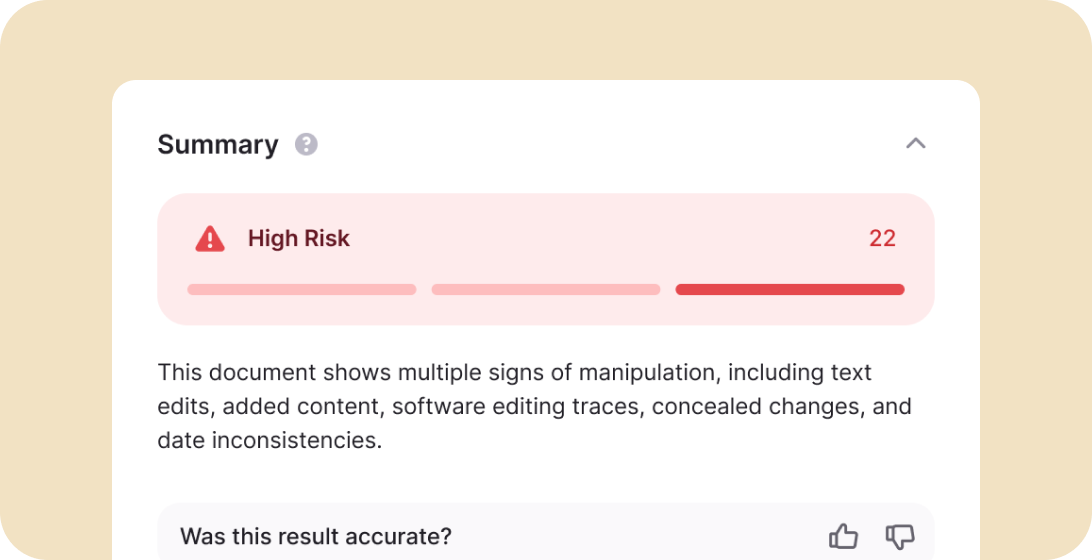
4. Review and decide. Every document receives a Trust Score (0 to 100) with visual fraud signals, severity levels, and plain-English summaries. High-risk documents route to compliance reviewers with evidence attached. Average processing time: approximately 72 seconds per document vs. 10 to 15 minutes for manual review. Risk assessments are audit-ready from the moment they're generated.
What Inscribe's KYB Solution Catches That Identity Platforms Miss
Forged and Fabricated Business Documents Beyond Identity Verification
Most KYB platforms focus on who is behind a business. Inscribe verifies that the business documents themselves are authentic. Here is what Inscribe's document forensics surfaces across KYB-specific document types.
Forged articles of incorporation. Template-based fabrications with real entity names inserted into fraudulent documents. Inscribe detects structural inconsistencies, font anomalies, and metadata mismatches that expose fakes. Detecting fake business documents starts at the incorporation layer.
Fabricated financial statements and business records. Inflated revenue figures, fabricated transaction histories, and AI-generated statements submitted to support business loan applications or merchant onboarding. Inscribe's Document X-Ray surfaces revision history that proves manipulation occurred. See the fake bank statement detector.
Manipulated invoices. Altered amounts, fabricated vendor details, and duplicated invoice templates submitted to inflate revenue claims or support fraudulent insurance claims. Network intelligence flags template reuse across submissions.
Misused business documents. Legitimate documents belonging to a different business entity, submitted to impersonate a real business or borrow its business legitimacy. Cross-document corroboration flags entity name mismatches across the submission set, catching synthetic identity fraud at the business level.
Misleading submissions through omission. Submitting only favorable financial periods, hiding recent adverse changes, or omitting pages that reveal liabilities. Inscribe flags incomplete submissions and inconsistent page sequences, surfacing risk exposure that traditional KYB processes miss.
Key Features for KYB Compliance Teams
Document X-Ray: Reveal What Was Changed in Business Documents
Surfaces a document's full revision history: what was altered, original values, and which editing software was used. Creates an auditable evidence trail for every document in the onboarding submission. This level of document forensics goes beyond what identity-only KYB software provides.
Trust Score and Natural Language Summaries
Every business document receives a Trust Score (0 to 100) with plain-English explanations of what was flagged and why. Reduces reviewer cognitive load, lowers false positive rates, and produces compliance-ready documentation. Learn more about Inscribe's Agentic Fraud Detection.
Cross-Document Corroboration for KYB Submissions
Cross-references all documents in a KYB submission, flagging entity name inconsistencies, address mismatches, and financial discrepancies across financial statements, incorporation papers, and invoices. This corroboration supports analysis of relationships between data points and can uncover connections to fraud rings. See online document verification.
Network Intelligence for Business Documents
Incoming business documents are compared against patterns from tens of millions of verified documents across regulated industries. Flags template reuse, structural inconsistencies, and metadata signatures that indicate fraud.
Adverse Media and Watchlist Screening Integration
Inscribe's KYB checks complement adverse media screening and global watchlist checks by validating that the underlying documents are authentic. When your team screens UBOs against sanctions lists and PEP databases, Inscribe ensures the documents supporting those checks haven't been forged or fabricated.
Ongoing Monitoring and Continuous Compliance
KYB verification doesn't end at onboarding. Ongoing monitoring is critical for tracking changes in risk profiles, ownership structures, and operational status of business relationships. Inscribe supports continuous monitoring by providing consistent, repeatable KYB verification that can be applied at any point in the business relationship lifecycle, helping your team maintain compliance as conditions change.
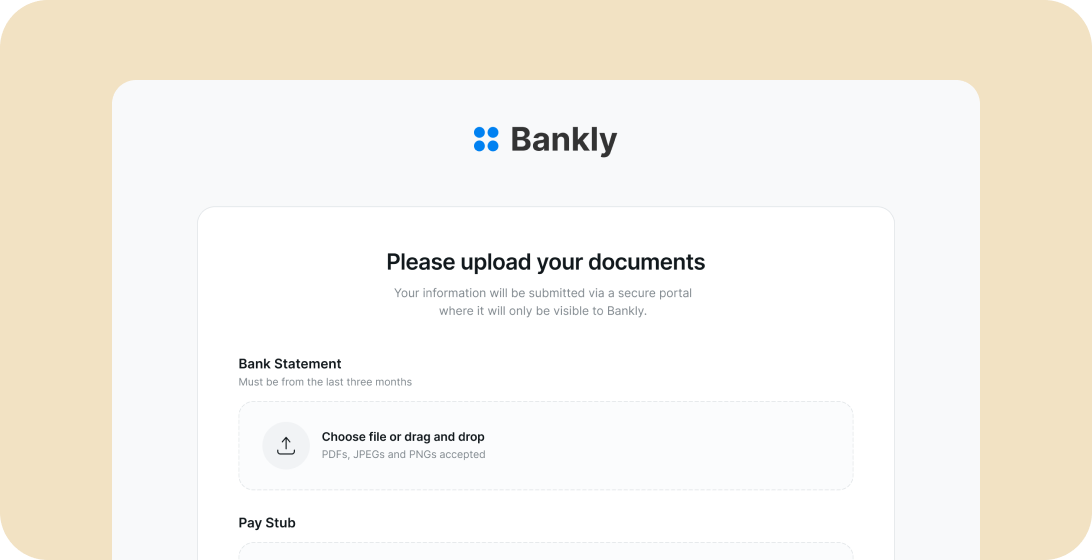
Secure Document Collection
Purpose-built portal for requesting business documents via secure links. Replaces email-based collection and maintains chain-of-custody integrity. Explore the document collector.
API-First Integration
RESTful endpoints, webhook support, and structured outputs integrate into existing KYB platforms and onboarding workflows. Most customers go live in days.
What's the Value of KYB Verification and Fraud Detection?
Inscribe detects forged and fabricated business documents at intake, before they become approved accounts, funded loans, or onboarded merchants. The same forensic analysis that catches personal document fraud extends naturally to business documents: articles of incorporation, business bank statements, and financial records follow the same forgery and fabrication patterns as personal ones. At Logix Federal Credit Union, Matt Overin said Inscribe helped prevent more than $3M in potential fraud losses. Michael Coomer, Senior Director of Fraud and Verification Services at BHG Financial, said: "You can't see previous versions with the human eye. There's no manual process that compares to what Inscribe uncovers."
Fraud Caught Before It Enters the Pipeline
Inscribe detects forged and fabricated business documents at intake, before they become approved accounts, funded loans, or onboarded merchants. BCU prevented $5.6M in losses. Logix FCU saved $3M+. BHG Financial replaced manual fraud detection with a scalable, transparent system.
72-Second Review vs. 10 to 15 Minutes Manual
Your team can process more onboarding applications, faster, without increasing headcount. Automated KYB verification replaces the most resource-intensive part of KYB document review and improves operational efficiency.
Audit-Ready Evidence That Satisfies KYB Requirements
Every verification decision is logged with Trust Scores, fraud signals, revision history, and plain-English summaries. Defensible output for anti money laundering (AML) and KYB regulators and internal audit. SOC 2 Type II and ISO 27001 certified. Review Inscribe's security posture.
Reduce Fraud and Lower False Positives for Legitimate Businesses
Faster, automated document verification means legitimate customers and genuine business applicants get decisions faster. Inscribe helps reduce fraud losses while lowering false positive rates, so your team spends less time on unnecessary escalations.
Scalable as Onboarding Volume Grows
Inscribe's Agentic Fraud Detection scales with your business. High-volume business onboarding doesn't require proportionally more reviewers.
How should you evaluate a KYB software stack?
KYB platforms generally fall into three categories, each solving a different part of business verification. Most mature KYB programs use more than one.
Inscribe fits the document-first row. It's designed to sit alongside identity-first platforms and full-stack compliance systems, not replace them, closing the specific gap where a business can pass identity and ownership checks while still submitting a forged or fabricated document.
What Are KYB Requirements and How Does Document Verification Fit?
Know Your Business (KYB): Beyond Identity Verification
KYB stands for Know Your Business, a due diligence process financial institutions use to verify a business entity's legal existence, ownership structures, and standing before establishing a business relationship. KYB requirements typically include entity verification against company registration records, identification of ultimate beneficial owners (UBOs), screening against sanctions lists, adverse media checks, and ongoing monitoring. Most KYB platforms handle these steps through database lookups and identity verification, but without document verification, the KYB process has a blind spot: a business entity can pass every check and still submit forged, fabricated, or misleading documents.
Inscribe's document forensics close that gap by verifying the corporate documents and financial records that KYB checks rely on. Traditional KYB processes that rely on manual reviews are slow, inconsistent, and vulnerable to sophisticated fraud. Automated KYB verification helps financial institutions maintain compliance and prevent fraud across the full KYB process, even across complex corporate structures and multiple jurisdictions.
Ready to Close the KYB Verification Gap?
Most KYB platforms verify who owns a business. Inscribe verifies that the business documents themselves are authentic.
👉 Explore the Demo Center
👉 Request a Live Demo
👉 See how Inscribe catches forged documents
Frequently Asked Questions About KYB Fraud Detection and Compliance

KYB fraud detection verifies that business documents submitted during Know Your Business (KYB) compliance reviews are authentic, unaltered, and consistent. Inscribe goes beyond identity checks to verify articles of incorporation, financial statements, beneficial ownership records, and business filings, catching forged and fabricated files that identity-only platforms miss. It is a critical fraud prevention layer within the broader KYB process.
Common KYB documents include articles of incorporation, company registration certificates, financial statements, proof of business address, beneficial ownership documentation, identity documents for directors and UBOs, and business tax forms. Inscribe verifies all of these for document authenticity, not just format. The specific KYB requirements vary by jurisdiction and regulatory framework.
KYC (Know Your Customer) verifies individual identity. KYB (Know Your Business) verifies a business entity: legal existence, ownership structures, ultimate beneficial ownership, and financial standing. Both require document verification, but the KYB process involves a broader and more complex document set, including business filings, financial records, and beneficial ownership mapping. For more on where Inscribe fits into KYC workflows specifically, see Inscribe for KYC Workflows.
KYB requirements include verifying business legitimacy through entity verification, identifying ultimate beneficial owners (UBOs), screening against sanctions and politically exposed persons lists, conducting adverse media checks, performing risk assessments, and maintaining ongoing monitoring. Financial institutions that fail to meet these regulatory requirements risk fines, legal penalties, and reputational damage.
Yes. Inscribe analyzes metadata, revision history, font anomalies, and pixel-level details, comparing incoming documents against millions of verified templates. Most KYB platforms verify who owns a business. Inscribe verifies that the business documents themselves are authentic, enabling further investigation when fraud signals are detected.
Identity platforms verify who owns a business through selfie matching, UBO database checks, and sanctions screening. Inscribe verifies that the business documents themselves are authentic, catching forged incorporation papers and fabricated financial records that pass identity checks entirely.
API-first with RESTful endpoints, webhook support, and structured output. Integrates into existing KYB platforms, onboarding flows, and LOS systems. Data collection and data extraction happen automatically. Most customers go live within days. Documentation at docs.inscribe.ai.
SOC 2 Type II and ISO 27001 certified. Every KYB verification decision logged with Trust Scores, evidence signals, and plain-English summaries for a defensible audit trail. Inscribe supports anti money laundering (AML) and regulatory compliance programs across multiple jurisdictions. Review the Trust Center.
Approximately 72 seconds per document, including data extraction, fraud detection, and Trust Score generation, compared to 10 to 15 minutes for manual review. This helps financial institutions reduce fraud risk without adding friction for legitimate businesses.
Inscribe combines forensic analysis, network intelligence, and cross-document corroboration to build accurate risk profiles for each submission. This contextual approach helps reduce false positives by distinguishing genuine anomalies from benign formatting variations or data entry errors, so compliance teams spend time on real threats, not false alarms.
About the author
Stephanie Spangler is the Head of Product Marketing at Inscribe, where she covers AI-powered fraud detection, document risk, and how financial institutions are adopting agentic AI. She writes on the intersection of product and practice — translating what fraud detection technology does into what it means for the risk teams using it.
Learn More
Dive deeper into document processing

What will our AI Agents find in your documents?
Start your free trial to catch more fraud, faster.