Inscribe vs. Plaid, Finicity, and Yodlee: which do you need for bank statement verification?
Table of Contents
[ show ]- Loading table of contents...


Most lending teams need both bank connectivity and document verification, and Plaid already runs both. Plaid, Finicity, and Yodlee connect to a borrower's bank account and pull live data. Inscribe verifies whether the bank statement data in front of you is authentic. Plaid uses Inscribe inside its income verification product to check the files applicants upload, and Inscribe can ingest the account data Plaid pulls as a JSON file and analyze that too.
Teams searching for bank statement verification software often land on Plaid, Finicity, or Yodlee, because those names dominate bank account verification and open banking. The two categories solve different fraud problems. Connectivity confirms a bank account is real and pulls live data from the institution. Document verification authenticates a submitted statement and detects forgery, edits, and AI-generated manipulation.
For risk, fraud, compliance, and underwriting teams at banks, credit unions, fintechs, and lenders, that distinction determines where fraud exposure actually sits. This comparison covers what each platform verifies, how Plaid and Inscribe work together across both the upload path and the open banking path, when lenders need both layers, and how forged or AI-generated statements are detected.
Inscribe's 2026 State of Document Fraud Report found that roughly 1 in 16 documents processed in 2025 were flagged as fraudulent, showing signs of manipulation, fabrication, or misrepresentation. That risk concentrates in the files an applicant uploads, which makes document verification central to faster onboarding, safer underwriting, lower fraud losses, and stronger compliance.
The short answer: Plaid, Finicity, and Yodlee are the right solution when you need live bank data from a connected account. Inscribe is the right solution when you need to confirm that bank statement data has not been tampered with, whether it arrived as a file or through a connection. Most lending teams run both layers, and in Plaid's case the two run together inside the same product.
What's the difference between bank connectivity and document verification?
Open banking aggregators like Plaid, Finicity, and Yodlee are bank account verification methods. They authenticate via API or OAuth directly with financial institutions. The borrower logs in, grants permission in a secure flow, and the aggregator pulls real-time balances, transaction history, and identity data straight from the source. No document changes hands in that flow, so there is nothing to forge.
Document verification exists for the cases aggregators cannot cover. Borrowers upload a PDF, screenshot, or scanned image of a bank statement for all kinds of reasons: their institution doesn't support open banking, they opted out of the bank-login flow, or they're self-employed with accounts at multiple banks. Someone still needs to determine whether that file is authentic. That's what Inscribe does. It inspects the submitted document for signs of editing, fabrication, or AI generation.
Connectivity removes document fraud risk for the accounts it can reach, and leaves that risk fully in place for every account it cannot.
Both layers exist in the same lending stack for practical reasons:
Coverage gaps. Small banks, credit unions, and international institutions often lack open-banking support. Direct bank connections reduce the risk of fake statements, but only where the connection is available.
User drop-off. Not every borrower completes the bank-login flow. Some abandon it over privacy concerns, technical difficulty, or locked credentials, which hurts the experience for customers who would rather not connect an account.
Borrower preference. Some applicants prefer to upload files, especially self-employed borrowers pulling prior statements from multiple banks. Those documents carry fraud risks that connectivity tools were never designed to address.
How do Plaid and Inscribe work together?
Plaid is the clearest working example of both layers in one stack, and it is worth walking through because Plaid feeds both of Inscribe's inputs.
The document path. When an applicant reaches income verification and chooses to upload files instead of connecting an account, Plaid routes those documents through Inscribe. Inscribe analyzes the file for editing, fabrication, and AI generation, then returns a Trust Score and the specific risk signals behind it, which feeds Plaid's fraud decisioning. Plaid reported that Inscribe returns a result on each document in under 30 seconds, and that during the pilot the team saw potential to automate half or more of applicants through the process.
The open banking path. When an applicant does connect an account, Plaid pulls the transaction and balance data from the institution. That data can be delivered to Inscribe as a JSON file, and Inscribe runs its analysis on it the same way it would on an uploaded statement. Inscribe never connects to a bank directly. Plaid handles the connection, and Inscribe handles the analysis on top of the data it returns.
Two trust scores are in play here, and they answer different questions. Plaid Protect runs its own fraud model, called the Trust Index, which scores user, device, and account risk across the Plaid network. Inscribe's Trust Score applies to the document or data file itself. On the upload path, Inscribe's Trust Score is the document-level input feeding Plaid's fraud decision.
Read the full Plaid customer story.
What does each platform actually verify?
Bank connectivity platforms
The three are usually evaluated together, though they are positioned differently.
Plaid connects to more than 12,000 financial institutions and is an Inscribe partner, using Inscribe for document fraud detection inside its income verification product.
Finicity, acquired by Mastercard in 2020, is an authorized report supplier for Fannie Mae's Desktop Underwriter validation service and Freddie Mac's Asset and Income Modeler, which is why it appears most often in mortgage workflows.
Yodlee reports connecting to over 19,000 data sources globally, with aggregation coverage extending across international institutions.
All three connect directly to a borrower's account at the financial institution and pull structured bank data:
- Identity of the account holder: name, address, and account ownership validated against institution records
- Live balance and transaction history: real-time or near-real-time access to deposits, electronic payments, wire transfers, and other transactions. Finicity supports cash flow analytics across up to 24 months of historical data
- Account and routing validation: confirming the account and routing numbers belong to the stated owner
- Income and cash flow signals: income verification and cash flow analysis derived from actual transaction patterns at the source
Inscribe
Inscribe is document fraud detection software. It verifies whether the bank statement data in front of you was edited, generated, or tampered with, and it does not connect to bank accounts or pull live data itself.
It works on two inputs: files an applicant submits, and structured account data delivered by a connectivity platform such as Plaid.
On submitted files, Inscribe runs:
- Forensic metadata inspection: analyzing creation tools (was this PDF generated by a bank system or by editing tools like Photoshop?), revision history, timestamps, and structural fields
- Pixel and image forensics: detecting compression artifacts, cloned areas, inconsistent fonts, pasted images, and altered deposit amounts that indicate manipulated bank statements.
- Structural and layout analysis: comparing the document against known legitimate bank templates to identify template-based fraud. Inscribe's data shows 1 in 5 flagged documents in 2025 exhibited template-based fraud signals, up from 1 in 14 in 2024, according to the 2026 State of Document Fraud Report
- Cross-document consistency: checking whether names, addresses, employer details, and transaction patterns match across bank statements, pay stubs, and tax documents within the same application
On connected-account data, Inscribe analyzes the transaction and balance records for the same irregularities it looks for in a verified statement, which is where verification hands off to bank statement analysis software.
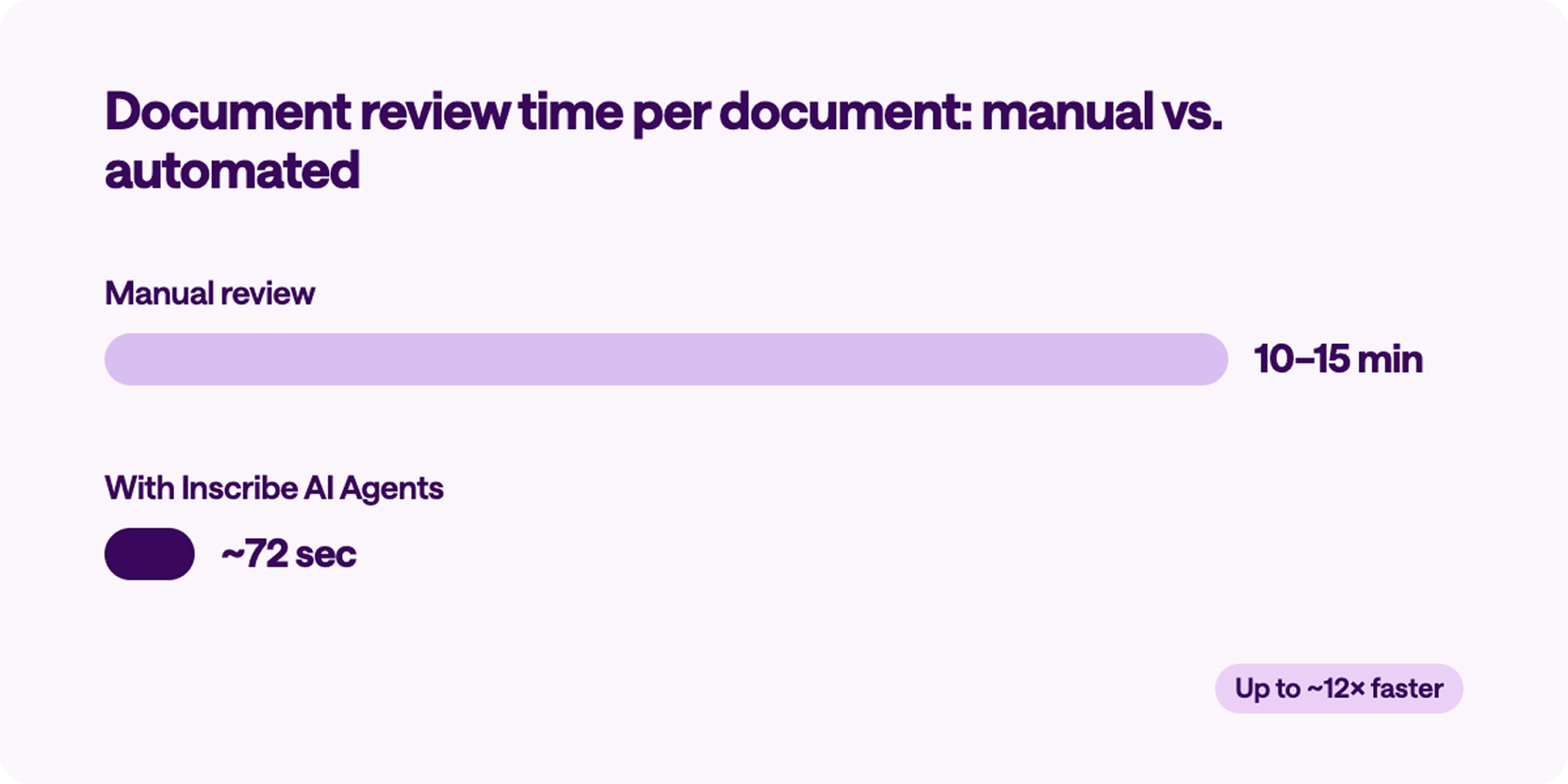
Inscribe verifies a statement in approximately 72 seconds. Across Inscribe's customer network, manual document review typically takes 10 to 15 minutes per document, which makes automated verification roughly 8 to 12 times faster depending on where a given document falls in that range. Those figures come from Inscribe's own reporting in the 2026 State of Document Fraud Report and published customer case studies.
For a team reviewing 200 documents a day, that difference is about 40 hours of review time under manual process against roughly 4 hours with Inscribe.
Connectivity platforms score the account, the device, and the network behavior behind a connection. Inscribe scores the data itself, through forensic analysis of the file that was submitted or returned. Plaid Protect covers account and identity risk with the Trust Index, and for document-level forensics on uploaded income files Plaid uses Inscribe.
Open banking tools tell you what actually happened in an account, using live data pulled from the institution. Document verification tools tell you whether the record in front of you accurately represents that reality. Both signals matter, and each requires the right tool applied to the right data source.
Evaluation criteria
Plaid, Finicity, and Yodlee all fall into the connectivity column, with the coverage and workflow differences noted above. Plaid is the one that also runs the verification layer, through Inscribe.
When do lenders need document verification alongside bank connectivity?
Connectivity alone is sufficient when:
- The borrower's institution supports open banking and the borrower consents to connect
- Real-time cash-flow data is the primary need for loan approvals
- The lending process routes entirely through connected accounts with no document upload path
- Direct bank connections minimize tampering risk by accessing real-time data from the borrower's account
Document verification alone is needed when:
- The applicant's bank falls outside aggregator coverage, such as regional credit unions, international institutions, or banks in countries with weak open-banking frameworks
- Self-employed applicants rely on bank statements and invoices rather than standard pay stubs for income verification
- Borrowers upload files instead of connecting, whether by preference, technical limitation, or because they're submitting prior statements from closed accounts
- Mortgage lenders and other high-stakes underwriters require document evidence to verify specific financial claims
- Manual review exception queues need automated fraud detection to process documents at scale
Both are needed when:
Most full-funnel underwriting operations fall here. The majority of applicants may connect accounts through Plaid, Finicity, or Yodlee, but a meaningful subset always submits documents instead, and that is where document fraud risk concentrates. The connected-account path validates data at the source, and the upload path arrives with no such guarantee.
Lenders adding the document layer on their own report consistent results. BHG Financial cut manual review time by more than 90% and prevented millions in potential fraud losses. "Inscribe was the inflection point for us," said Michael Coomer, Director of Fraud Management at BHG Financial. Kinecta Federal Credit Union saved $850,000 in fraud losses and reduced document review time by 99%. Logix Federal Credit Union prevented over $3 million across eight months, which Matt Overin, Manager of Fraud Risk Management at Logix FCU, described as potential loan fraud savings plus a run of ID theft saves the team would otherwise have missed.
For high-volume lending operations, the practical takeaway is to apply document forensics to the upload path rather than assuming the connected-account path covers everything.
How Inscribe detects forged or AI-generated bank statements
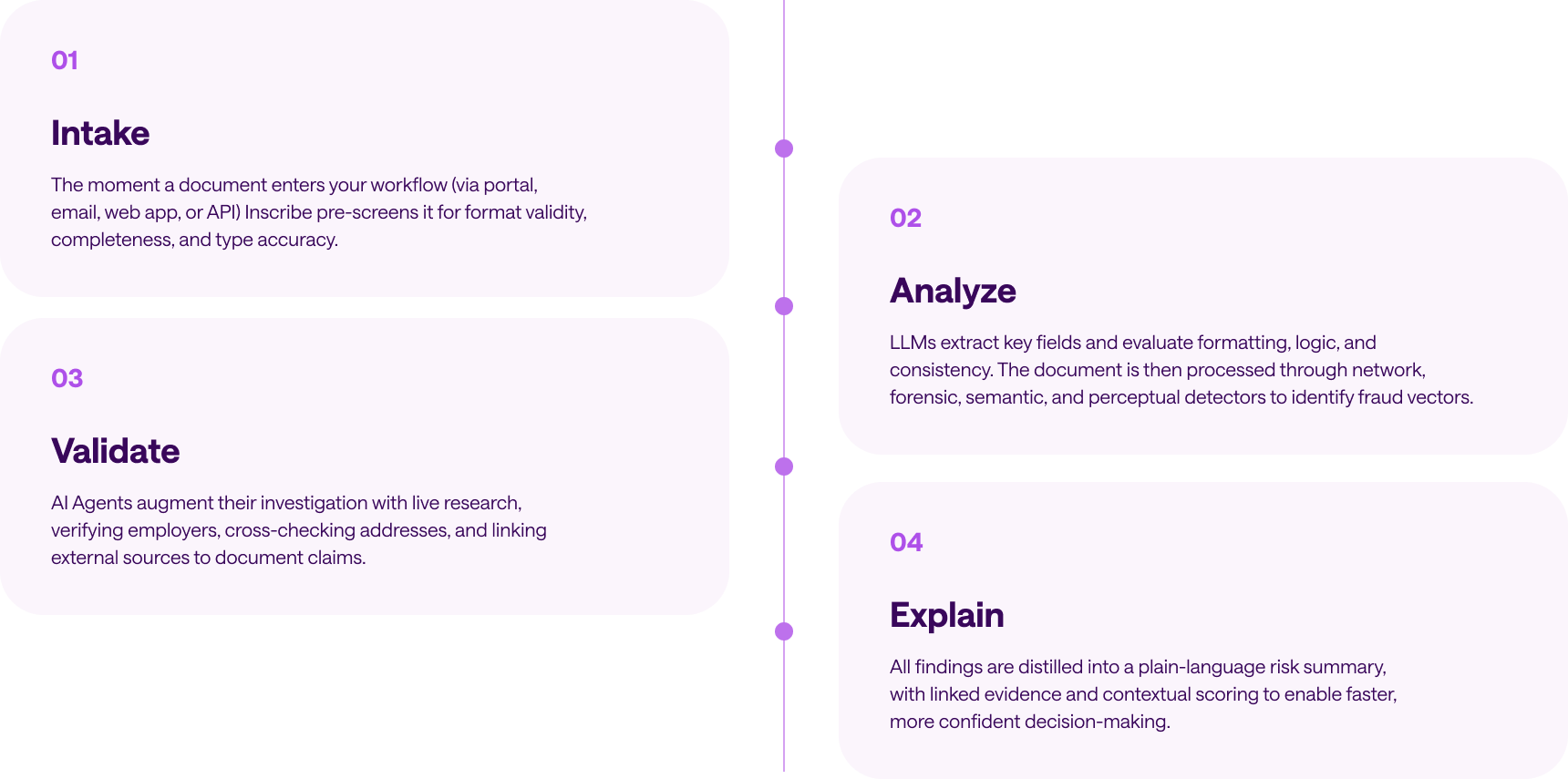
Inscribe uses layered detection across multiple forensic dimensions. Metadata inspection checks the file's creation tool, revision history, and structural fields. A statement built in a spreadsheet tool and exported to PDF leaves different fingerprints than one produced by a bank's own system. Pixel-level forensics detect compression artifacts, pasted content, inconsistent shadows, and font anomalies. Template and network analysis identifies reused blank templates circulated online. Cross-document consistency checks verify that names, addresses, employers, and amounts match across all documents in an application.
Inscribe's models train on millions of documents and update continuously, which matters as AI-generated fraud grew nearly fivefold between April and December 2025, according to the 2026 State of Document Fraud Report.
Connectivity tools and document verification tools each cover a distinct layer of fraud risk in the bank statement verification process. If your borrowers connect accounts and you need live bank data, Plaid, Finicity, and Yodlee are purpose-built for that. If borrowers submit documents, and a meaningful percentage always will, you need verification on that path. And if you already run Plaid, both inputs can reach Inscribe: the file the applicant uploads, and the account data Plaid returns.
Does Inscribe replace Plaid, Finicity, or Yodlee?
No. Inscribe operates in a different layer of the same underwriting problem, and in Plaid's case it operates inside the same product.
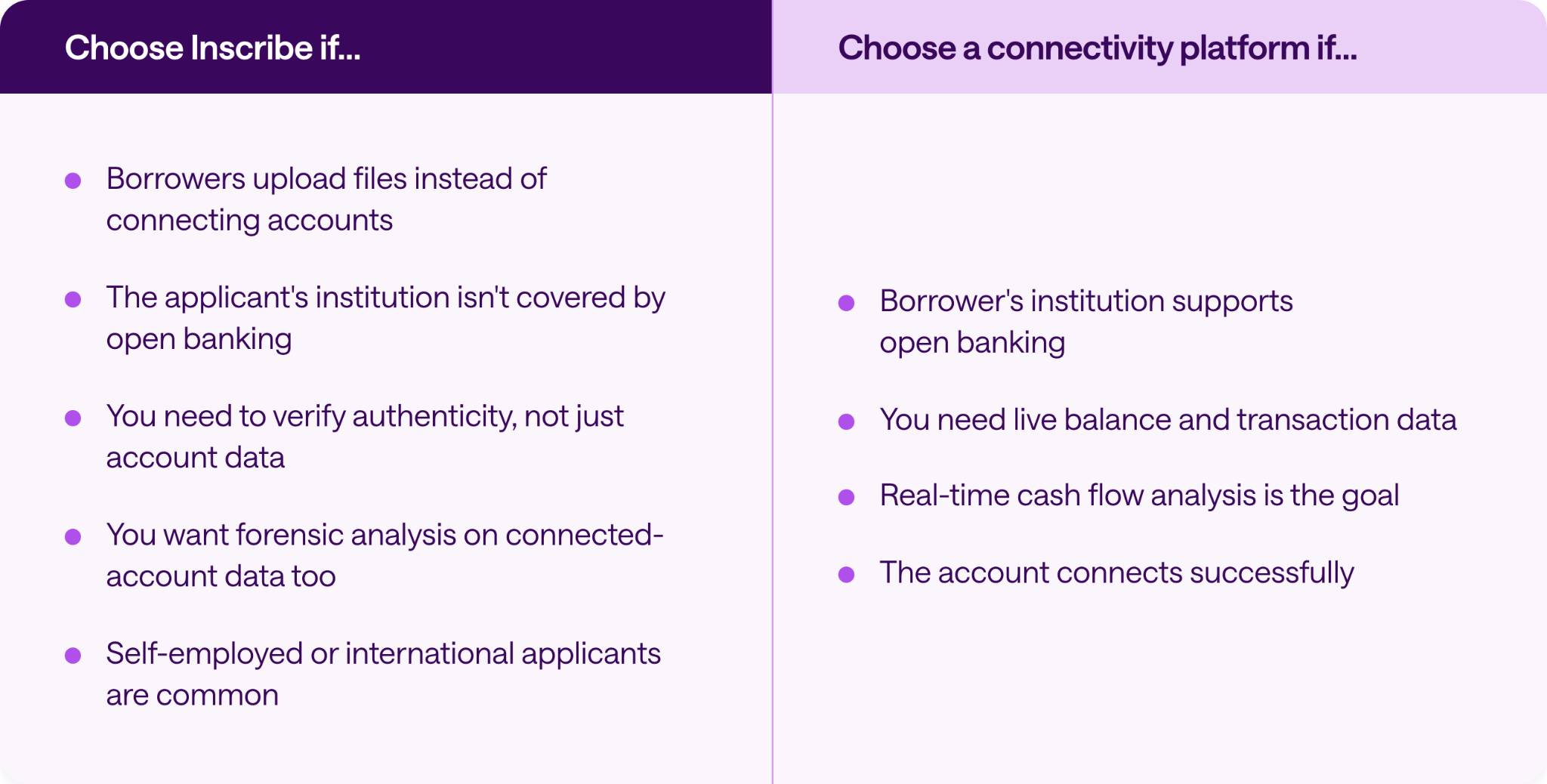
Plaid, Finicity, and Yodlee fetch live financial data and verify account existence, balances, transactions, and how money moves directly from the bank. Inscribe inspects the resulting record for authenticity, detecting whether someone used editing tools to alter a balance, fabricated a statement from a dark-web template, or submitted an AI-generated document built to pass manual review.
In mature lending risk stacks, both run together. The aggregator handles broad coverage for borrowers who connect directly. The verification layer handles the fallback path, covering customers who fall out of the connected flow and submit files the aggregator never touched. That's where fraudulent bank statements are most likely to appear. Running both layers also protects the customer experience by keeping onboarding flexible without opening the door to fraudulent activity.
Both paths carry an audit requirement. When a document is declined, the reviewer needs to show why. Inscribe attaches a plain-language explanation and linked evidence to every risk score, so a rejected application has a defensible record behind it rather than a bare number.
Request a demo to see how Inscribe's verification layer fits alongside your existing connectivity stack.

Plaid verifies that a bank account is real by connecting directly to the financial institution and pulling live transaction history, balances, and identity data. Inscribe verifies that the bank statement data itself is authentic, whether it arrived as an uploaded file or as account data pulled by Plaid. The two run together inside Plaid's income verification product, where Plaid owns the connection and the upload flow and Inscribe returns a document-level Trust Score with the risk signals behind it.
Yes, through Inscribe. When an applicant uploads income documents in Plaid's flow, Plaid routes those files to Inscribe, which analyzes them for editing, fabrication, and AI generation and returns a Trust Score. Plaid's own fraud products cover account, device, identity, and network risk, including the Trust Index score in Plaid Protect. Document-level forensics on uploaded files is the layer Inscribe provides. Lenders who buy the two separately get the same division of labor.
Because open banking cannot cover every institution, and not every borrower will connect an account. Coverage gaps exist for small banks, credit unions, and international institutions. Some borrowers drop off during the bank-login flow or prefer uploading files. The documents submitted in those fallback paths carry real fraud risk. Inscribe's 2026 State of Document Fraud Report shows 1 in 16 documents flagged as fraudulent in 2025. Combining both tools covers the full funnel: connectivity for the connected path, document verification for the upload path.
Yes, that is Inscribe's core function. It analyzes any submitted document independently of whether the borrower's account was connected elsewhere. It works on PDFs, scanned images, photos, and low-quality files from any bank or financial institution. Optical character recognition extracts text and numbers from bank statements, and Inscribe's AI then verifies document authenticity. Machine learning analyzes financial activity for irregularities in balances and transactions across the submitted files. Inscribe can also ingest structured account data as a JSON file when a connectivity platform is already in place.
No. Bank statement verification is an authenticity check focused on whether the record was tampered with. Bank statement analysis software extracts data from verified documents, including transactions, balances, and deposit amounts, then interprets cash flow patterns, spending behavior, and income signals to support underwriting decisions. The order matters, because analysis run on an unverified document produces confident-looking numbers from a file that may be fabricated.
About the author
Conor Burke is the co-founder and CTO of Inscribe, where he leads the AI and engineering systems behind the platform's document fraud detection capabilities. He writes and speaks on the technical mechanics of fraud detection — how LLMs reason, where rules-based systems break down, and what it actually takes to build AI that explains itself.
Learn More
Dive deeper into document fraud

What will our AI Agents find in your documents?
Start your free trial to catch more fraud, faster.