
Agentic AI Fraud Detection for Lenders
Table of Contents
[ show ]- Loading table of contents...


Fraud tactics now change faster than rules can be written for them.
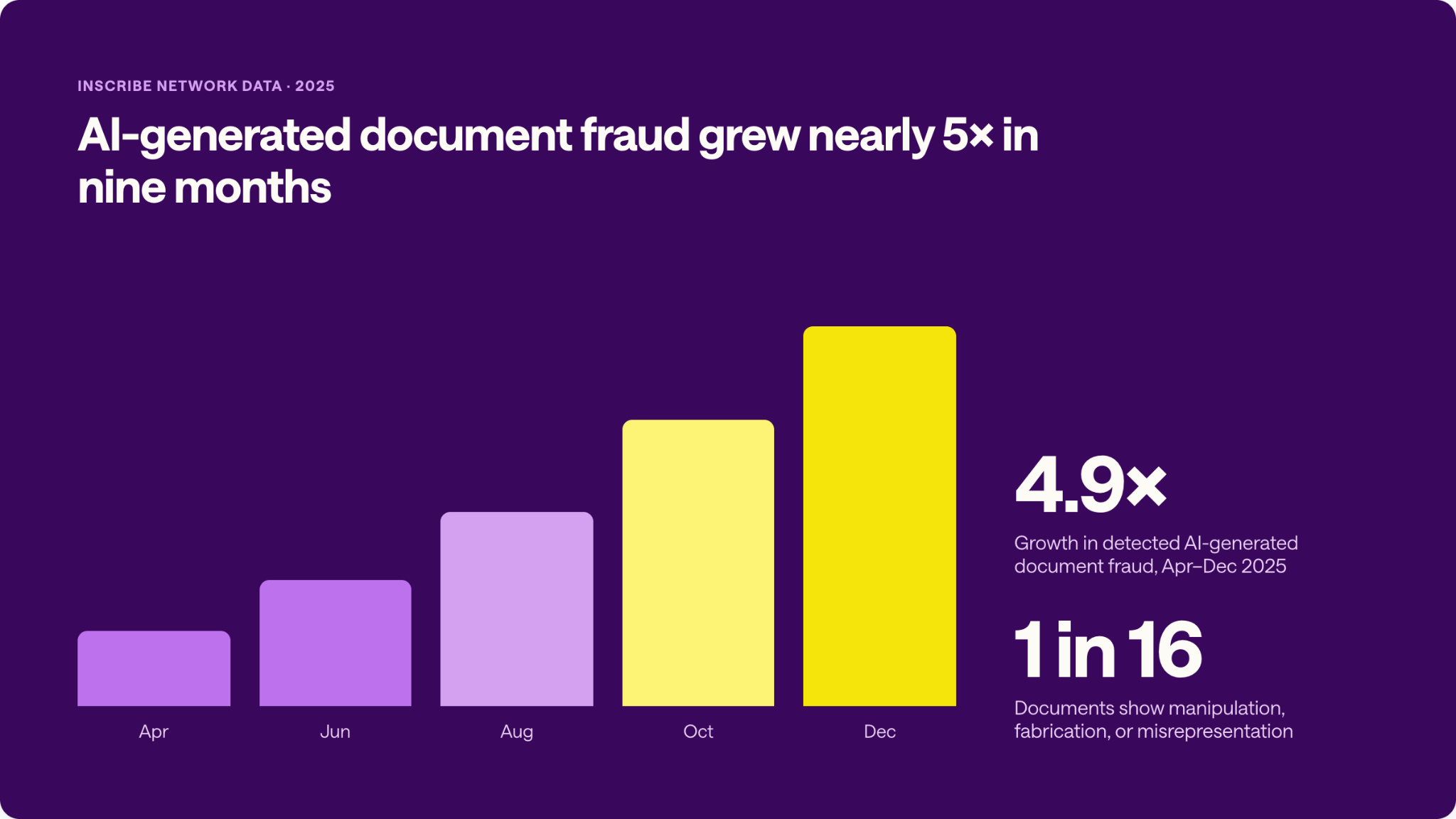
The detected volume of AI-generated document fraud across Inscribe's network grew nearly fivefold between April and December 2025. In financial services workflows more broadly, roughly 1 in 16 documents shows signs of manipulation, fabrication, or misrepresentation.
A rules-based system catches the patterns someone has already seen, documented, and encoded. It has no answer for the fake it has never met. That gap is what agentic AI fraud detection is built to close.
That gap is what agentic AI fraud detection is built to close, and it is the newest layer of AI fraud detection for lenders.
Inscribe is the first agentic document fraud detection platform: AI agents that investigate every borrower document the way a fraud analyst would, adapt their analysis to what they find, and explain every decision in plain language.
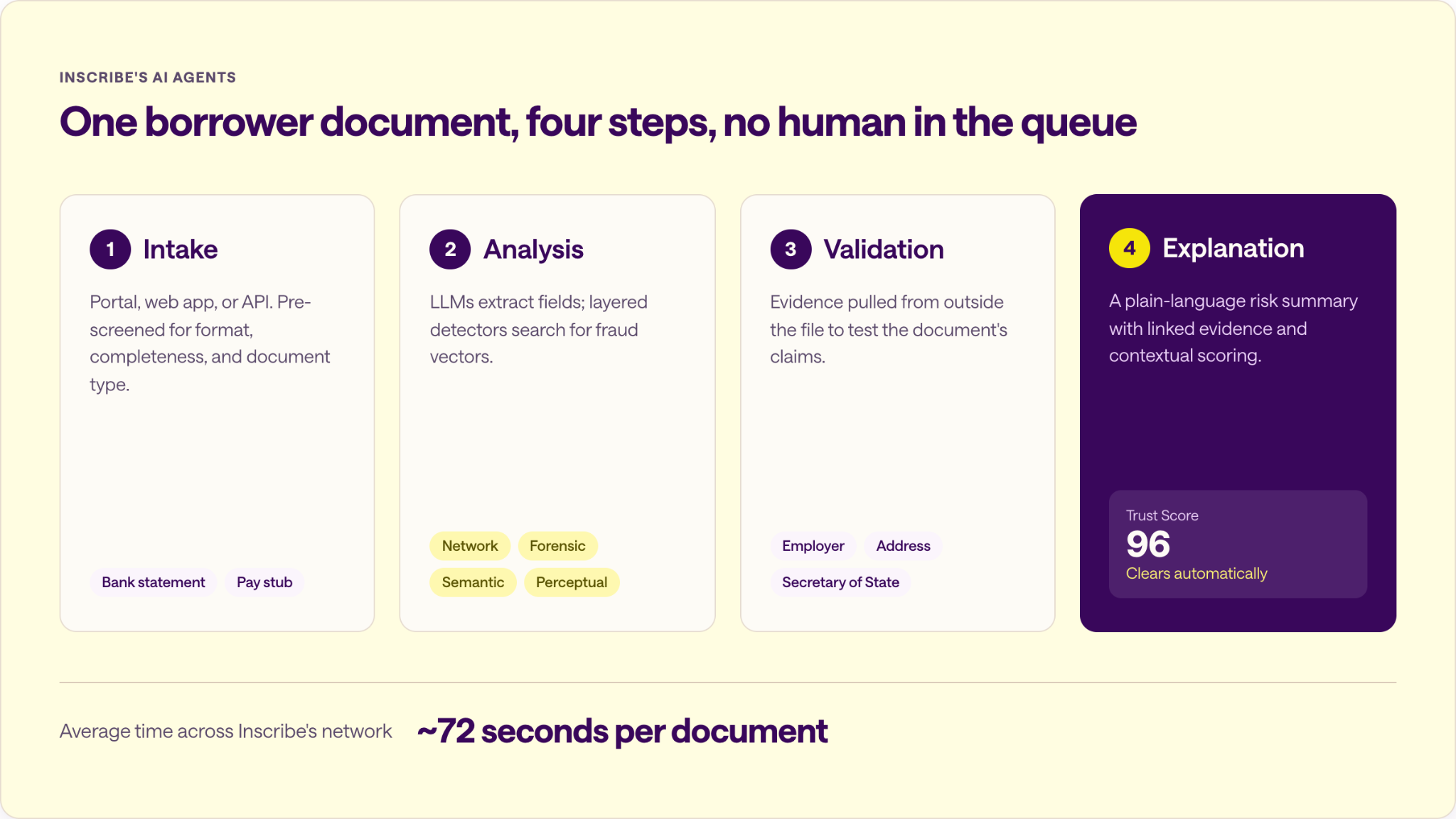
Purpose-built for document risk screening since 2017, SOC 2 Type II and ISO 27001 certified, and trusted by leading banks, credit unions, and fintechs, Inscribe returns results in about 72 seconds per document on average across its network. See the agents work end to end in the Demo Center.
What is agentic AI fraud detection?
Agentic AI fraud detection is fraud detection performed by AI agents: systems that plan an investigation, choose which analyses to run, validate evidence against outside sources, and adapt their approach as new information emerges. Each signal is weighed in context rather than in isolation. Static, rules-based detection scores a document once against a fixed set of known patterns. An agent behaves more like an investigator. It notices something odd, digs deeper, and keeps going until it can explain what it found.
That distinction matters in lending because modern document fraud arrives in many ways, all built to pass static checks. Fraudsters now use multimodal LLMs and image generation tools to produce synthetic bank statements, pay stubs, and tax forms that mimic layout, typography, metadata, and signatures with precision. A fraudulent document can look flawless on its surface while carrying dozens of subtle inconsistencies underneath, and finding them takes both domain-specific reasoning and forensic detail. That combination is exactly what agents supply.
Much of the coverage of agentic AI for fraud detection focuses on transaction monitoring: models that separate fraudulent transactions from legitimate transactions by continuously analyzing massive streams of transaction details, payments, and signals from users' devices as money moves. That layer matters, but for lenders the loss is usually decided earlier, at the document layer, where an applicant's bank statements and pay stubs determine what gets approved. Inscribe's agents work at that upstream point, so fraud is blocked before a transaction ever exists.
Inscribe's AI agents are trained on millions of authentic financial documents and tested against the latest fraud tactics, which is why they can flag a first-of-its-kind fake instead of waiting for it to become a known pattern.
How is agentic AI different from rules-based fraud detection?
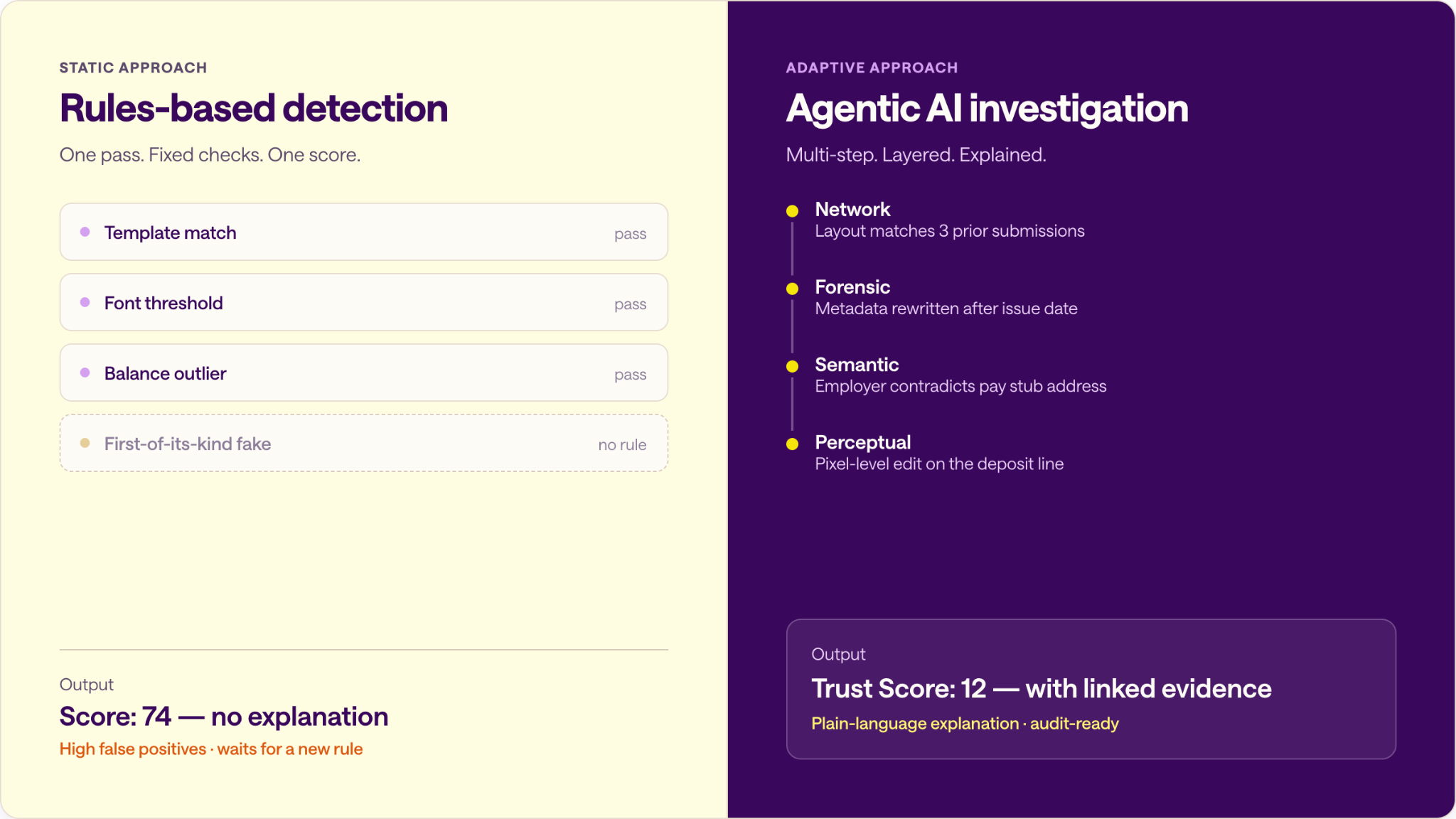
Rules-based fraud detection systems apply predefined logic: match a template, check a threshold, flag an outlier. Agentic AI for fraud detection runs an adaptive, multi-step investigation that changes course based on what each document reveals. The practical differences show up in four places:
- What gets checked. A rule tests for the specific patterns someone wrote it to catch. Inscribe's AI agents apply layered detection to every document: network analysis against a library of genuine and fraudulent documents, forensic analysis of structure, fonts, metadata, and file history, semantic checks that cross-reference names, addresses, employment, and income, and perceptual analysis that examines files at the pixel level for edits and AI-generation artifacts.
- What happens with the unknown. When fraud tactics change, a rules engine waits for a human to notice the new tactic and write a rule for it. An agent adapts its investigation to unfamiliar signals, which is how it catches fraud no one has documented yet.
- What you learn from a flag. A rule returns a score. Inscribe's agents return the score plus a plain-language explanation of exactly what triggered concern, with linked evidence your team can act on and defend in an audit.
- How the system improves. A rule library grows only as fast as your backlog. Inscribe's agents learn from your analysts' in-app reviews and from ongoing training by Inscribe's in-house Risk Ops team, so detection capabilities sharpen with every review.
Static AI fraud detection approaches also bury teams.
Rules tuned to catch everything generate high volumes of false positives, and the alert fatigue that follows is how real fraud slips through tired reviews. Context-aware evaluation cuts those false alerts, because an agent weighs each signal against the whole file before it raises a flag.
Inscribe runs this layered agentic analysis inside its document fraud detection software, so the reasoning happens on every document, not just the ones an analyst has time to question.
How does agentic AI fraud detection work at underwriting and onboarding?
At underwriting and onboarding, Inscribe's AI agents review each document the moment a borrower or business submits it, moving through four steps before a human ever needs to look:
- Intake. The document enters through your portal, web app, or API, and the agent pre-screens it for format validity, completeness, and type accuracy, so bad files are filtered out before they slow the queue.
- Analysis. LLMs extract key fields and evaluate formatting, logic, and consistency, while network, forensic, semantic, and perceptual detectors search the document for fraud vectors.
- Validation. The agent extends the investigation beyond the file itself: verifying employers, cross-checking addresses, confirming incorporation status against Secretary of State records, and linking external sources to the document's claims.
- Explanation. Findings are distilled into a plain-language risk summary with linked evidence and contextual scoring, so your underwriters and onboarding analysts decide with the reasoning in front of them.
The effect at the point of decision: authentic files clear automatically, exceptions arrive with the investigation already done, and decision making speeds up because your team's judgment is spent where it changes the outcome. That is why banks, credit unions, and fintech lenders put agents at the front of origination rather than the end.
Document authenticity is one half of the decision. For how agents extend into the credit side, see our companion page on AI agents for credit risk and underwriting.
Where do AI agents fit in your fraud prevention workflows?
AI agents for fraud detection fit anywhere a document carries a decision, and they execute the same layered investigation in each place. Four document review workflows come up most often for lenders:
- Loan underwriting document review. Bank statements, pay stubs, and business financial documents are the files underwriters rely on most, and the 2026 Document Fraud Report found they are also the three document types risk leaders rank most vulnerable to manipulation. Agents confirm each file is authentic and extract its data before underwriting trusts a single number, the foundation of document verification for lenders.
- Applicant and business onboarding. For business lending and account opening, agents automate KYB document fraud detection and enrich it with real-time research: incorporation status, web presence, and adverse media, checked without an analyst switching between systems.
- Income and employment verification. 91.2% of altered documents include edits to financial details: pay rates, deposits, balances, and wages. Agents corroborate income and employment claims across every document in the file and flag the contradictions a one-document check misses.
- Document collection. Through Inscribe's secure document collection portal, agents review files as applicants upload them, so fraud is caught at the point of submission instead of days later in a queue.
How do AI agents catch fraud rings?
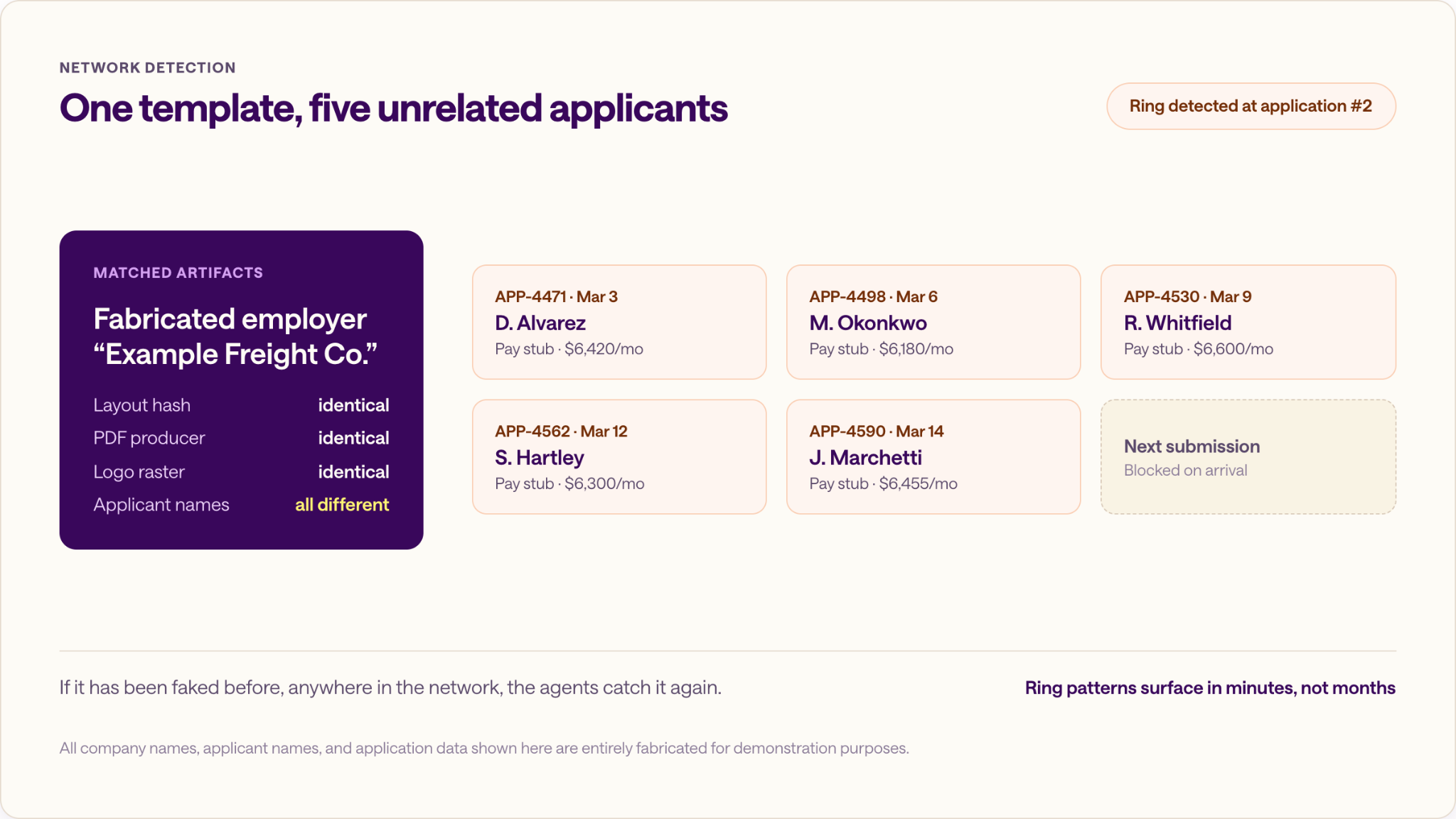
AI agents catch fraud rings by connecting documents that no single reviewer would ever see together. A fraud ring rarely announces itself in one file. Rings operate by industrializing what worked in the past: the same template, fabricated employer, or layout reused across dozens of applications, lightly edited each time, with no visible connection between the applicants. No one person reviewing one file at a time can see that pattern, which is why coordinated attacks keep succeeding against manual review.
Inscribe's network-based detection is built for exactly this behavior. Agents compare every document against a library of genuine and fraudulent documents drawn from across Inscribe's network, running data analysis that identifies recycled templates, repeat layouts, and shared artifacts: matching metadata, employer details, or location information surfacing across unrelated applicants. That lets your team identify collusion between applicants who appear unrelated, trace a suspicious file back to prior submissions, and shut a ring down at the second document instead of the fortieth. If it has been faked before, anywhere in the network, the agents catch it again. And because network checks run on every submission, ring patterns surface in minutes, while the applications are still open, instead of emerging months later in a loss review.
What results do lenders see with agentic AI for fraud detection?
Document fraud costs lenders money twice: once in the loss itself and again in the operations time spent chasing it. Lenders and the platforms that serve them use agentic AI to turn document review from a queue into a checkpoint. Plaid is the clearest example. Plaid's income verification products let loan applicants prove income by uploading documents, and every uploaded file is a fraud surface. With Inscribe's AI agents reviewing each submission, Plaid cut document review from 1-2 days to seconds and automated half of its reviews entirely, so the lenders on its platform get cleared documents back while the applicant is still in the flow.

The pattern holds across Inscribe's lending customers: Logix Federal Credit Union saved more than $3M in potential fraud losses in eight months, and Kinecta Federal Credit Union prevented $850K in losses while cutting review time by 99%.
Why use agentic AI if you already have rules-based automation?
Because rules and agents solve different problems, and the space between them is where modern fraud gets through. Rules excel at specific tasks and known patterns, and they should stay. What they cannot do is reason about a document that was designed, often by another AI, to satisfy them. Every static check is a specification a fraudster can build to, and generative tools have collapsed the cost of building to it. Fraudsters iterate against traditional systems faster than new rules can ship, and that gap will keep widening.
Agents close that gap without asking you to rebuild anything. Inscribe deploys alongside your existing decisioning stack through an API, web app, or collection portal, and most teams are live within days. The result is a layered fraud prevention strategy: your rules keep handling the known patterns, while the agents investigate everything else, explain their findings, and hand your analysts exceptions instead of queues. Michael Coomer, Director of Fraud Management at BHG Financial, reports a 90% reduction in document review time under that model.
See agentic AI on your own documents
Inscribe is the first agentic document fraud detection platform: AI agents that investigate every borrower document the way a fraud analyst would, adapt to what they find, and explain every decision in plain language. The fastest way to evaluate it is with the documents your team reviews today.
👉 Read the full guide to AI fraud detection for lenders
👉 See what your reviewers are up against in the 2026 Document Fraud Report
👉 Explore the Demo Center
Frequently asked questions about agentic AI fraud detection

Agentic AI fraud detection uses AI agents that plan an investigation, choose which analyses to run, validate evidence against outside sources, and adapt as new information emerges, rather than scoring documents against fixed rules. Inscribe applies it to borrower documents at underwriting and onboarding, where document fraud concentrates.
Generative AI creates content; agentic AI pursues a goal through multi-step reasoning and tool use. In fraud detection they sit on opposite sides of the fight: fraudsters use generative AI to produce synthetic documents, and Inscribe's AI agents, capable of adapting mid-investigation, use LLMs, computer vision, and machine learning to expose them.
Inscribe's AI agents investigate every borrower document the way a fraud analyst would, layering network, forensic, semantic, and perceptual detection, adapting the investigation to what each document reveals, and explaining every decision in plain language. That layered approach catches recycled templates, metadata tampering, cross-document contradictions, and pixel-level edits in a single pass. The agents then determine whether the file can be trusted and say why.
Machine learning models classify: they score an input against patterns learned from training data. Agentic AI uses those models as tools inside a larger investigation, deciding what to examine next, pulling in outside evidence, and producing a reasoned explanation instead of a bare score.
Yes. Every Inscribe decision comes with a plain-language explanation of what was detected, the severity of each signal, and linked evidence, which gives your team documentation it can stand behind in exams, audits, and compliance reviews. Inscribe is SOC 2 Type II and ISO 27001 certified.
Fraud detection agents need the same governance as any model in finance. That means defined responsibility for outcomes, human oversight of exceptions, security controls, and documentation regulators can audit. Inscribe is built for that accountability: every decision ships with plain-language evidence, the platform is SOC 2 Type II and ISO 27001 certified, and leading financial institutions pair the agents with the model risk management frameworks set out in SR 11-7 and examined by the OCC, FDIC, and NCUA.
No. Agents execute the repetitive document checks and hand your analysts finished investigations, keeping your team on the front line of the complex cases that need human judgment. Detection also improves over time as the agents learn from your analysts' in-app reviews.
Yes. Context-aware evaluation is the main reason: Inscribe's agents weigh every signal against the full application before raising a flag, instead of firing a rule on each anomaly in isolation. That cuts the false positives traditional fraud detection methods generate in volume, and with them the alert fatigue that wears down human fraud teams and lets real fraud through.
Bank statements, pay stubs, tax forms, business financial documents, invoices, utility bills, and identity documents, among others: the files lenders depend on at underwriting and onboarding, and the ones the 2026 Document Fraud Report found are most often faked.
Most teams are live within days. The technology connects through an API, a web app, or a secure document collection portal, so agents start reviewing documents inside your existing underwriting and onboarding workflows without a rebuild.
About the author
Conor Burke is the co-founder and CTO of Inscribe, where he leads the AI and engineering systems behind the platform's document fraud detection capabilities. He writes and speaks on the technical mechanics of fraud detection — how LLMs reason, where rules-based systems break down, and what it actually takes to build AI that explains itself.
Learn More
Dive deeper into document fraud

What will our AI Agents find in your documents?
Start your free trial to catch more fraud, faster.