Fraud risk management software for banks: where the document layer fits
Table of Contents
[ show ]- Loading table of contents...


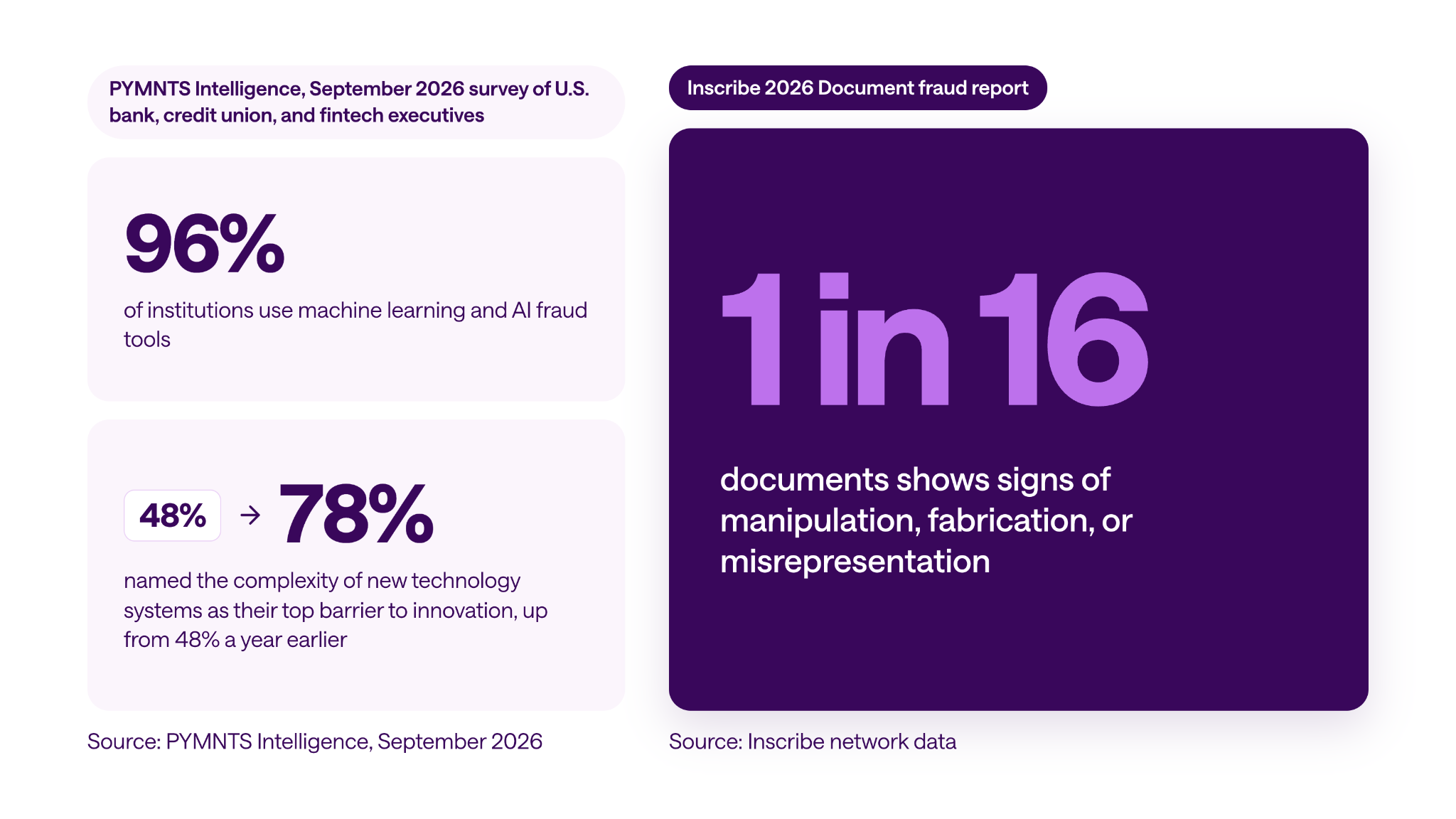
The fraud stack at most banks has grown faster than the bank’s ability to integrate it. In PYMNTS Intelligence’s September 2026 survey of U.S. bank, credit union, and fintech executives, 96% of institutions reported using machine learning and AI fraud tools, and 78% named the complexity of new technology systems as their top barrier to innovation, up from 48% a year earlier. The report’s conclusion was that institutions are stacking overlapping systems on top of each other, and integrating them well has become the new challenge.
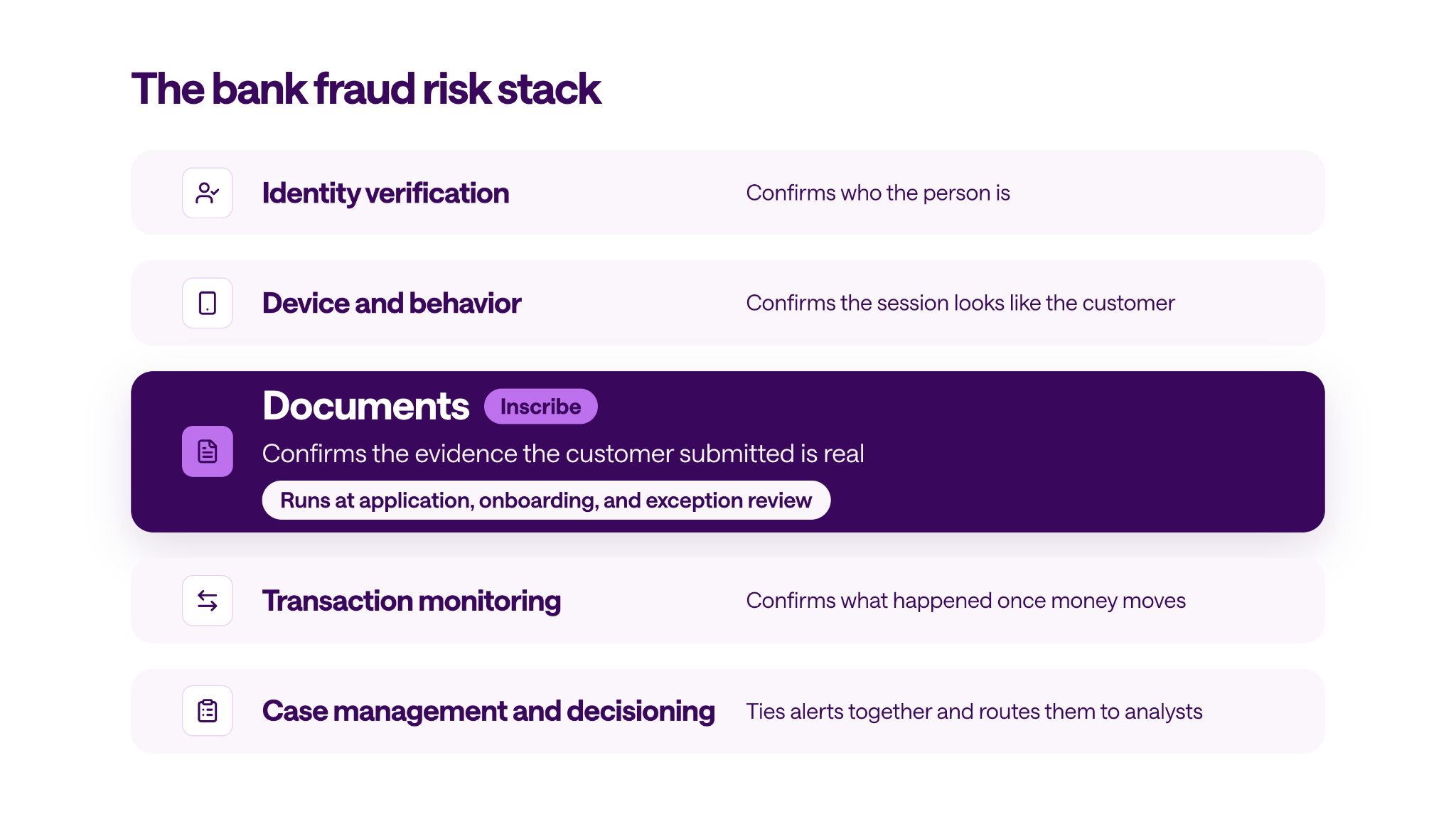
That stack usually has a shape: identity verification at the front door, device data and behavioral analytics across sessions, transaction monitoring and anti-money laundering (AML) controls once money moves, and a decisioning or case management platform tying the alerts together. What it often lacks is a layer that examines the documents a customer submits to open an account or borrow money. Across Inscribe’s network, roughly 1 in 16 of those documents shows signs of manipulation, fabrication, or misrepresentation, and none of the layers above is built to notice.
That gap is the document layer, and it belongs inside AI fraud detection for lenders as one specialized control among several.
Inscribe is the document layer in a bank’s fraud risk management stack: agentic document fraud detection that verifies each customer document is authentic, extracts its data, and explains every decision, running alongside the transaction monitoring and identity verification tools you already have.
Purpose-built for document risk screening since 2017, SOC 2 Type II and ISO 27001 certified, and used by top 10 U.S. banks and community financial institutions alike, Inscribe returns results in about 72 seconds per document on average across its network. See the agents work end to end in the Demo Center.
ALT TEXT: PYMNTS: 96% of institutions use AI fraud tools, but 78% cite system complexity as the top barrier, up from 48%. Inscribe: 1 in 16 documents is manipulated.
What are the core features of the document layer in a bank’s fraud risk management stack?
The document layer is the set of controls a bank applies to the files customers submit as evidence such as bank statements, pay stubs, tax forms, business filings, invoices, utility bills, and identity documents. Those files arrive at the moments of highest exposure, account opening, loan underwriting, account verification, and source-of-funds review, and they carry the data points the rest of the decision depends on. The document layer’s job is to establish whether each file is authentic, what it actually says, and why it can or cannot be trusted, before that data moves downstream.
Fraud risk management software for banks is rarely one product. It is a stack of specialized layers, usually orchestrated by a horizontal platform such as FICO Falcon, Feedzai, NICE Actimize, or Verafin that scores events, manages cases, and routes alerts to analysts. Each layer answers a different question. Identity verification answers whether the person exists and matches their credentials. Device data and behavioral analytics answer whether user behavior in the session looks like the customer. Transaction monitoring uses machine learning and anomaly detection to analyze transactions against the account’s history and flag suspicious activity. AML compliance workflows answer whether that activity suggests money laundering. The document layer answers whether the evidence the customer handed over is real.
Its core features follow from that job: risk scoring on every file, extraction of the data the file contains, checks against external data sources, network intelligence across institutions, and a plain-language explanation of every finding. Those are the capabilities that help financial institutions detect what the other layers cannot, and the rest of this page walks through them.
Inscribe’s 2026 Document Fraud Report makes the case for treating that as its own layer. Financial manipulation cuts across first-party, third-party, and synthetic identity fraud, so the report concludes that effective prevention depends on layered, lifecycle-based controls that evaluate financial consistency alongside identity, behavior, and context. Organizations that rely on onboarding checks or static identity verification alone are increasingly exposed as tactics evolve. Our companion pages cover the detection method and where the document layer fits in credit risk; this page covers where it fits in the bank’s fraud stack.
Where does document fraud detection fit alongside transaction monitoring, identity verification, and AML compliance?
Document fraud detection sits upstream of all three. Transaction monitoring can only begin once an account exists and there is transaction data to analyze, AML compliance depends on that same flow of transactions, and identity verification confirms a person without examining the financial claims that person makes. The document layer covers the step in between, where a real customer with a verified identity submits evidence that decides how much credit they get, whether their account is funded, or whether an exception gets cleared.
That step is where much of the risk hides. The 2026 Document Fraud Report found that 91.2% of altered documents include edits to financial details such as pay rates, deposits, balances, and wages, and the share of flagged documents with both identity and financial edits rose from 40.2% in 2024 to 59.8% in 2025. A large portion is first-party fraud: a genuine applicant inflating a genuine pay stub. Identity checks pass because the identity is real. Transaction monitoring never sees it because the loan has not funded yet, so there are no transaction patterns to flag. The only place the manipulation is visible is in the document.
The layers are not interchangeable, and each one is still necessary:
- Identity verification confirms who. It catches stolen and synthetic identities at onboarding, and with device data it defends against account takeover across customer interactions through the relationship. It does not read a bank statement.
- Transaction monitoring confirms what happened. It separates legitimate transactions from suspicious transactions using transaction context, customer behavior, and predictive analytics, and it is where real-time fraud detection for payment fraud and high-risk transactions lives. In the Federal Reserve’s 2026 survey of more than 400 U.S. financial institutions, debit card payments were the most targeted channel, with 75% of institutions experiencing attempts, and check fraud was the second most frequently reported type. Those controls are built for money already in motion.
- AML compliance confirms the activity is lawful. Transaction monitoring for money laundering, sanctions screening, and suspicious activity reporting run on the same transaction data and share case management tools with fraud, which is why many banks now run compliance and fraud prevention as one risk operations function.
- The document layer confirms whether the evidence is real. It runs at application, onboarding, and exception review, and it feeds the other layers with a signal they cannot generate on their own: a trust decision on each file, with the reasoning attached.
That upstream gap is also why the document layer changes where fraudsters go, as well as what gets caught. Hailey Windham, Community Banking Lead at Sardine, put it this way in the 2026 Document Fraud Report:

A stack with a document layer removes the path of least resistance that a stack without one leaves open.
How does data integration work when Inscribe plugs into existing fraud prevention systems?
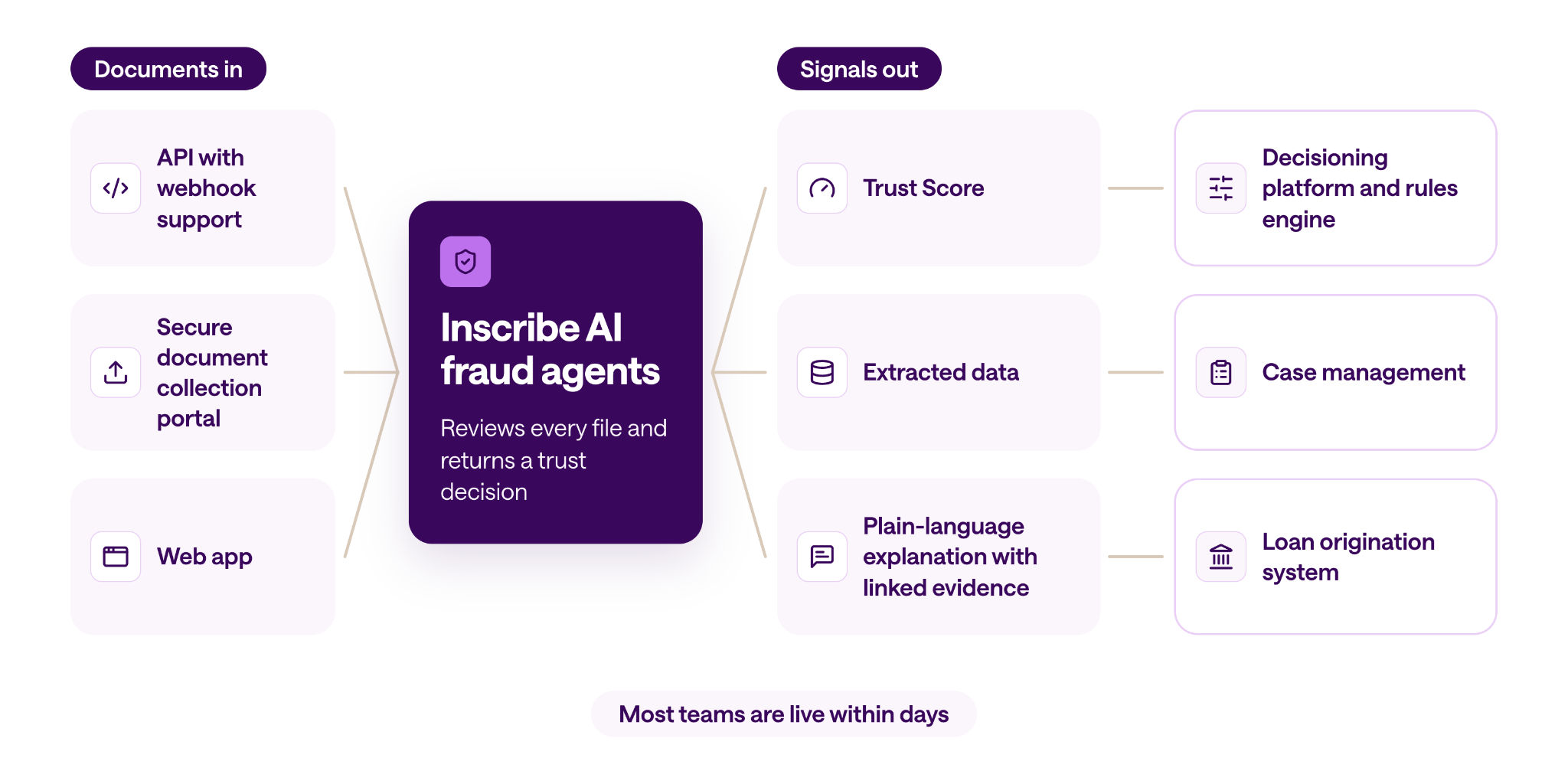
Inscribe plugs into existing systems as a signal source and a review workflow, so your decisioning platform, case management system, and fraud teams keep their roles. It serves the platform you already run, including legacy systems that were never built to read a PDF. Data integration runs in both directions. Documents enter through API integration with webhook support, a web app, or Inscribe’s secure document collection portal. Inscribe’s AI fraud agents review each file and return a Trust Score, severity levels, extracted data, and a plain-language explanation with linked evidence. Those outputs go wherever your stack already makes decisions: a rules engine, a decisioning platform, a loan origination system, or the investigation workflows in your case management tools.
Inside a bank, that shows up in four places:
- Onboarding and underwriting. Application documents are reviewed the moment they arrive, so altered, reused, and AI-generated files are caught during account opening and lending rather than after funding.
- Bank account verification and source-of-funds checks. Inscribe connects document findings with third-party data sources to confirm ownership and origin of funds, giving analysts context to resolve alerts and reduce unnecessary alerts reaching investigators.
- Exception handling. When another layer raises an alert that turns on a document, the file lands in review with the investigation already done: what was edited, where, and how severe.
- Network intelligence. Every submission is compared against a library of genuine and fraudulent documents drawn from millions of files across Inscribe’s network, so a template that was used against another institution is recognized the first time it reaches yours. Relationship mapping across documents in the same file surfaces hidden relationships, such as one employer letterhead behind a dozen unrelated applicants.
This is the same pattern banks are already following across the stack. PYMNTS found that 71% of institutions plan to develop new in-house fraud systems, but 93% of those efforts combine third-party fraud technology with proprietary tools, and none reported building any of the 11 tracked technologies entirely on their own. The document layer follows suit: a specialized signal your own team controls, consumed by the platform you already run, that improves the data quality of everything downstream. Document fraud detection software covers the detection layers in depth, and Inscribe for banks shows how top 10 U.S. banks and community institutions deploy it. Most teams are live within days.
Our platform already covers account takeover and payment fraud. Which fraud threats does the document layer add?
The fraud threats that arrive as evidence instead of as transactions: fabricated income, inflated balances, recycled statement templates, and AI-edited business financials. Most horizontal platforms are built to orchestrate signals, and document forensics is a signal they consume rather than produce. A decisioning platform may extract fields from a PDF or run a basic template match, which is enough to catch a crude fake and the fraud patterns already in its rules. It is not enough for what the 2026 Document Fraud Report shows arriving now: 1 in 5 flagged documents in 2025 showed signs of template-based manipulation, up from 1 in 14 in 2024, and detected AI-generated document fraud grew nearly fivefold between April and December 2025. Those files reconcile, format correctly, and carry clean metadata. Extraction reads them without objection.
Catching them takes signals that generic document checks do not evaluate: file history and metadata tampering, template lineage across a network, contradictions between documents in the same file, and pixel-level artifacts from AI editing. Inscribe’s agents apply network, forensic, semantic, and perceptual detection to every document, and because they are trained on millions of authentic financial documents and tested against current fraud tactics, they flag a first-of-its-kind fake before it becomes a known pattern. Your platform’s rules and models stay in place. The document layer gives them a better input.
The same logic applies to traditional rule-based systems and manual review. Rules catch what someone wrote down, which is why fraud teams pair them with machine learning that adapts as fraud patterns change. Analysts reading files page by page were effective when fraudsters used basic image editing tools. The report’s interviews describe workflows built on custom spreadsheets, spot-checked math, and three or four documents open side by side to compare balances. Those workflows fail when AI ensures the math adds up, the formatting is consistent, and the metadata looks clean. A document layer does that comparison on every file and hands the analyst the result.
Does the document layer add false positives or reduce them?
Reducing false positives is one of the key benefits banks report, because the document layer resolves the alert instead of adding another one. When an identity or transaction control flags a file, an analyst still has to open the document and decide. Inscribe returns that decision with the evidence attached: a Trust Score, the severity of each signal, and what was edited and where. High-risk files reach investigators with the work done, and files that clear stay out of the queue entirely, which is where the operational efficiency shows up.
Three things keep the signal precise at enterprise scale. Network intelligence compares each file against millions of genuine documents, so ordinary formatting variation is recognized as ordinary. Analyst feedback in the app feeds model development, so a false positive corrected once is learned. And Inscribe’s in-house risk operations team tests the agents against current fraud tactics, so the models adapt without your fraud teams retraining them. The result is fewer unnecessary alerts, lower operational costs per file, and audit logs that show why each document was cleared or held.
What results do banks see from the document layer?
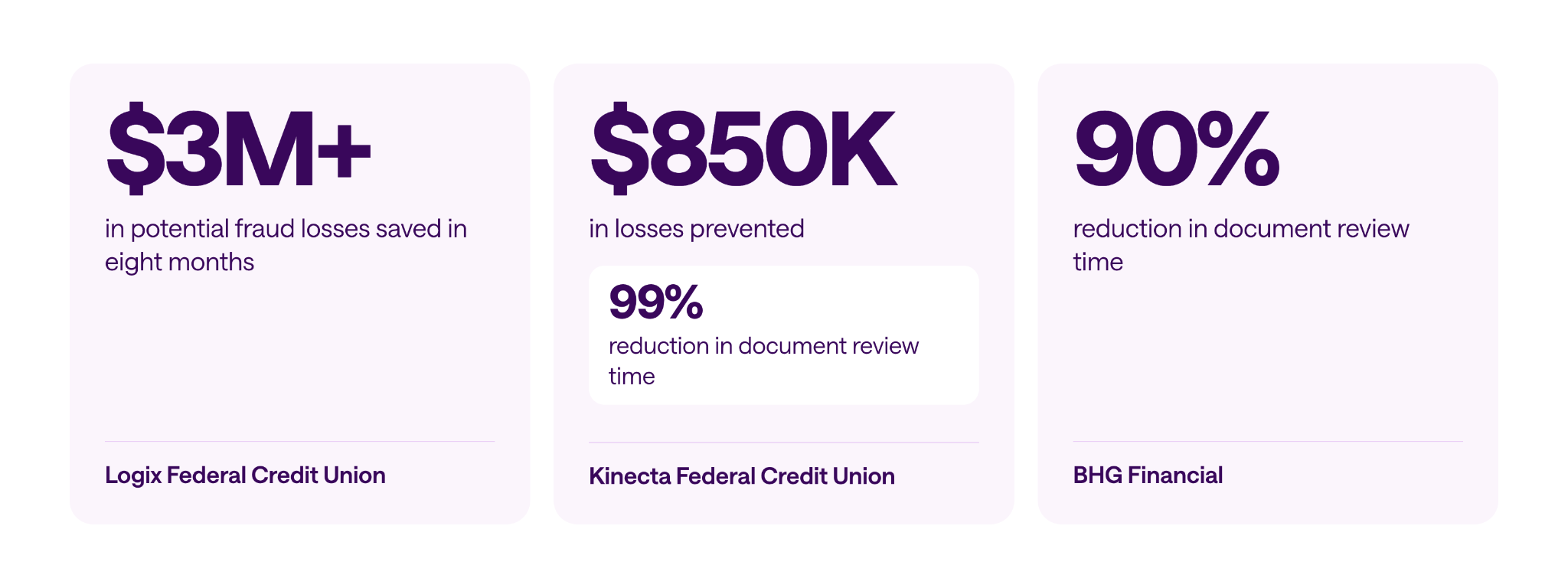
Banks see two results when the document layer is in place: fewer fraudulent files reaching funding, and analyst time returned to the alerts that need judgment. The clearest measure is losses prevented. Logix Federal Credit Union saved more than $3M in potential fraud losses in the first eight months after deploying Inscribe. Kinecta Federal Credit Union prevented $850K in losses while cutting document review time by 99%. Institutions using Inscribe for application review report a 30-minute reduction in application processing time, and the workflow automation gives scalable risk management from community banks to large financial institutions without adding review headcount.
The second measure is capacity. Michael Coomer, Director of Fraud Management at BHG Financial, reports a 90% reduction in document review time after replacing manual fraud detection with a transparent, scalable system. In the 2026 Document Fraud Report, he also named the harder part of the work:
“There is often an unwillingness to acknowledge that this behavior exists within your customer base. Reframing what we consider a ‘good customer’ is uncomfortable, but necessary.”
Michael Coomer, Director of Fraud Management, BHG Financial
That is the document layer’s other contribution to the stack. First-party fraud is invisible to identity and transaction controls by design, and a bank only sees how much of it exists once a layer is reading the files.
What do examiners expect from the document layer?
Examiners expect the document layer to meet the same regulatory requirements as every other control in the stack: defined ownership, documented procedures, human oversight of exceptions, and audit logs an examiner or internal audit team can test. In April 2026, the OCC, Federal Reserve, and FDIC issued revised model risk management guidance that supersedes SR 11-7. It excludes generative and agentic AI models from its scope as novel and rapidly evolving, and directs banks to govern them through their broader risk management programs, which places the burden on the bank’s own governance and on the documentation its vendors can produce. Compliance costs rise when a vendor cannot explain its output; they fall when every finding arrives with its reasoning.
Inscribe is built for that review. Every decision returns a plain-language explanation of what was detected, the severity of each signal, and linked evidence, so the finding can be defended in an exam, an audit, or a fair lending review. Detection improves over time as the agents learn from your analysts’ in-app reviews and from ongoing training by Inscribe’s in-house Risk Ops team, and the platform is SOC 2 Type II and ISO 27001 certified. The agentic AI fraud detection spoke covers governance for agents in more depth [cross-link placeholder: agentic AI fraud detection spoke, slug pending Drew].
Next steps: see the document layer on your own files
Inscribe is the document layer in a bank’s fraud risk management stack: agentic document fraud detection that verifies each customer document is authentic, extracts its data, and explains every decision, running alongside the transaction monitoring and identity verification tools you already have. The fastest way to evaluate it is with the files your analysts are reviewing today.
👉 Read the full guide to AI fraud detection for lenders
👉 See how banks use Inscribe
👉 Explore document fraud detection software
👉 See what your analysts are up against in the 2026 Document Fraud Report
👉 Explore the Demo Center
Frequently asked questions about fraud risk management software for banks

Fraud risk management software for banks is a stack of specialized controls, usually orchestrated by a decisioning or case management platform, that covers identity verification, device and behavioral analytics, transaction monitoring, and document verification. Inscribe is the document layer in that stack: agentic document fraud detection that verifies each customer document is authentic, extracts its data, and explains every decision, running alongside the tools a bank already has.
The document layer is the set of controls applied to the files customers submit as evidence, such as bank statements, pay stubs, tax forms, business filings, and identity documents, at account opening, underwriting, account verification, and exception review. It establishes whether each file is authentic, what it says, and why it can be trusted before the data moves to a credit model, a funding decision, or an analyst.
No. Inscribe produces a document trust signal that your decisioning platform, case management system, rules engine, or loan origination system consumes. Transaction monitoring, identity verification, and device analytics continue to run as they do today; the document layer covers the step they were never built to examine.
Transaction fraud happens after an account exists and money moves, and is caught by monitoring patterns against account history. Document fraud happens earlier, when a customer submits altered or fabricated evidence to open an account, qualify for credit, or clear a check. The 2026 Document Fraud Report found 91.2% of altered documents include edits to financial details, which is why the two require different controls.
Account opening, loan underwriting, bank account verification, source-of-funds review, and exception handling on alerts raised elsewhere in the stack. Inscribe runs at each of those points and returns a Trust Score, severity levels, extracted data, and an explanation for every file.
Through an API with webhook support, a web app, or a secure document collection portal. Outputs are structured so they can be scored by a rules engine, routed by a case management system, or written into a loan origination system. Most teams are live within days.
Yes. First-party fraud, where a real customer alters real documents to qualify, passes identity checks and precedes any transaction, so the document is the only place it is visible. Inscribe detects it through forensic signs of editing, semantic contradictions across the file, and network matches against known templates, and explains what changed.
Bank statements, pay stubs, tax forms, business financial documents, invoices, utility bills, and identity documents, among others. Bank statements are the file fraud leaders rank most vulnerable: 85.6% of the 90 risk leaders surveyed for the 2026 Document Fraud Report named them as their top concern.
Defined ownership, documented reasoning, human oversight of exceptions, and an audit trail. The revised interagency model risk guidance of April 2026 leaves generative and agentic AI to a bank’s broader risk management program, so vendor explainability matters. Inscribe returns a plain-language explanation and linked evidence with every decision and is SOC 2 Type II and ISO 27001 certified.
Look for a provider purpose-built for document fraud (a document check bolted onto a broader platform tends to stop at extraction), a network of real financial documents large enough to recognize recycled templates, explanations an examiner can read, and integration through an API or portal that fits existing systems. Inscribe created the category in 2017 and is used by top 10 U.S. banks and community institutions.
About the author
Conor Burke is the co-founder and CTO of Inscribe, where he leads the AI and engineering systems behind the platform's document fraud detection capabilities. He writes and speaks on the technical mechanics of fraud detection — how LLMs reason, where rules-based systems break down, and what it actually takes to build AI that explains itself.
Learn More
Dive deeper into document fraud

What will our AI Agents find in your documents?
Start your free trial to catch more fraud, faster.