
Proof of income fraud detection for lenders
Table of Contents
[ show ]- Loading table of contents...


Every lending decision rests on a claim about income, and income documentation is still how most borrowers back that claim. That is exactly where fraud concentrates.
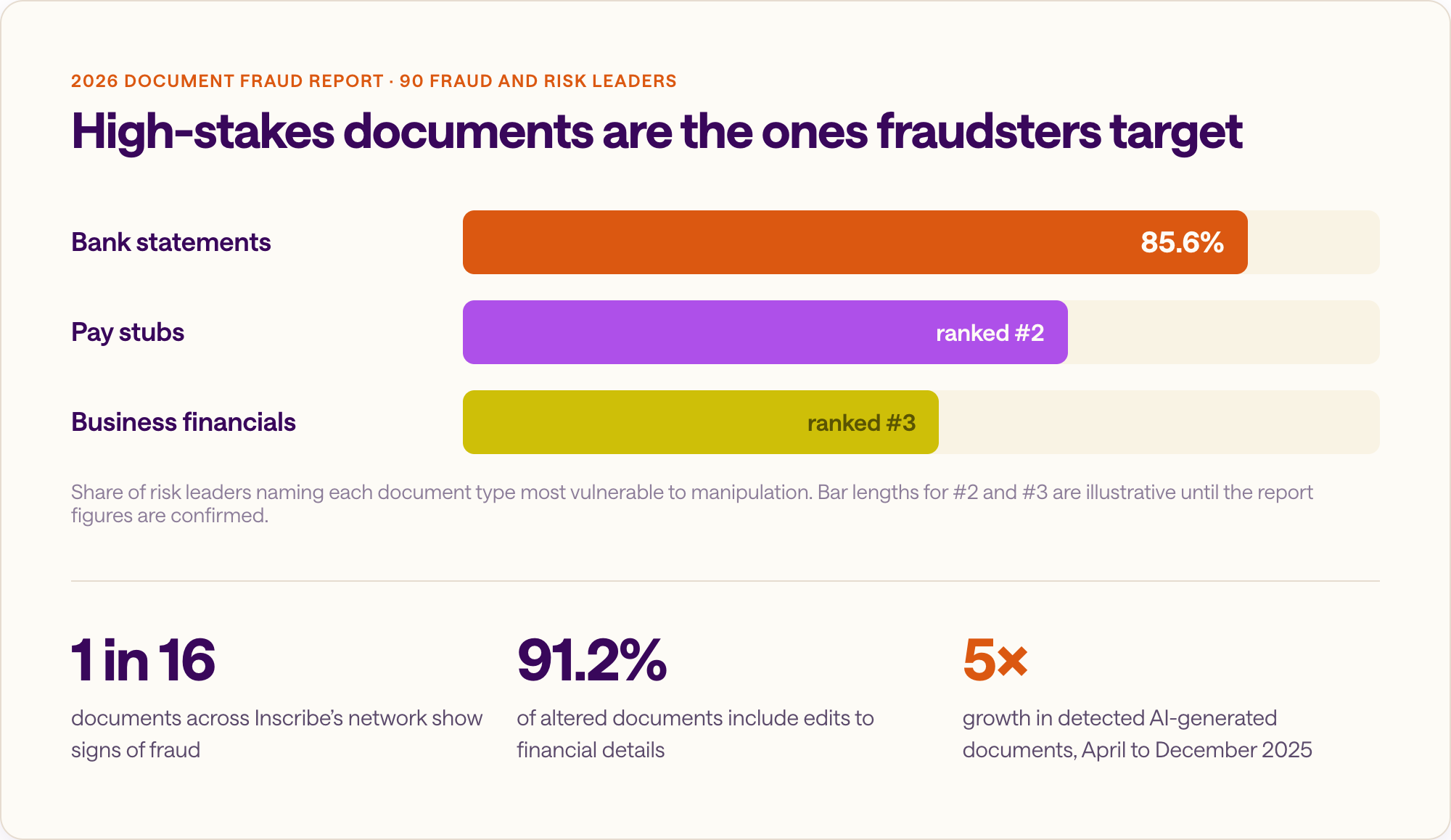
Roughly 1 in 16 documents submitted to financial services workflows shows signs of manipulation, fabrication, or misrepresentation, and 91.2% of altered documents include edits to financial details: pay rates, deposits, balances, and wages. In a survey of 90 fraud and risk leaders for the 2026 Document Fraud Report, the three document types ranked most vulnerable to manipulation (bank statements, pay stubs, and business financial documents) are the same three your underwriters rely on to verify income.
Inscribe is proof of income fraud detection for lenders: AI that verifies the pay stubs, bank statements, and tax documents borrowers upload, catching edited, template-generated, and AI-fabricated income documents before they reach underwriting.
Purpose-built for document risk screening since 2017, SOC 2 Type II and ISO 27001 certified, and trusted by leading banks, credit unions, and fintechs, Inscribe returns a Trust Score and plain-language evidence in about 72 seconds per document on average across its network. Income documents are one slice of the problem, and “Underwriting Document Review Automation” covers how the same detection layers apply across every document type a lending team reviews. See the full workflow in the Demo Center.
What does proof of income fraud look like?
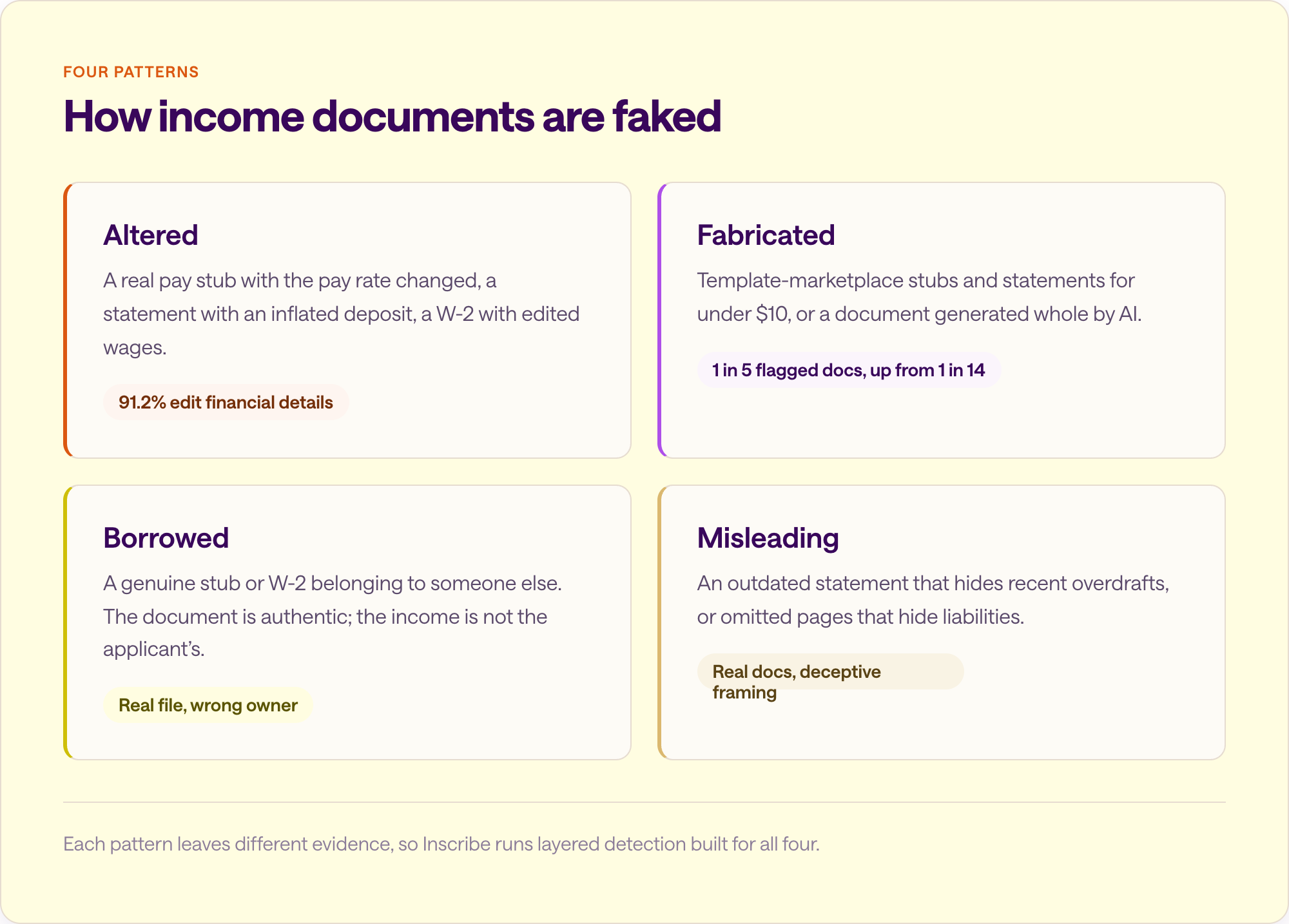
Proof of income fraud is the submission of altered, fabricated, borrowed, or misleading income documents to qualify for credit an applicant's real finances would not support. It rarely announces itself. The math usually adds up, the logo is right, and the file opens clean. It shows up in four patterns, and each one leaves different evidence:
- Altered documents. A real pay stub with the pay rate changed, a bank statement with an inflated deposit, a W-2 with edited wages. This is the dominant pattern: 91.2% of altered documents include edited financial details. Generative tools now make these edits in a one-sentence prompt, and they keep the totals consistent.
- Fabricated documents. Template marketplaces sell editable pay stubs and bank statements at consumer prices, with same-day delivery and unlimited revisions. In 2025, 1 in 5 flagged documents showed template-based manipulation, up from 1 in 14 in 2024. Fully AI-generated documents are the emerging layer on top: detected volume grew nearly fivefold between April and December 2025.
- Borrowed documents. A real pay stub or W-2 that belongs to someone else, a friend, a family member, or a stolen identity. The document is authentic; the income is not the applicant's.
- Misleading submissions. Real documents used deceptively: an outdated statement that hides recent overdrafts, omitted pages that hide liabilities, a legitimate document framed to misrepresent affordability.
The goal is almost always the same: eligibility inflation or affordability misrepresentation, propping up a loan application the applicant's real finances would not support. Because each pattern leaves different evidence, Inscribe runs layered detection built for all four, whether the falsified documents are off-the-shelf templates or carry a single pixel-level edit that manual review would never catch.
Do lenders need document fraud detection if they already verify income through payroll data?
Yes, because payroll verification only protects the applicants it reaches. Payroll platforms confirm income directly from the employer's system, and when that connection succeeds there is no document in the loop to falsify. Document fraud detection covers the applicants where the connection doesn't land, and that share skews toward the applicants most worth checking.
Platforms like Argyle and Truv connect to a borrower's payroll provider with their permission and return wages, pay frequency, and employment history straight from the source. The Work Number answers the same question from a database of records purchased from employers and payroll vendors. Both are authoritative, and neither can be altered by the applicant.
That last point is why the remaining applicants matter. Someone inflating their income cannot change what their payroll provider reports, so the rational move is to decline the connection, cite an unsupported employer, and upload a pay stub instead. Documents arriving through that fallback come disproportionately from applicants who opted out of the check they couldn't defeat. The payroll platforms treat this as a known gap: Argyle now sells a document-based income product of its own, framing payroll, banking, and documents as three stages of a single verification waterfall, because direct connections do not reach every applicant. That last stage arrives as uploads, and document authenticity is the only check left.
Coverage is one part of it. Payroll data speaks to wage income and nothing else. Bank statements, which risk leaders ranked most vulnerable at 85.6%, sit outside payroll entirely, as do tax returns for self-employed borrowers and business financial documents in SMB lending. And when the employer itself is fabricated, there is no payroll system to connect to, and the failed connection looks identical to a genuine coverage gap. That upload lane is exactly what Inscribe verifies: every document that arrives because payroll data couldn't, or wouldn't, answer the question.
Does Inscribe compete with bank connectivity providers like Plaid?
No. Inscribe works alongside bank connectivity providers rather than against them. Connectivity establishes what moved through an account. Inscribe establishes whether a submitted document is authentic. The two answer different questions, and lending workflows need both answered.
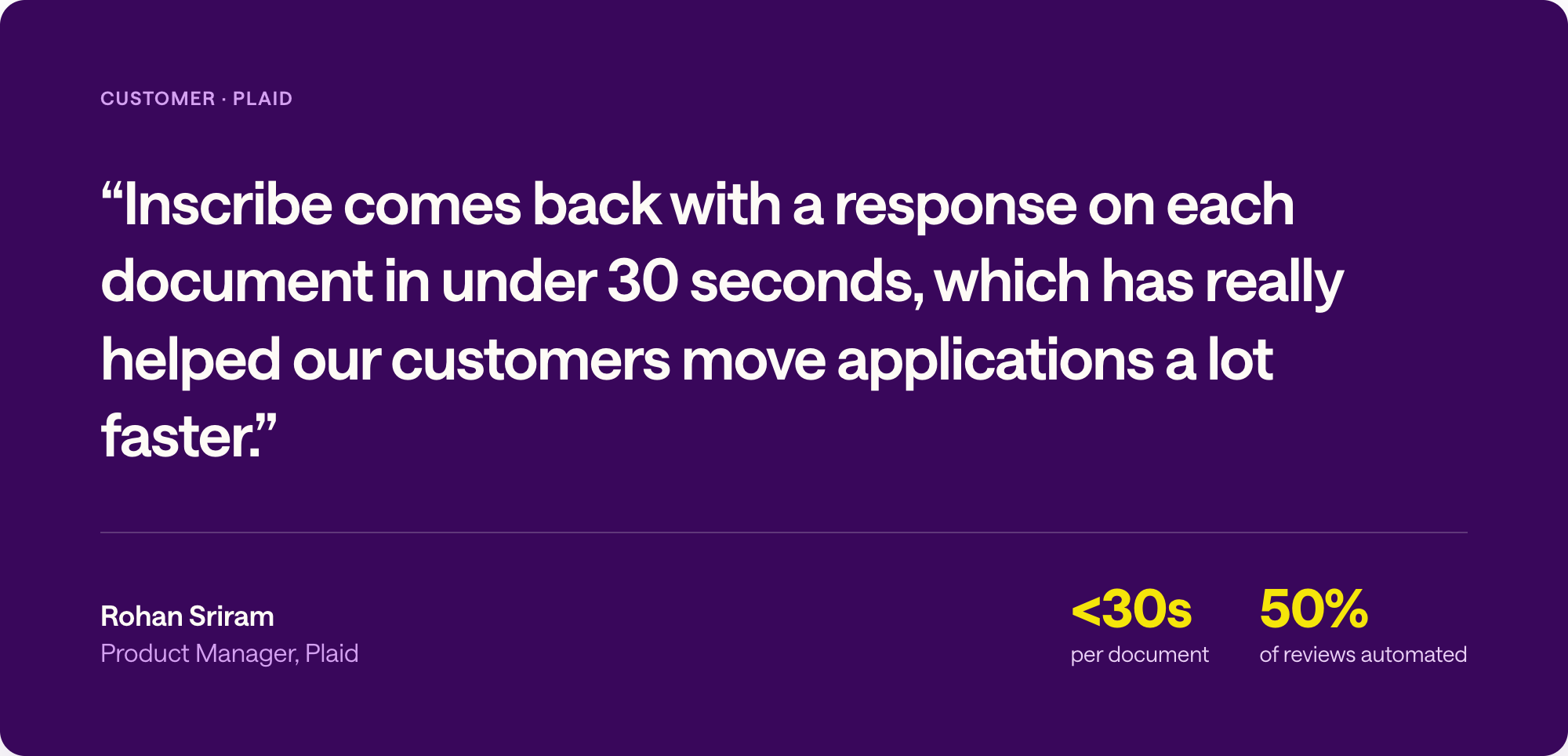
The clearest proof is that Plaid is an Inscribe customer. Plaid's income verification product routes uploaded documents through Inscribe for exactly that authenticity check, which cut document review from one to two days to under 30 seconds per document in Plaid's workflow and automated half of reviews, including uploads that arrive as smartphone photos rather than true PDFs.
For a fuller breakdown of where document verification ends and bank connectivity begins, see Inscribe vs. Plaid.
What documents does proof of income fraud detection cover?
Proof of income fraud detection covers pay stubs, bank statements, tax documents, and employment verification letters: every document a lender accepts as evidence of earnings. Lenders rarely see one document per applicant. They see a file: statements, stubs, and tax forms that are supposed to tell one consistent story. Inscribe verifies proof of income documents individually and as a set.
Pay stubs
A pay stub condenses an employee's pay into a handful of fields: gross pay, tax withholdings, net pay, and the pay period they cover. That small surface is what makes pay stubs the easiest income document to fake and the second-most-cited concern among risk leaders. Inscribe validates what a reviewer rarely has time to test: the arithmetic between the fields, year-to-date totals against pay cadence, employer details against public records, and layout against known payroll providers. The red flags underwriters can still check by hand are covered in the next section.
Bank statements
Bank statements are the document risk leaders worry about most: 85.6% named them the most vulnerable type. Their complexity is the reason. Dozens of transactions, running balances, and dates give a fraudster more places to hide an inflated deposit and give a reviewer more to reconcile. They also carry extra weight for self-employed borrowers and independent contractors, whose bank account activity often stands in for pay stubs entirely. Inscribe parses every transaction, tests whether balances carry correctly across pages, and compares each statement against patterns from tens of millions of analyzed documents to catch recycled templates and repeat balances. Bank Statement Verification Software covers this workflow in depth, and the Fake Bank Statement Detector covers the forgery signals specifically.
Tax documents
W-2s, 1099s, full 1040 tax returns, and IRS tax transcripts carry the numbers underwriters treat as most authoritative, which is exactly why fraudsters target them. A transcript pulled directly from the IRS is trustworthy; the risk sits in borrower-uploaded copies, which can be edited like any other PDF. AI-generated W-2s are now a documented pattern, and an edited wage figure is hard to catch by eye because the rest of the form stays untouched. Inscribe checks internal consistency (wages against withholdings, employer identification details, form-version formatting) and corroborates tax figures against the pay stubs and statements in the same file. See How to Spot a Fake W-2 for the manual checks.
Employment verification letters
An employment verification letter is the easiest income document to fabricate, because there is no format to violate: letterhead, a signature, a salary figure, and it looks done. When the employer itself is invented, the letter usually anchors the file, backed by a website built in an afternoon and a phone number that rings to the fraudster. Inscribe verifies the letter and the employer behind it, checking employer details against public records and web presence, and testing the letter's claims against every stub and deposit in the same submission. Employment fraud that survives a surface read rarely survives that corroboration.
The file as a whole
A fraudster can keep one document internally consistent. Keeping a fabricated pay stub, an edited statement, and a borrowed W-2 consistent with each other is much harder. Inscribe corroborates income and employment data across the entire submission and flags the contradictions. Cross-document inconsistency is where proof of income fraud most often comes apart.
How to spot fake pay stubs: red flags from gross pay to net pay
You spot a fake pay stub by testing whether its pay stub information holds together, because the fields are related by arithmetic and convention in ways fakes get wrong. A legitimate stub records an employee's pay for a specific pay period: gross pay at the top, then tax withholdings (federal taxes, state taxes, Social Security taxes, and Medicare), and finally net pay, the take-home pay that actually lands in the account. That structure is what makes stubs checkable:
- Gross-to-net math that doesn't hold. Take-home pay should equal gross pay minus taxes paid and deductions, to the cent. Note that a clean calculation clears nothing on its own: generators get the math right far more reliably than manual editors do.
- Year-to-date totals that don't track the calendar. A stub dated in March with YTD figures implying nine months of earnings, or weekly payments that don't multiply out to the employee's salary, points to fabrication.
- Pay dates that drift. Salaried workers are usually paid on a fixed cadence, and many employers run biweekly or semimonthly payroll. Pay dates that wander, or a given pay period that overlaps the previous one, are classic edit artifacts.
- Details that don't corroborate. A stub identifies both the employer and the employee. Names, addresses, and employer identification numbers should match the rest of the file and public records.
- A format that matches no known payroll provider. No federal law requires a standard pay stub format. The Fair Labor Standards Act requires employers to keep payroll records, not to issue stubs, so layouts vary widely by state and by payroll software. That variety gives fraudsters cover, and it is why Inscribe matches documents against known payroll provider output instead of trusting any single template.
One caution: a single pay stub proves little either way. Underwriters typically collect a month or more of stubs plus corroborating documents, and fraud usually surfaces in the seams between them. The full manual checklist is in How to Spot Fake Pay Stubs; Inscribe runs every check above automatically, on every stub.
Why pay stub generators make convincing fakes cheap
Creating pay stubs online is a legitimate business. Small businesses, self-employed workers, and independent contractors use payroll software and pay stub generator sites to create accurate pay stubs and keep clean payroll records. But the same user-friendly sites that sell check stubs to a contractor will let an applicant generate pay stubs for an employer that never paid them: their own pay stubs, with any dollar amount they choose. Buying a pay stub online costs a fraction of the loan it is meant to unlock, the better generators calculate withholdings from current tax laws so the math reconciles perfectly, and the output is visually identical to traditional pay stubs from a payroll provider.
That is why detection has to go below the surface. Inscribe's network detection recognizes the fingerprints of known stub generators and recycled templates, forensic detection reads the file's creation history, and semantic detection tests the stub against the rest of the file. A document from an online paystub maker or a one-off paystub generator can get every visible field right and still give itself away in metadata, template lineage, and cross-document contradictions.
How AI proof of income fraud detection works at the document level
AI proof of income fraud detection analyzes a document's metadata, structure, pixels, and content, compares it against patterns from tens of millions of analyzed documents, and returns a scored, explained verdict on whether the document can be trusted. That depth matters because fake documents no longer look fake: visual inspection stopped being a reliable test once generative tools learned to keep spacing, fonts, and math consistent, so the meaningful signals live below the surface, and that is where Inscribe's AI agents investigate. Four detection layers run on every income document:
- Forensic detection analyzes metadata, fonts, and file history, including creation tools and edit signatures. Document X-Ray recovers revision history, showing what was changed, what was originally there, and when.
- Network detection compares each document against patterns from tens of millions of analyzed documents to catch recycled templates, suspicious layouts, and balances that have appeared before under a different identity.
- Semantic detection reads the document the way a seasoned underwriter would: does the gross-to-net math hold, do year-to-date totals match the pay cadence, do deposits line up with the pay stubs, does the employer check out.
- Perceptual detection examines documents at the pixel level to surface edits and AI-generation artifacts that look flawless to the human eye.
Every flag comes back explained. Each document returns a Trust Score from 0 to 100, severity levels, and a plain-language summary, so your team defends decisions with evidence instead of gut instinct. Income documents run through the same online document verification workflow Inscribe applies across document types, at about 72 seconds per document on average across its network, against 10-15 minutes for manual review. Integration is API-first with webhook support, documented at docs.inscribe.ai.
How do lenders use proof of income fraud detection at underwriting?
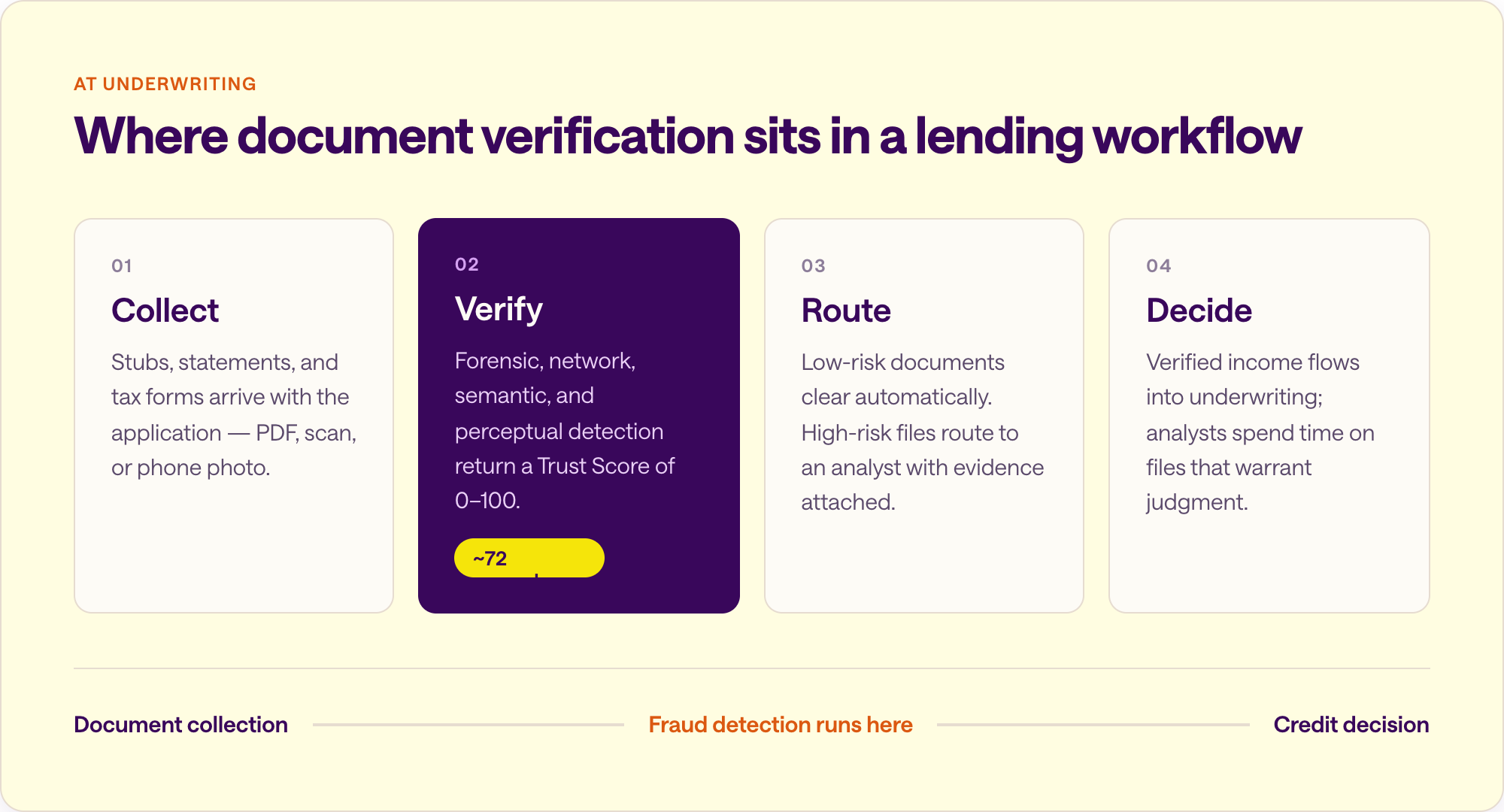
Lenders run proof of income fraud detection between document collection and the credit decision, so fraud is caught before it reaches the credit model rather than unwound after funding:
- Collect. Borrowers upload documents with their loan application, or your team requests files through Secure Document Collection for a cleaner chain of custody and fewer missing pages.
- Verify. Every pay stub, statement, and tax form is analyzed in seconds, whether it arrives as a true PDF, a scan, or a phone photo.
- Route. Low-risk documents clear automatically. High-risk files route to an analyst with the evidence attached, so review starts with the answer instead of a blank queue.
- Decide. Verified income documents flow into underwriting, and your analysts spend their time on the files that warrant judgment.
The same flow supports consumer lending, where inflated salaries and fabricated deposits surface before approval; business lending, where P&Ls with inflated revenue or trimmed business expenses get the same scrutiny; and equipment financing, where funding speed is the product. Across all three the stakes concentrate at underwriting, and speed is the operational case: lenders that quote in 24-48 hours lose applicants when statements sit in a review queue, and the borrowers willing to wait are often the ones with no other options. Automated verification keeps same-day SLAs intact without loosening scrutiny. More context on the lenders industry page and in Document Verification for Lenders.
What do lenders catch with Inscribe?
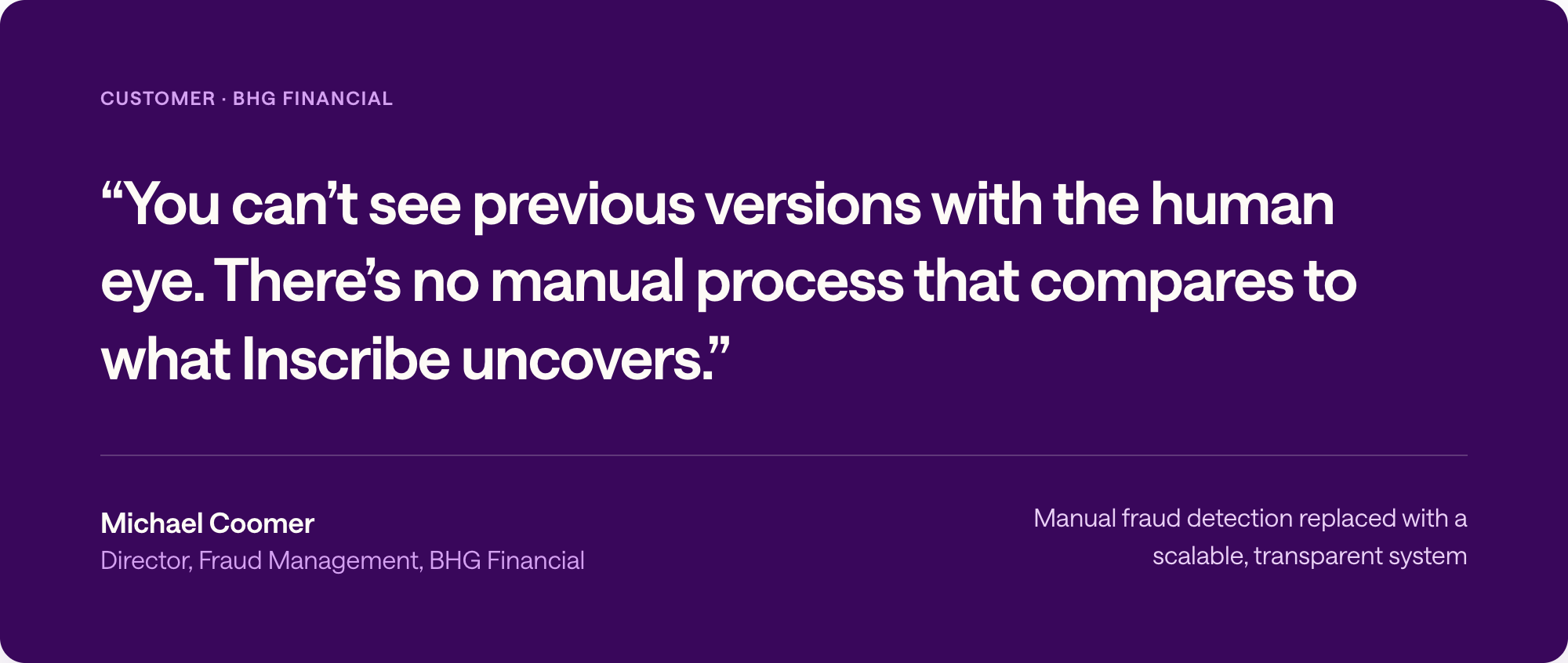
Lenders using Inscribe report millions in prevented losses from altered statements, fabricated stubs, and reused templates, along with review queues that clear in seconds instead of days. BHG Financial replaced manual fraud detection with a scalable, transparent system, giving its team time back, a consistent way to verify income documents at volume, and clarity moving forward.
The results repeat across lending customers. BCU prevented $5.6 million in losses from confirmed altered documents in the first nine months of 2025, including a $75,000 auto loan stopped by a single fingerprint mismatch on a bank statement. Logix Federal Credit Union prevented more than $3 million in potential fraud losses in eight months. Kinecta saved $850,000 in fraud losses while cutting document review time by 99%.
Ready to catch proof of income fraud before you fund?
Inscribe is proof of income fraud detection for lenders: AI that verifies the pay stubs, bank statements, and tax documents borrowers upload, so every approval rests on income you can trust.
👉 Explore the Demo Center
👉 Request a demo
👉 Go broader with AI fraud detection for lenders
👉 See how income fraud is evolving in the 2026 Document Fraud Report
Frequently Asked Questions

Proof of income fraud is the submission of altered, fabricated, borrowed, or misleading income documents, most often pay stubs, bank statements, and tax forms, to qualify for credit the applicant's real finances would not support. Roughly 1 in 16 documents submitted to financial services workflows shows signs of manipulation, and 91.2% of altered documents include edits to financial details such as pay rates, deposits, and balances.
Lenders spot fake pay stubs by inspecting file metadata and edit history, matching layout and fonts against known payroll formats, and testing whether the numbers reconcile: gross pay to net pay, taxes paid, year-to-date totals, and pay cadence. Inscribe runs these checks automatically, recognizes output from known stub generator sites, and returns a Trust Score with plain-language evidence, so underwriters see exactly why a pay stub was flagged. The manual red flags are covered in How to Spot Fake Pay Stubs at inscribe.ai/document-processing/how-to-spot-fake-pay-stubs.
Yes. AI surfaces manipulation signals the human eye misses, including metadata inconsistencies, font anomalies, pixel-level edits, recycled templates, and figures that contradict other documents in the same file. Inscribe is proof of income fraud detection for lenders that verifies the pay stubs, bank statements, and tax documents borrowers upload, catching edited, template-generated, and AI-fabricated income documents before they reach underwriting.
Bank statements, pay stubs, and tax forms such as W-2s, 1099s, and 1040 tax returns are the most frequently faked income documents. In Inscribe's survey of 90 fraud and risk leaders, 85.6% named bank statements the document type most vulnerable to manipulation, with pay stubs and business financial documents ranking second and third. Self-employed applicants raise the difficulty further, because their income rests on bank statements and tax returns rather than employer pay stubs. The full breakdown is in the 2026 Document Fraud Report.
Inscribe parses every transaction, tests whether balances reconcile across pages, recovers revision history through Document X-Ray, and compares the statement against patterns from tens of millions of analyzed documents to catch recycled templates and repeat balances. Each statement returns a Trust Score from 0 to 100 with a plain-language summary an underwriter can read in seconds. Bank Statement Verification Software covers the full workflow.
Yes, and both paths are cheap. Pay stub generator sites let anyone create pay stubs online with any employer name and dollar amount, calculating withholdings from current tax laws so the math reconciles, while detected AI-generated document fraud grew nearly fivefold between April and December 2025. Inscribe's network detection recognizes generator and template fingerprints, and its perceptual detection catches AI-generation artifacts, so both patterns surface before underwriting.
Income verification calculates what a borrower earns, typically from payroll data, bank connections, or the figures on submitted documents. Proof of income fraud detection confirms those documents are authentic and unaltered before the figures are trusted. A fabricated pay stub can pass an income calculation perfectly, so lenders that accept uploaded documents need both.
Inscribe is document verification software for income documents. Payroll connectivity platforms verify income data at its source. Inscribe verifies that the pay stubs, bank statements, and tax documents an applicant uploads are authentic before their figures are trusted.
Inscribe returns results in about 72 seconds per document on average across its network, and high-volume integrations run faster: in Plaid's income verification workflow, responses come back in under 30 seconds per document. Either way, low-risk documents clear automatically, so authentic applicants keep moving while only high-risk or low-confidence files route to a human reviewer, compared with 10-15 minutes per document in manual review.
The best fit for lenders is software that verifies every income document type in one pass, explains each flag in plain language, and returns results fast enough for same-day decisions. Inscribe has been purpose-built for document risk screening since 2017, is SOC 2 Type II and ISO 27001 certified, and catches the edited, template-generated, and AI-fabricated income documents that identity checks and manual review miss.
About the author
Stephanie Spangler is the Head of Product Marketing at Inscribe, where she covers AI-powered fraud detection, document risk, and how financial institutions are adopting agentic AI. She writes on the intersection of product and practice — translating what fraud detection technology does into what it means for the risk teams using it.
Learn More
Dive deeper into our Solutions


What will our AI Agents find in your documents?
Start your free trial to catch more fraud, faster.