Underwriting document review automation for lenders
Table of Contents
[ show ]- Loading table of contents...


Document review is where underwriting slows down. A single document review can take up 30 minutes per application, and at that pace a growing lender burns dozens of analyst-hours a day before a single credit decision gets made. The queue is also a fraud surface: across Inscribe’s network, roughly 1 in 16 documents shows signs of manipulation, fabrication, or misrepresentation, and the 2026 Document Fraud Report found that the documents underwriters scrutinize most (bank statements, pay stubs, and business financials) are also the ones most often faked.
Inscribe automates underwriting document review with AI agents that verify each borrower document is authentic, extract its data, and explain every decision, so your underwriters review exceptions instead of everything.
Purpose-built for document risk screening since 2017, SOC 2 Type II and ISO 27001 certified, and trusted by leading banks, credit unions, and fintechs, Inscribe returns results in about 72 seconds per document on average across its network.
Document review is one workflow inside a broader problem, and AI Fraud Detection for Lenders covers how the same detection layers apply across every document type a lending team reviews. See it end to end in the Demo Center.
What is underwriting document review automation?
Underwriting document review automation is software that uses artificial intelligence or predefined rules to classify, verify, and extract data from the documents in a loan application, clearing authentic files automatically and routing only exceptions to a human reviewer. It replaces the slowest step in origination: a person opening each pay stub, bank statement, and tax form to check it by eye.
That manual review process does not scale, and the people responsible for it know it.

The cost is not just labor. Slow review creates adverse selection: lenders that quote in 24-48 hours lose applicants when files sit in a queue, and the borrowers willing to wait are often the ones with no other options. Automated review covers the full document mix in a lending file, from income documents to business financials to IDs and proof of address. Document Verification for Lenders covers the document types in depth.
One note on the phrase, because it spans industries: a law firm automates document review to flag a risky contract clause across thousands of contracts, an insurer to move through case files, a compliance team to test policies against regulations. In those legal and compliance contexts, the goal is usually finding language. In lending, the goal is trust, and that is the version this page covers.
Why isn’t rules-based automation enough for document review?
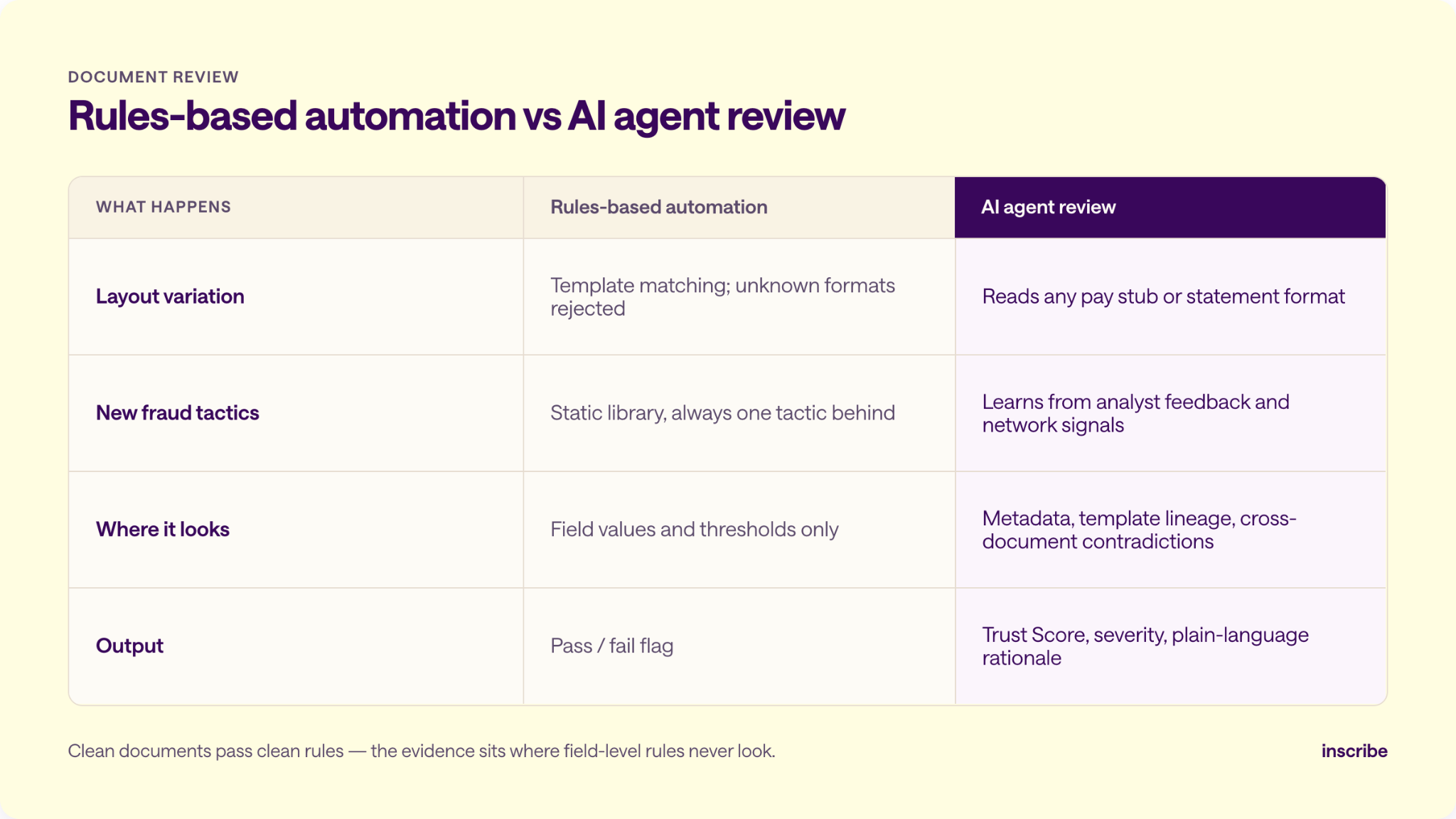
Rules-based automation applies the same predefined rules to every document: match a known template, read the expected fields, flag anything outside a threshold. It falls short at underwriting for two reasons: borrower documents refuse to standardize, and modern fraud is built to pass fixed checks.
- Layouts vary endlessly. No federal law requires a standard pay stub format, and every bank formats statements differently. Template matching either rejects good documents or waves through bad ones, and both outcomes create work.
- Static rules fall behind. New generator sites and AI editing tools appear constantly, and a rules library is always one tactic behind. Detected AI-generated document fraud grew nearly fivefold between April and December 2025.
- Clean documents pass clean rules. Generated and template-built documents reconcile perfectly: the math adds up and the formatting is right. The fraud evidence lives in metadata, template lineage, and cross-document contradictions, places field-level rules never look.
Extraction-only tools have the same blind spot from a different angle. OCR reads a document; it does not decide whether the document deserves to be trusted, and extraction alone cannot ensure accuracy, because a perfectly extracted number from a fabricated statement is still wrong. Automating extraction without verification just moves those errors into your credit model faster.
How do AI agents review underwriting documents differently?
AI agents review a document the way a seasoned analyst would: they adapt to what they find, investigate further when something looks off, and explain exactly what triggered concern in plain language, automating tasks like classification and parsing while leaving judgment with your team. Instead of running one fixed pass, each agent decides what the document in front of it requires. The review runs in four stages, in sequence:
- Intake. Documents arrive by upload, API, or a Secure Document Collection link, and are pre-screened for format validity, completeness, and type before review begins.
- Analyze. LLM-based parsing extracts key fields and evaluates formatting, logic, and consistency, checking that dates, totals, and balances reconcile, while forensic, network, semantic, and perceptual detectors identify manipulation: edit history, recycled templates, contradictions in the story, and pixel-level artifacts.
- Validate. Agents extend the investigation beyond the file, verifying employers, cross-checking addresses, and confirming web presence, so the document is judged in context instead of isolation.
- Explain. Every document returns a Trust Score from 0 to 100, severity levels, and a plain-language summary of what was found and why it matters, which is what makes automated decisions defensible in front of auditors and regulators.
Version control for borrower documents
Underwriting has always had a quiet version control problem: the file a borrower uploads is only the latest version, and edits leave no visible trace. Document X-Ray restores that traceability by recovering revision history, showing what changed, what was originally there, and when. It works like version control in reverse: instead of tracking your own edits, it exposes someone else’s.
The detection capabilities also improve with your team, learning from in-app analyst feedback and from Inscribe’s in-house risk operations team. Underwriting documents run through the same online document verification workflow Inscribe applies across document types; integration is API-first with webhook support, documented at docs.inscribe.ai.
Where does fraud detection fit in the document review workflow?
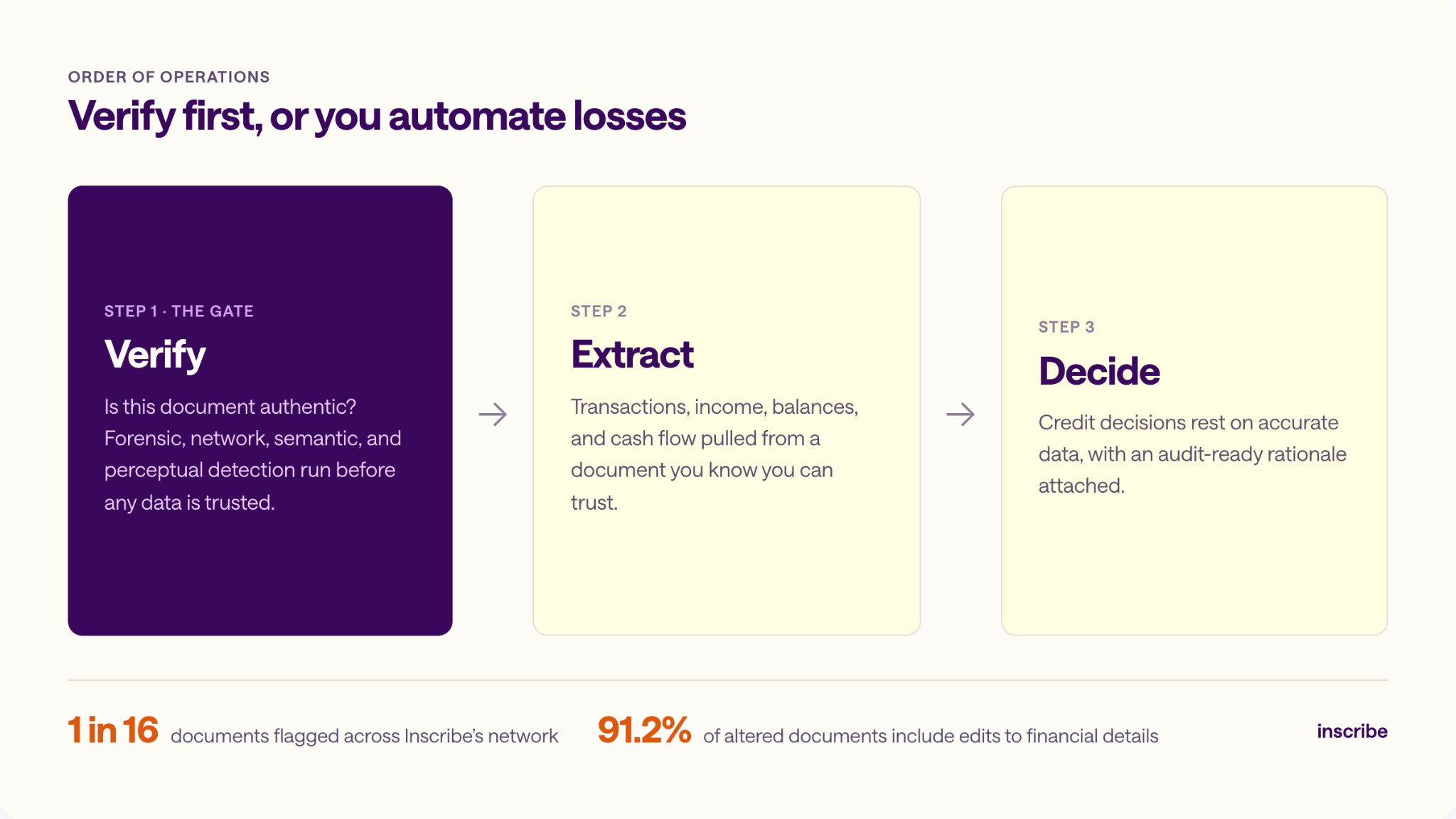
Fraud detection belongs at the front of the document review workflow: each document is verified as authentic before its data enters extraction and risk assessment. With roughly 1 in 16 documents flagged as showing signs of fraud in 2025, and 91.2% of altered documents including edits to financial details, the ordering is the difference between automating review and automating losses.
In practice the flow is: verify, then extract, then decide. A bank statement clears verification before the Bank Statement Analyzer extracts transactions and cash flow from it, so risk decisions rest on accurate information from documents you know you can trust. The same gate applies to pay stubs, tax forms, and business financials at loan origination; Loan Document Fraud Detection covers the fraud signals by document type.
How do lenders use automated document review in loan underwriting?
Lenders run automated review between application intake and the credit decision, across underwriting workflows in every lane where documents gate the loan:
- Consumer lending. Income and identity documents are verified at origination, so inflated salaries and fabricated deposits surface before approval instead of in collections.
- Business and SMB lending. Multi-page statements, P&Ls, and business financials get consistent scrutiny at volume, whatever their complexity. Coast built its underwriting around a goal of deciding 90% of applications the same day they arrive, which is only possible because document review is automated.
- Equipment financing. Funding speed is the product. Rapid Finance promises money in clients’ accounts within 24-48 hours, a window manual document review consumes on its own.
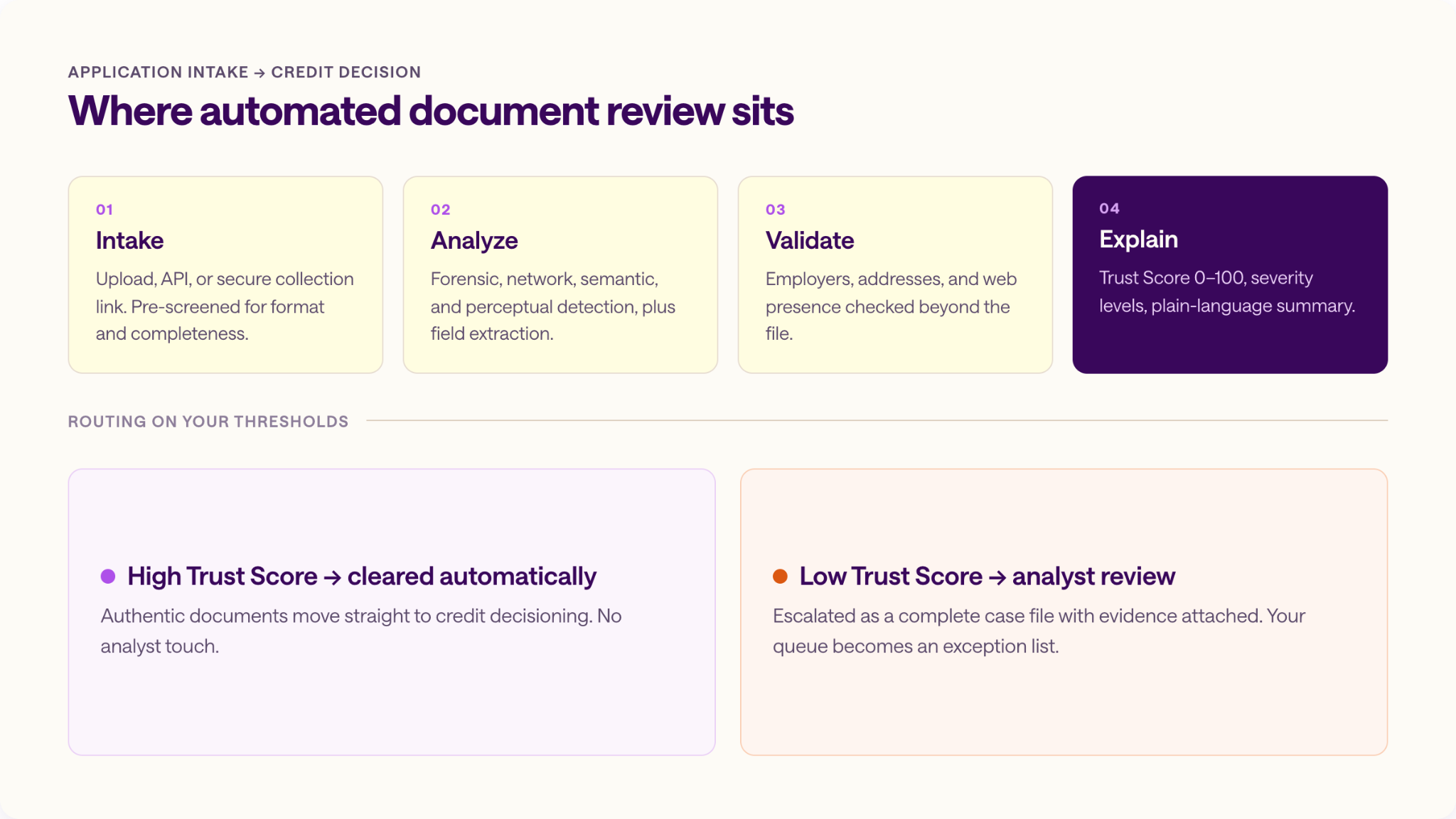
Routing is where the operational gains land. Low-risk documents clear automatically through approval routing you configure, and high-risk files reach analysts as complete case files with the evidence attached. Exception handling stays yours to define: set Trust Score thresholds, decide what escalates, and let your team prioritize the files that warrant judgment, so analysts focus their expertise where it matters. Your queue stops being a backlog and starts being an exception list.
The shift is measurable in analyst time.
What results do lenders see from automated document review?
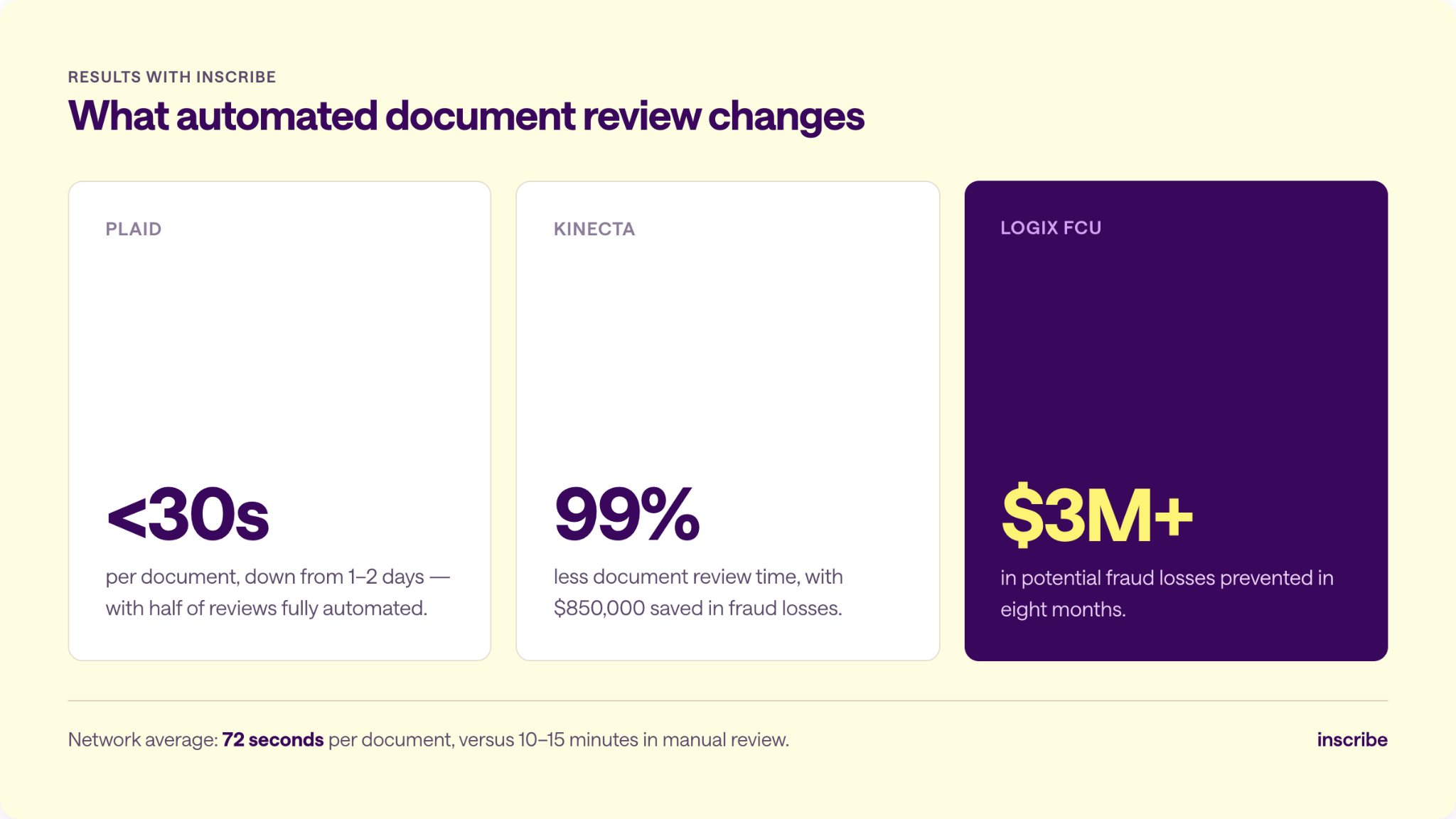
Inscribe customers report steps that took days clearing in seconds, with half or more of reviews fully automated and manual review time cut by 90% or more. Plaid routes uploaded documents through Inscribe inside its income verification product and cut document review from one to two days to under 30 seconds per document in that workflow and automated half of reviews, so the lenders on its platform get cleared documents in seconds instead of days. Kinecta reduced document review time by 99% while saving $850,000 in fraud losses. Logix Federal Credit Union prevented more than $3 million in potential fraud losses in eight months.
The pattern across all of them: the gaps manual review leaves at volume get closed, authentic applicants move faster, analysts manage real exceptions instead of clearing queues, and the decisions that reach auditors come with evidence attached.
Ready to automate underwriting document review?
Inscribe automates underwriting document review with AI agents that verify each borrower document is authentic, extract its data, and explain every decision, so approvals speed up without loosening scrutiny.
👉 Explore the Demo Center
👉 Go broader with loan underwriting
👉 See what your reviewers are up against in the 2026 Document Fraud Report
Frequently Asked Questions

Underwriting document review automation is software that classifies, verifies, and extracts data from loan application documents, clearing authentic files automatically and routing only exceptions to human review. Inscribe adds fraud detection at the front of that flow, so every pay stub, bank statement, and tax form is confirmed authentic before its data is trusted.
Rules-based automation applies predefined rules: match a template, read the fields, flag outliers. AI agents adapt to each document, investigate further when something looks off, and explain what triggered concern in plain language. The difference matters because borrower documents vary endlessly and modern fraud is engineered to pass fixed checks, with clean math, correct formatting, and evidence that hides in metadata and cross-document contradictions.
Yes, when verification comes before extraction. Inscribe automates underwriting document review with AI agents that verify each borrower document is authentic before its data is used, running forensic, network, semantic, and perceptual detection to catch edited, template-generated, and AI-fabricated documents that look clean to the eye and to field-level rules.
Pay stubs, bank statements, W-2s, 1099s, tax returns, business financials such as P&Ls, employment verification letters, IDs, and proof of address, arriving as true PDFs, scans, or phone photos. Inscribe reviews each document individually and corroborates details across the whole application file, which is where fraud most often comes apart.
No, and human judgment stays essential. The working framework: automation handles volume, pattern detection, and routine clearing, while underwriters and analysts handle exceptions, ambiguity, and judgment, starting from a plain-language summary of the evidence instead of a blank file. Complex, high-risk, and low-confidence cases still route to a person.
Inscribe returns results in about 72 seconds per document on average across its network, against 10-15 minutes per document in manual review. High-volume integrations run faster still: in Plaid’s income verification workflow, responses come back in under 30 seconds per document.
Yes, when every decision is explained. In compliance contexts, what matters is traceability: why a document cleared, what was flagged, and on what evidence. Inscribe returns a Trust Score, severity levels, and a plain-language rationale for each document, producing consistent, loggable evidence for internal audit, examiner review, and the Bank Secrecy Act recordkeeping standards FinCEN and the federal banking regulators hold lenders to. Inscribe is SOC 2 Type II and ISO 27001 certified.
Most lenders integrate Inscribe’s REST API and webhooks with existing systems such as a loan origination system or onboarding flow, define Trust Score thresholds for automatic clearing, routing, and escalation, and fold reviewer training into rollout, all without heavy engineering resources. The same setup gives stakeholders across credit, risk, and compliance one consistent view of document decisions. Documents can also be requested through Secure Document Collection for a cleaner chain of custody; technical documentation is at docs.inscribe.ai.
The best fit verifies documents are authentic before extracting their data, explains every flag in plain language, and returns results fast enough for same-day decisions. Inscribe automates underwriting document review with AI agents trained on millions of financial documents, has been purpose-built for document risk screening since 2017, and is SOC 2 Type II and ISO 27001 certified.
About the author
Stephanie Spangler is the Head of Product Marketing at Inscribe, where she covers AI-powered fraud detection, document risk, and how financial institutions are adopting agentic AI. She writes on the intersection of product and practice — translating what fraud detection technology does into what it means for the risk teams using it.
Learn More
Dive deeper into our Solutions


What will our AI Agents find in your documents?
Start your free trial to catch more fraud, faster.