
Fraud-aware intelligent document processing for loan applications
Table of Contents
[ show ]- Loading table of contents...


Fraud-aware intelligent document processing (IDP) is document automation that classifies a loan document, extracts its data, and verifies that the document is authentic in the same pass, so the data reaching your loan origination system comes from documents you can trust. Standard IDP platforms typically measure how accurately the data extracted matches the document, and they can pass a fabricated file as cleanly as a real one. Roughly 1 in 16 documents (about 6%) processed across Inscribe's network in 2025 showed signs of fraud, and the 2026 Document Fraud Report found that 1 in 5 flagged documents was built from a purchased template, up from 1 in 14 in 2024. Those are often the files that extract cleanest.
Inscribe is fraud-aware intelligent document processing for loan applications: AI agents that classify, extract, and verify every borrower document in a single pass, so the data entering your loan origination system comes from documents you know are authentic.
Purpose-built for document risk screening since 2017 and trusted by leading banks, credit unions, and fintechs, Inscribe returns extracted data, a Trust Score, and a plain-language explanation in about 72 seconds per document. See it in the Demo Center.
What is fraud-aware intelligent document processing for loan applications?
Fraud-aware IDP treats a document's authenticity as an output alongside its type and its data. Conventional IDP, the category analyst firms such as Everest Group track, is defined by four steps: capture, classify, extract, validate. In practice that means document intake and document sorting, data extraction with optical character recognition and natural language processing, and validation rules that check the structured data. Fraud-aware, AI-driven document processing adds a fifth question, is this document real, and answers it with evidence: how the file was made, whether its template has been seen before, whether its story holds together across the loan file, and whether its pixels show editing or generation.
Which types of IDP vendors do lenders evaluate?
Lenders evaluating intelligent document processing technology typically see four vendor types.
Why doesn't IDP built for accounts payable catch fraudulent loan documents?
Standard IDP typically misses fraudulent loan documents because its accuracy is measured against the document, and a fraudulent document is designed to be internally consistent. Most intelligent document processing technology grew up in accounts payable and invoice processing, paired with robotic process automation in an intelligent automation stack, where the goal is fewer errors and less manual data entry on documents nobody fakes. Loan processing inverts that assumption, because extraction accuracy improves when a document is clean and machine-readable, and fabricated documents can be exactly that: AI-generated document fraud, still under 5% of fraudulent documents, grew nearly fivefold in monthly volume between April and December 2025. 91.2% of altered documents include edits to financial details such as pay rates, deposits, and balances, the fields an extraction pipeline is tuned to read. A clean extraction of an edited balance is a precise copy of a false number.
Jessica Lara, Risk Operation Analyst on Inscribe's in-house risk operations team, sees it daily:
"The most troubling documents I come across are not the ones generated using AI from scratch, but legitimate documents that fraudsters then use AI to alter. In terms of formatting and visual characteristics, everything for the most part looks perfect and as expected, which makes them difficult to catch if you're just relying on your eye."
How does Inscribe process a loan application?
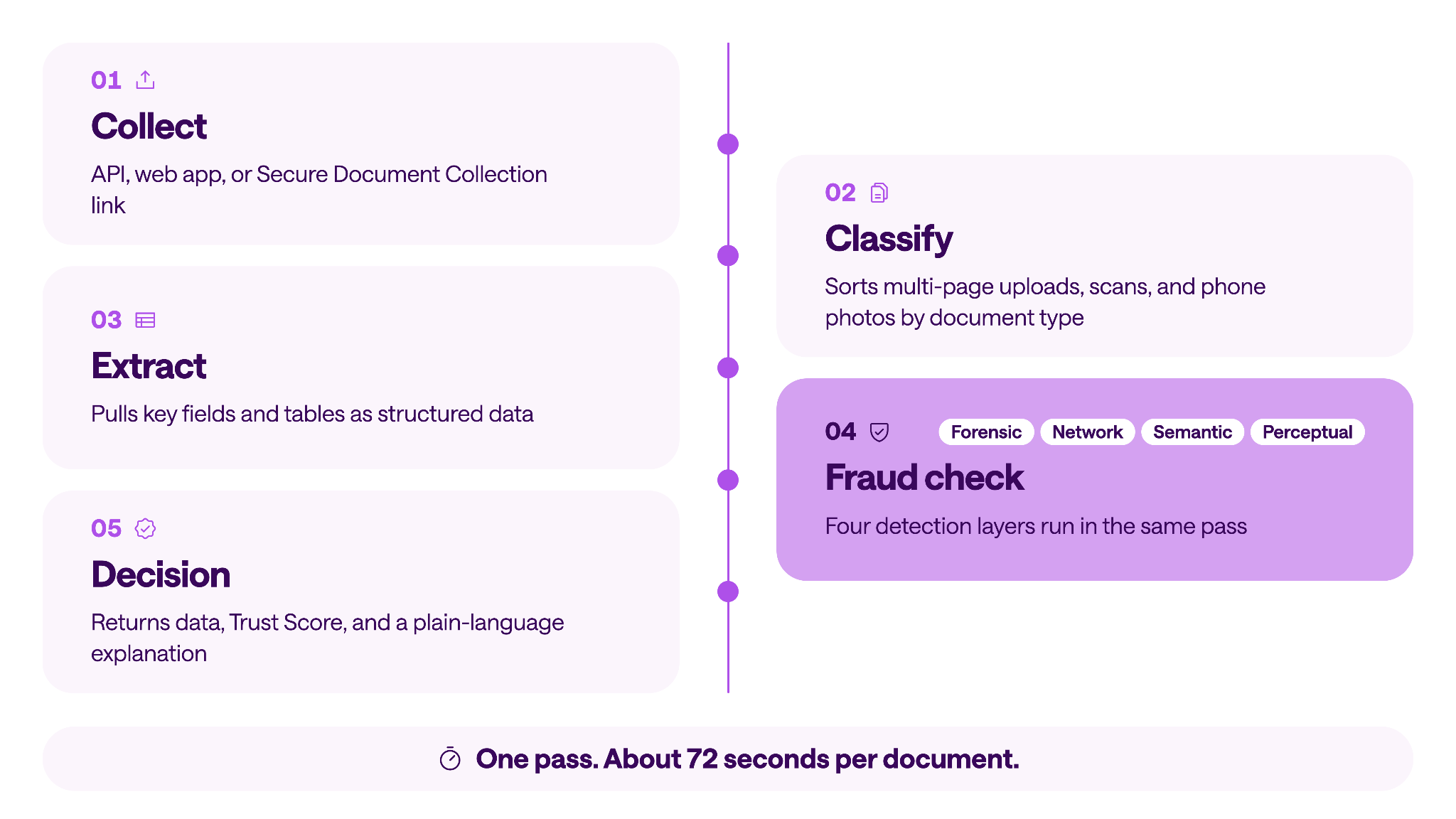
Inscribe processes a loan application in five steps and returns, for every document, its type, its data extracted as structured data, a Trust Score from 0 to 100, and the evidence behind it.
- Collect. Document intake runs by API, the web app, or a Secure Document Collection link that replaces email attachments with a clean chain of custody.
- Classify. AI agents trained on millions of financial documents sort multi-page uploads, scans of paper documents, and phone photos by document type. Documents vary by issuer, so document sorting is learned from the documents themselves.
- Extract. LLM-based parsing pulls key data fields and tables in context from structured and unstructured documents; the Bank Statement Analyzer turns a cleared statement into usable data for underwriting.
- Fraud check. Four detection layers run on the same pass: forensic (metadata, fonts, file history), network (patterns from tens of millions of documents that expose recycled templates), semantic (whether the story adds up), and perceptual (pixel-level edits and generation artifacts). Agents then corroborate across the loan file: does the employer on the pay stub deposit into the account on the statement.
- Decision. The REST API returns extracted fields, Trust Score, severity levels, and a plain-language summary, with webhooks for real-time events, documented at docs.inscribe.ai. Every decision is logged with its evidence.
Agents learn from your analysts' in-app feedback and from Inscribe's risk operations team, so detection keeps pace without a rules library to maintain.
Which loan application documents does fraud-aware IDP handle?
Fraud-aware loan document processing handles the full document mix in a loan file, and document complexity ranges from a one-page pay stub to a 40-page business bank statement.
Bank statements get the deepest scrutiny because 85.6% of the 90 fraud and risk leaders surveyed for the 2026 report named them the document type most vulnerable to manipulation. Tax documents and bank records are corroborated against pay stubs, because income is the data point credit reports do not carry, and identity verification runs in the same pass, so customer onboarding and lending share one workflow. Proof of income fraud detection for lenders goes deeper on income documents.
Does fraud-aware IDP change by loan type, from consumer loans to mortgage origination?
The document mix changes by loan type; the verification does not. Consumer loans and personal loans lean on pay stubs, bank statements, and IDs; business lending adds P&Ls; mortgage origination brings the largest loan file, with tax returns and asset statements across months. Inscribe classifies documents and verifies them the same way in every lane, so lenders automate one workflow.
Why use Inscribe if you already run an IDP or document automation platform?
You keep the IDP platform. Inscribe adds the verification layer it lacks, and your workflow automation stays where it is; what changes is whether the data moving through it can be trusted.
How does a verification gate work?
Your IDP platform or LOS calls Inscribe's API as documents arrive. Inscribe returns a Trust Score and findings, your pipeline extracts and routes as before, and documents below your threshold stop before their data reaches the loan record. Plaid runs this pattern at scale inside its income verification product.
When does Inscribe become the financial document engine?
When bank statements, pay stubs, tax documents, and business financials carry most of the risk. Inscribe handles extraction and verification for those, and your IDP platform keeps the contracts, disclosures, and closing packages it is built for, which removes a duplicated extraction step.
How does Inscribe run inside the LOS?
Partner integrations with loan origination systems and orchestration platforms put results where underwriters and operations teams already work, with routing on Trust Score thresholds you define. ==[Confirm whether any LOS or orchestration partners can be named.]== Inscribe is scoped to the financial and identity documents that decide whether a loan gets made, where a verification error costs the loan itself.
What results do lenders see from fraud-aware intelligent document processing?
Lenders see manual document review fall by 90% or more and fraud losses stopped before funding. BHG Financial reduced manual document review time by more than 90%, according to Michael Coomer, Director of Fraud Management. Plaid receives a decision on each submitted document in under 30 seconds. Kinecta Federal Credit Union prevented $850,000 in potential fraud losses and reduced document review time by 99%, according to Jorge Cortes, Vice President, Enterprise Risk Management. Logix Federal Credit Union saw potential loan fraud savings of over $3 million in eight months, according to Matt Overin, Manager, Fraud Risk Management. BCU has prevented $80 million in losses with Inscribe, including $5.6 million from altered documents in the first nine months of 2025, according to Nickie Christianson, Senior Manager, Account Protection Team.
How do fewer errors improve customer satisfaction?
Authentic documents clear straight through, so processing speed rises without added manual effort and applicants stop being asked to resubmit. Manual data entry is where most loan processing errors enter the loan file; automated document processing removes that step, and human review starts from a case file with evidence attached. Operational efficiency, lower operational costs, and credit decisions made on data quality you can defend arrive together.
How should lenders evaluate intelligent document processing for loan applications?
Evaluate IDP for lending on whether it can tell you a document is real as well as what it says, and on whether its outputs hold up under examination.
Is authenticity an output?
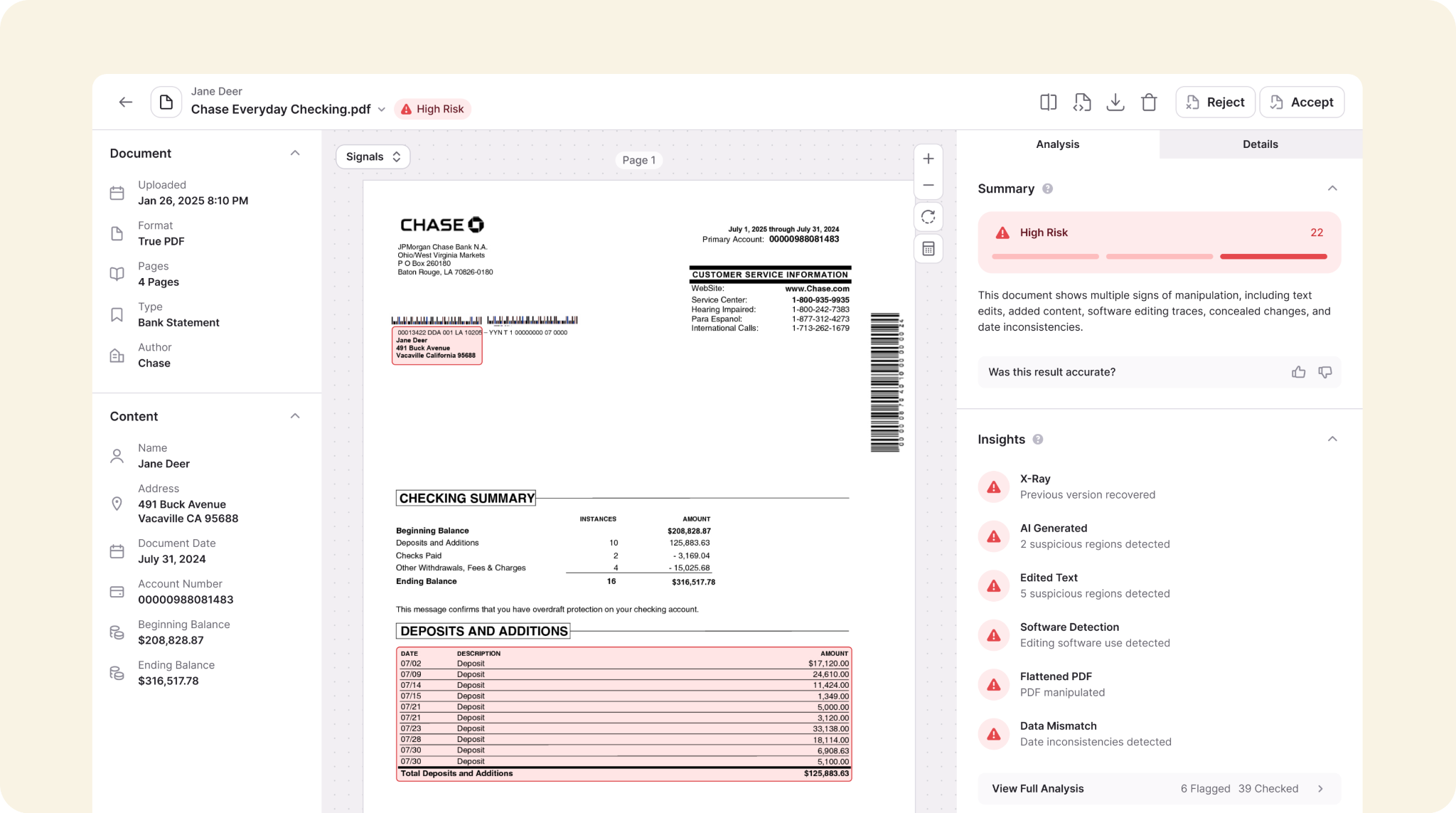
Ask for the field. An AI document processing platform that returns type, data, and confidence with no authenticity score is a reading tool.
Is it trained on financial documents?
Bank statements, pay stubs, and tax forms are where lending fraud concentrates. Confirm the models were trained on them. Inscribe's agents are trained on millions of financial documents and compare each file against tens of millions of documents.
Does it hold up for regulatory compliance?
Under the Equal Credit Opportunity Act and Regulation B, the CFPB requires creditors to state the specific principal reasons for adverse action, so if a flagged document contributes to a denial you need a reason you can state, and OCC, FDIC, and NCUA examiners expect a traceable record of why a document was accepted or declined. A plain-language rationale per document, with audit trails and compliance reports from the same log, is the deliverable.
Who controls exception routing?
You should. Which Trust Scores clear automatically, which route to an analyst for human review, and which escalate are policy decisions your team sets and the system enforces.
Does integration need a project?
It should not. Look for a REST API, webhooks, and partner integrations with your LOS, so the financial operations team sees results in the systems it already uses.
How are security and provenance handled?
Loan documents are sensitive data, and financial institutions answer for how they are handled. Confirm SOC 2 Type II and ISO 27001 certification and retention and deletion controls.
Ready to process loan applications with fraud-aware IDP?
Inscribe is fraud-aware intelligent document processing for loan applications: AI agents that classify, extract, and verify every borrower document in a single pass, so your loan origination system runs on data from documents you know are authentic.
👉 Explore the Demo Center
👉 See how the results get reviewed with underwriting document review automation
👉 See what your pipeline is up against in the 2026 Document Fraud Report
Frequently asked questions about fraud-aware intelligent document processing

OCR converts an image to text. Standard IDP adds classification, data extraction, and validation rules. Fraud-aware IDP adds authenticity: forensic, network, semantic, and perceptual checks that establish whether the document is real, plus cross-document checks across the loan file. The difference is in how intelligent document processing treats the document: as data to read, or as evidence to verify.
Yes. Bank statements, pay stubs, tax documents including W-2s, 1099s, and tax returns, business financials such as P&Ls, identity documents, proof of address, and employment letters, as PDFs, scans, or phone photos. Each is classified, extracted, verified, and corroborated against the rest of the loan file.
Yes, when every result carries a rationale. Inscribe returns a Trust Score, severity levels, and a plain-language explanation for each document: loggable evidence for internal audit, examiners, and the specific-reason requirement for adverse action under the CFPB's Regulation B.
Processing time is about 72 seconds per document on average across Inscribe's network, compared with 10-15 minutes in manual review, with classification, extraction, verification, and explanation all returned in that window.
About the author
Stephanie Spangler is the Head of Product Marketing at Inscribe, where she covers AI-powered fraud detection, document risk, and how financial institutions are adopting agentic AI. She writes on the intersection of product and practice — translating what fraud detection technology does into what it means for the risk teams using it.
Learn More
Dive deeper into our Solutions


What will our AI Agents find in your documents?
Start your free trial to catch more fraud, faster.


