

AI fraud detection for lenders: Stop document fraud before a loan is funded
Table of Contents
[ show ]- Loading table of contents...


AI fraud detection for lenders uses machine learning, computer vision, and LLM-based analysis to catch fraudulent documents and risky applicants during onboarding and underwriting, before a lending decision is made. Most fraud platforms monitor transactions after money moves. Inscribe's AI agents investigate the documents behind every lending decision, at onboarding and underwriting, before a loan is funded. They analyze bank statements, pay stubs, tax forms, and business financials the way an experienced fraud analyst would, then explain exactly what they found and why it matters.
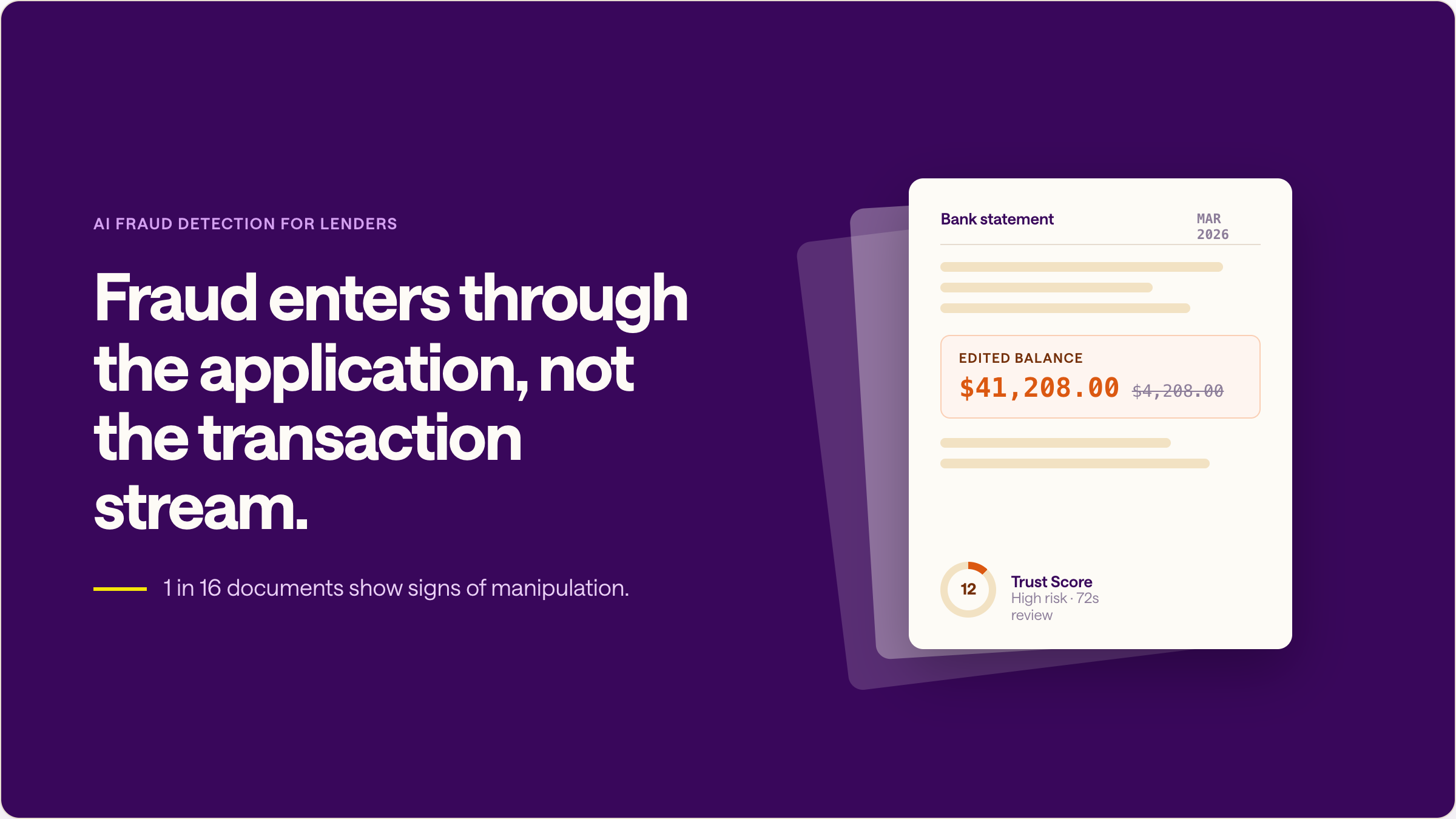
When lenders hear "AI fraud detection," most picture transaction monitoring: models watching payments for anomalies after an account is open and money is moving. That layer matters, but it misses where lending fraud actually starts. In Inscribe's 2026 Document Fraud Report, roughly 1 in 16 documents processed across the network showed signs of manipulation, fabrication, or misrepresentation, and 91.2% of altered documents contained edits to financial details like balances, deposits, and income. That fraud enters through the application, not the transaction stream.
Inscribe has been purpose-built for document risk screening since 2017, is trusted by leading banks, credit unions, fintechs, and lenders, and is SOC 2 Type II and ISO 27001 certified. Logix Federal Credit Union saved $3M+ in potential fraud losses. BCU prevented $5.6M. Below: how AI fraud detection platforms for lenders and financial institutions work, how they differ from transaction monitoring, and where Inscribe fits in your risk stack.
What makes document fraud detection different from transaction fraud detection?
Document fraud detection differs from transaction fraud detection in what it inspects, when it runs, and which fraud it catches. The two answer different questions. Transaction monitoring asks whether money movement looks abnormal for an account that already exists. Document fraud detection asks whether the evidence used to open that account or approve that loan was real in the first place.
The distinction matters for three reasons:
- Timing. Transaction monitoring is reactive by design. Its anomaly detection needs payment activity to analyze, separating legitimate transactions from suspicious ones, so it can only flag fraud after funds start moving, which for a lender often means after the loan is funded and the loss is already on the books. Document fraud detection runs at onboarding and underwriting, when you can still decline, escalate, or request more evidence.
- Signal source. Transaction models learn from payment behavior. Document fraud hides in the files themselves: metadata inconsistencies, font anomalies, template reuse, edited balances, and fabricated deposits. According to the 2026 Document Fraud Report, 85.6% of fraud and risk leaders name bank statements as the document type most vulnerable to manipulation, and 1 in 5 flagged documents in 2025 showed signs of template-based manipulation, up from 1 in 14 in 2024.
- Fraud type coverage. First-party fraud, income inflation, and synthetic identities supported by fabricated documents frequently pass identity checks and behave normally at the transaction level, at least at first. The share of documents with both identity and financial manipulation rose from 40.2% in 2024 to 59.8% in 2025, which means detection strategies anchored to a single signal type miss meaningful risk. Synthetic identity fraud and identity theft both tend to begin with a document, long before credit bureaus or transaction history show anything wrong.
.png)
Most loan fraud arrives inside the application file, before any payment activity exists for a monitoring system to analyze. In practice, lenders need both layers. Transaction monitoring protects funded accounts. Document fraud detection software protects the decision itself. Inscribe is built for the second job, and it feeds cleaner decisions into everything downstream.
.png)
AI fraud detection techniques: How Inscribe's AI Agents uncover hidden fraud patterns
The main AI fraud detection techniques for documents are forensic, network-based, semantic, and perceptual detection, run in layers so no single signal carries the decision. Modern AI fraud detection goes far beyond format checks and visual review. That shift is necessary because the fraud itself has changed. Detected AI-generated document fraud grew nearly fivefold between April and December 2025, and editable document templates now sell online for as little as $10, according to the 2026 Document Fraud Report. The pattern behind that growth, and where it goes next, is documented in the next wave of AI-generated document fraud. External forecasts point the same direction: Deloitte's Center for Financial Services projects that generative AI could push US fraud losses from $12.3 billion in 2023 to $40 billion by 2027. Surface-level review can no longer separate a real bank statement from a convincing fake, and fraud leaders know it: 97.8% report concern about AI-enabled document fraud. Modern AI systems answer with layered analysis, pairing machine learning algorithms and computer vision with natural language processing to read documents the way an investigator would.
Inscribe's AI Risk Agents apply four layered detection techniques to every document:
Forensic detection: structure, fonts, and metadata
Every document leaves a digital fingerprint. Forensic detectors analyze structure, fonts, metadata, creation tools, and file history to uncover tampering and synthetic files that pass manual review, establishing document authenticity from evidence rather than appearance. Document X-Ray reveals revision history signals, showing what changed, what was originally there, and when.
Network-based detection: template and pattern matching
Fraudsters reuse what works. Network detection compares each submission against Inscribe's library of genuine and fraudulent documents built from tens of millions of analyzed files, catching recycled templates, suspicious layouts, and repeat patterns across institutions. Because organized fraud rings run the same fraud schemes against many lenders at once, historical fraud data from across the network helps identify patterns and expose coordinated fraud no single institution can see alone.
Semantic detection: cross-document consistency
The story inside a document has to add up. Semantic analysis cross-checks names, addresses, employers, income figures, and transaction logic within and across documents to surface contradictions that a clean-looking file can hide.
Perceptual detection: pixel-level and AI-generation artifacts
Some edits only show at the pixel level. Perceptual detection examines documents for AI-generation artifacts, localized edits, and subtle visual inconsistencies, which is increasingly important as generative AI fraud improves. AI-edited documents, where fraudsters modify specific fields on an otherwise genuine file, currently pose the greater risk because most of the document is real. Regulators see the same shift: FinCEN's alert FIN-2024-Alert004 warns that fraudsters are using generative AI to create falsified documents that bypass identity verification, and reminds financial institutions of their reporting obligations under the Bank Secrecy Act (BSA).
These techniques run together on every submission, so detection does not depend on any single signal. If you want to see the layered analysis on a real bank statement, the Bank Statement Analyzer shows how the signals combine.
.png)
How do AI Agents apply to credit risk and underwriting?
AI agents apply to credit risk and underwriting by investigating every document in an application the way a fraud analyst would, then handing underwriters an explained, evidence-backed recommendation. That makes AI agents for fraud detection in financial services different from static models or rules engines. An agent works the way an analyst works: it reviews the document, decides what to investigate next based on what it finds, pulls in supporting evidence, and writes up its findings in plain language. The difference is that it does this in about 72 seconds instead of the 10–15 minutes a manual review takes.
Inside a lending workflow, that investigation follows four steps:
- Intake. The moment a document enters your workflow (via portal, email, web app, or API), Inscribe pre-screens it for format validity, completeness, and type accuracy.
- Analyze. LLMs identify the document type using generative AI document classification, then extract key fields and evaluate formatting, logic, and consistency. The document runs through the network, forensic, semantic, and perceptual detectors.
- Validate. Agents extend the investigation beyond the document: verifying employers, cross-checking addresses, confirming business registration and web presence, and linking external sources to the claims in the file.
- Explain. Findings are distilled into a Trust Score, severity levels, linked evidence, and a plain-language summary your underwriters, auditors, and regulators can follow.
For credit risk teams, the explanation step is the one that changes daily work. A flag without evidence creates another queue. A reasoned recommendation with linked signals lets an underwriter clear a file in minutes, escalate with confidence, or decline with documentation that holds up in audit. You can watch a full investigation in the Agentic Fraud Detection demo, and the engineering behind it is covered in a case study on the AWS Machine Learning Blog.
What are the tenefits of AI in fraud detection for lenders?
The benefits of AI in fraud detection for lenders show up in three places every lending team measures: losses, operating cost, and speed to decision.
- Catch fraud manual review misses. As document quality improves, meaningful fraud signals move below the surface, into metadata, internal logic, and cross-document patterns that reviewers cannot see. Inscribe detects manipulation that is invisible to the human eye, including AI-generated and template-based fraud.
- Cut manual review by up to 90%. Inscribe automates document parsing, classification, verification, and research tasks. Institutions in the 2026 Document Fraud Report describe spending 60–90 minutes per application on document review before automation. At 45 minutes per document and 200 daily applications, that is roughly 150 analyst-hours per day on document checks alone. Automating routine document verification frees analysts for complex investigations.
- Approve good customers faster. Speed is a competitive variable in lending. When verification takes days, the best applicants go elsewhere and adverse selection sets in. Reviews that complete in about 72 seconds keep same-day decisioning realistic.
- Make every decision defensible. Consistent scoring, linked evidence, and plain-language rationale support regulatory compliance across KYC, KYB, anti-money laundering (AML), and fair lending documentation requirements, so risk teams act with certainty instead of gut instinct.
- Adapt to evolving fraud tactics. Agents improve through analyst feedback and training from Inscribe's in-house Risk Ops team, and network detection means a fraud technique seen anywhere strengthens defenses everywhere. The 2026 Document Fraud Report tracks the emerging fraud trends this feedback loop is built to catch.
What are the AI banking fraud detection capabilities across onboarding and underwriting?
AI banking fraud detection capabilities apply anywhere a document is used to establish trust. Fraud pressure is broadly distributed: most document types used to verify critical facts show baseline fraud rates in the 4–7% range. These are the workflows where document fraud occurs and where lenders and financial institutions deploy Inscribe:
Consumer lending: income and affordability verification
Verify bank statements and pay stubs during origination so approvals rest on real financial data. Inscribe surfaces inflated income, fabricated deposits, inconsistent pay cadence, and mismatched employer details before approval. The same checks apply across the lending industry, from personal loans to mortgage lending, where mortgage fraud often hinges on altered bank statements and inflated income documents. For teams focused on statements specifically, bank statement analysis software covers this workflow in depth.
Business and SMB underwriting: financials and multi-month statements
Validate business financials, P&Ls, and multi-month statement sets at scale. Agents flag inconsistencies across pages and documents, selective omissions, and signs of fabrication, while keeping review standards consistent across underwriters.
KYB and KYC onboarding: business registrations and identity documents
Authenticate identity verification documents, business registrations, and supporting financials during onboarding, strengthening synthetic identity detection by testing whether the documents behind a new identity hold up. Agents run real-time KYB checks: incorporation status, Secretary of State records, web presence, and adverse media, enriched with what they found in the documents.
Equipment financing and specialty lending: invoices, quotes, and template reuse
Confirm invoices, quotes, and business documents where small edits materially change deal value, and catch template reuse across applications and dealers.
Banks and credit unions: branch, online, and indirect channels
Apply consistent document scrutiny across branch, online, and indirect channels, adding a layer of banking fraud protection without member friction. More context is available for banks and credit unions, and for detecting specific document types like fake bank statements.
.png)
How does AI-powered fraud detection compare to traditional methods?
AI-powered fraud detection outperforms traditional methods on speed, consistency, adaptability, and depth of evidence, and the gap widens as fraud tooling improves. Most lenders still run traditional fraud detection: manual review, static rule-based systems, and identity verification checks. Here is how AI-powered fraud detection compares with traditional methods on the dimensions that decide outcomes:
- Manual review takes 10–15 minutes per document, varies by reviewer experience and fatigue, and breaks down as volume grows. It also depends on visual inspection at the exact moment visual quality stopped being a reliable signal. AI agents apply the same forensic depth to every document in seconds, with no drift between reviewers.
- Rules-based systems catch known patterns but cannot adapt. Fraudsters test which templates pass, then scale what works; a static rule set is a fixed target. Unlike static rules, agentic detection adapts to what it finds in each document and learns from every confirmed case across the network.
- Identity-only verification confirms who the applicant is, not whether their bank statement is real. Someone can pass a selfie-to-ID match and still submit a fabricated statement. Document-level detection closes that gap.
The pattern across all three: traditional systems inspect the surface, and AI fraud detection systems investigate the substance. The 2026 Document Fraud Report puts it plainly: detection strategies that depend primarily on appearance or manual inspection are increasingly fragile in an AI-assisted environment.
Do AI fraud detection tools reduce false positives?
Static rules create a second problem beyond missed fraud: excessive false positives. Legitimate documents get flagged, review queues swell, and analysts lose time that belongs to genuine fraud cases. Because AI agents weigh dozens of signals and support dynamic risk scoring instead of fixed thresholds, they raise detection accuracy while routing fewer clean files to review. High-risk or low-confidence documents still go to human analysts automatically, so human oversight stays where judgment matters most instead of relying solely on automation.
WhatcCategories of AI fraud detection tools do lenders evaluate?
Lenders evaluating AI fraud detection tools typically choose across four categories, each covering a different slice of risk. Most institutions end up running more than one.
- Identity verification and KYC platforms such as Jumio, Sumsub, and Trulioo confirm that an applicant is who they claim to be, using document-based ID checks, biometrics, and database verification.
- Onboarding and decisioning orchestration platforms such as Alloy connect identity and risk data sources and route applications through configurable decisioning policies.
- Transaction and payment fraud monitoring platforms such as Feedzai, NICE Actimize, and SAS analyze money movement on funded accounts, scoring payments and managing fraud cases across the customer lifecycle.
- Document fraud detection platforms analyze the financial documents inside an application (bank statements, pay stubs, tax forms, business financials) for tampering, fabrication, and AI generation. This is Inscribe's category, and it is the only one of the four focused on whether the evidence behind a lending decision is real.
The categories are complementary rather than competing: identity tools verify the person, orchestration tools route the decision, transaction tools watch the money, and document tools verify the evidence.
Where does Inscribe fit in your fraud prevention stack?
Inscribe fits into your fraud prevention stack as the document intelligence layer: it runs earliest in the funnel, at application and onboarding, and feeds cleaner inputs to every system downstream. It does not replace horizontal enterprise fraud platforms; most Inscribe customers run both.
Horizontal platforms are built around who the customer is and how their money behaves. None of them performs deep forensic analysis on the financial documents inside a lending application, and that is the layer Inscribe adds. Here is how the two compare side by side:
.png)
What lenders and financial institutions achieve with Inscribe
The clearest evidence for AI fraud detection tools for financial services is what risk teams report after deployment:
- Logix Federal Credit Union saved more than $3M in potential fraud losses with automated document fraud detection.
- BCU prevented $5.6M in losses.
- BHG Financial replaced manual fraud detection with a scalable, transparent system.
“We use several systems and processes to vet our incoming members. When we get alerts from initial checks, that leads us down the path of requesting more documentation such as utility bills or lease agreements to verify proof of residence. We can stop the fraud from even getting in the front door.”
Matt Overin, Manager of Risk Management, Logix Federal Credit Union
“You can’t see previous versions with the human eye. There’s no manual process that compares to what Inscribe uncovers.”
Michael Coomer, Director of Fraud Management, BHG Financial
Speed gains compound the loss prevention. Underwriters interviewed for the 2026 Document Fraud Report describe document reviews that once took an hour or more per customer now running automated, with same-day decisioning on the majority of applications.
.png)
How do you choose the best AI tools for banking fraud detection?
You choose the best AI tools for banking fraud detection by testing candidates against your document mix, your review model, and your existing risk stack. As you evaluate fraud detection software for lenders, five criteria determine how much fraud risk a platform actually removes:
- Depth on financial documents. Bank statements, pay stubs, tax forms, and business financials carry the risk in lending. Confirm the platform performs forensic analysis on these document types rather than limiting itself to identity documents or data extraction.
- Evidence, not just alerts. Every flag should come with linked signals and a plain-language explanation your team can act on and defend in audit.
- Agentic investigation. Look for AI that adapts its analysis to what it finds and validates claims against external sources, rather than running a fixed checklist.
- Proven detection of AI-generated fraud. With detected AI-generated document fraud up nearly fivefold between April and December 2025, ask vendors to demonstrate detection of synthetic and AI-edited documents specifically.
- Integration and governance. API-first integration, webhook workflows, configurable routing, and certifications like SOC 2 Type II and ISO 27001 determine whether the tool can prevent fraud in live production environments, at your volumes.
Ready to detect document fraud before the loan is funded?
Stop fraud at the decision, before money moves.
👉 Explore the Demo Center
👉 Get started with your free trial
👉 Detect document fraud with Inscribe's Agentic AI
Frequently Asked Questions
FAQ

AI fraud detection for lenders uses machine learning, computer vision, and LLM-based analysis to identify fraudulent documents and risky applicants during onboarding and underwriting. Most fraud platforms monitor transactions after money moves; Inscribe's AI agents investigate the documents behind every lending decision before a loan is funded, returning a Trust Score, linked evidence, and a plain-language explanation in about 72 seconds.
Document fraud detection verifies that the evidence behind a decision (bank statements, pay stubs, tax forms) is authentic, and it runs before approval. Transaction fraud detection monitors money movement on accounts that already exist, so it flags fraud after funds are at risk. Lenders typically need both: transaction monitoring for funded accounts and document detection to protect the underwriting decision itself.
The main benefits of AI in fraud detection are catching manipulation invisible to manual review, reducing review time from 10–15 minutes to roughly 72 seconds per document, cutting manual review workload by up to 90%, keeping decisions consistent across reviewers, and producing audit-ready evidence for every flag. For lenders, faster verification also means approving good customers before competitors do.
AI agents review each document the way a fraud analyst would: pre-screening at intake, extracting and analyzing fields with LLMs, running layered fraud detectors, then validating claims against external sources like employer records and business registries. The agent adapts its investigation to what it finds and explains every conclusion. You can see the workflow in Inscribe's Agentic AI demo.
No. Horizontal enterprise fraud platforms monitor transactions and manage cases across the customer lifecycle. Inscribe is the document intelligence layer that runs earlier, at onboarding and underwriting, and feeds those systems cleaner inputs. Most Inscribe customers run both, integrating results through Inscribe's API.
Evaluate AI fraud detection platforms for lenders and financial institutions on five criteria: forensic depth on financial documents, evidence-backed explanations rather than opaque flags, agentic investigation that validates external claims, demonstrated detection of AI-generated and AI-edited documents, and production readiness (API-first integration, SOC 2 Type II and ISO 27001 certification).
Yes. AI-generated documents leave artifacts that layered detection can surface: generation-tool metadata, pixel-level inconsistencies, template patterns, and internal logic errors. Detected AI-generated document fraud grew nearly fivefold across Inscribe's network from April to December 2025, a shift traced in from forgeries to deepfakes, and Inscribe added new detectors during the year as generative AI models changed their output. AI-edited documents, where real files are selectively modified, are caught through the same forensic and semantic signals.
Implementation is typically measured in weeks. Inscribe is API-first with REST endpoints, webhook support, and structured outputs that flow into existing decisioning and case management systems. Documents can also be submitted through the dashboard or secure collection links while engineering integration is underway. Technical documentation is available at docs.inscribe.ai.
Document fraud is growing because the barrier to entry has collapsed: editable templates sell online for as little as $10, and generative tools can produce or alter a convincing document in seconds. In 2025, 1 in 5 flagged documents across Inscribe's network showed template-based manipulation, up from 1 in 14 the year before, and the fraud spans every document type lenders rely on.
Yes, and it is the only approach that scales with them. Artificial intelligence applies forensic depth at the speed and volume modern fraud operates at, learns from every new scheme seen across the network, and gains new detectors as generative tools change their output. Static defenses degrade as fraud evolves; agentic systems improve.
About the author
Conor Burke is the co-founder and CTO of Inscribe, where he leads the AI and engineering systems behind the platform's document fraud detection capabilities. He writes and speaks on the technical mechanics of fraud detection — how LLMs reason, where rules-based systems break down, and what it actually takes to build AI that explains itself.
What will our AI Agents find in your documents?
Start your free trial to catch more fraud, faster.