
AI Document Detector: How to Catch Fraud Before It Costs You
Table of Contents
[ show ]- Loading table of contents...


Document fraud is one of the fastest-growing forms of financial crime, and the methods are getting harder to spot. Fraudsters now use AI systems, editable templates, and consumer editing tools like Photoshop and Word to produce fake documents that survive visual inspection: bank statements with altered balances, doctored pay stubs, falsified tax returns, and forged identity documents. These fraudulent activities happen at scale. By the time your team catches the problem, the fraud losses and reputational damage are already locked in.
The financial stakes are not abstract. Document fraud costs organizations worldwide an estimated 5% of annual revenues, and the banking and financial services sectors are the most targeted industries. For individual cases, the average loss from a missed fraudulent document reaches $85,000.
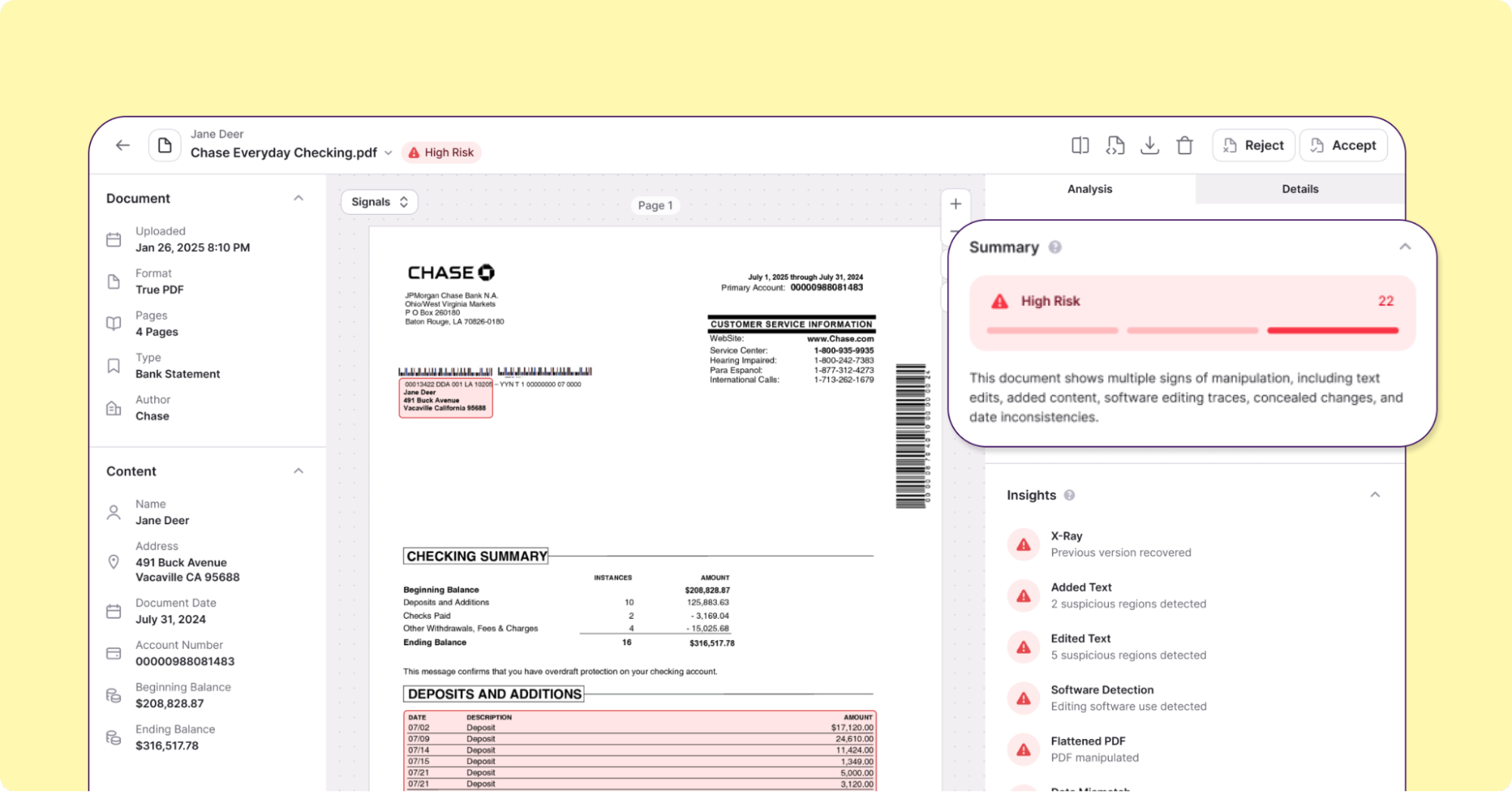
Inscribe is an AI-powered document detector built to stop fraud at the file level. It applies tamper detection, metadata analysis, image manipulation checks, and machine learning to catch fraudulent documents before they reach a decision point. Incoming documents are analyzed in about 72 seconds, and results are returned as a Trust Score, evidence signals, and plain-language summaries your team can act on and defend. Purpose-built for fraud detection since 2017, Inscribe is SOC 2 Type II and ISO 27001 certified.
Why Detecting Fraud in Documents Is Getting Harder
AI-generated and template-based document fraud is up 208%. But the challenge is not just volume. Fraudsters target high-value documents that unlock financial services, property access, or identity verification. They mix real and fake details across serial fraud attempts, pair stolen identities with false documents, and exploit the human eye's limits when reviewing large volumes of documents. Invoice fraud, fraudulent transactions, and identity-based fraud all depend on the same thing: fake or altered documents slipping past the front door.
The types of document fraud your team faces fall into a few patterns. Some involve altering real documents: changing names, dates, balances, or photos with editing software, or modifying a physical document and scanning it to hide the evidence (pre-digital document modification). Others are built from scratch using editable templates downloaded from the internet. Some schemes are automated, with bots or scaled human efforts exploiting the same weakness across dozens of submissions. And identity-based fraud often combines identity theft with synthetic identity fraud, blending stolen personal data with fabricated details to create entirely new synthetic identities.
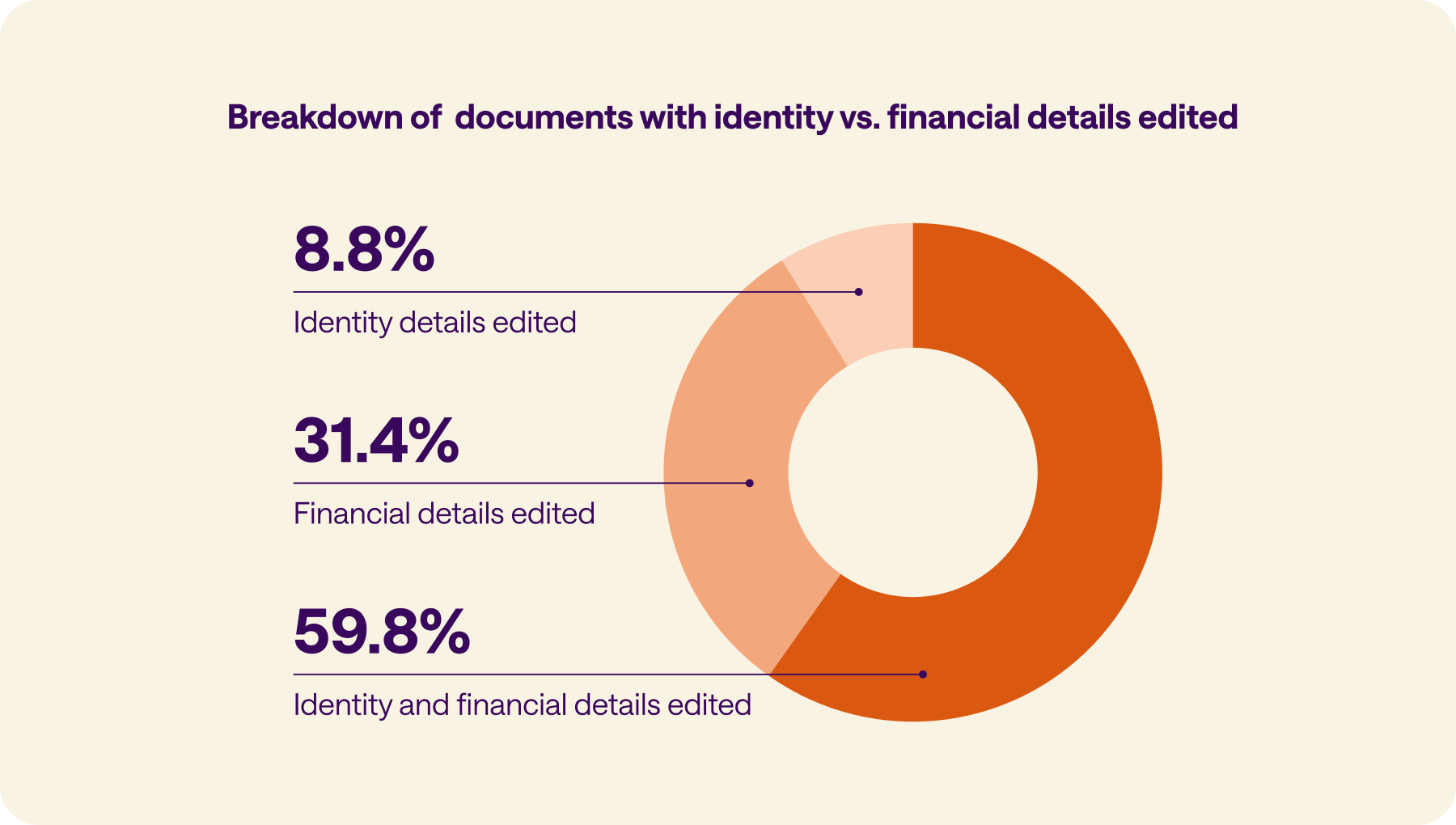
All of these depend on fraudulent files entering your workflow unchecked. The 2026 Document Fraud Report covers the latest tactics in detail.
How Inscribe's Document Detector Works
Inscribe layers multiple fraud detection methods into a single screening pipeline. Combining checks for image manipulation with rule-based data cross-checks produces more accurate results than any single method alone. Advanced AI also analyzes the context and meaning of content within documents, improving classification accuracy beyond what pattern matching can achieve.
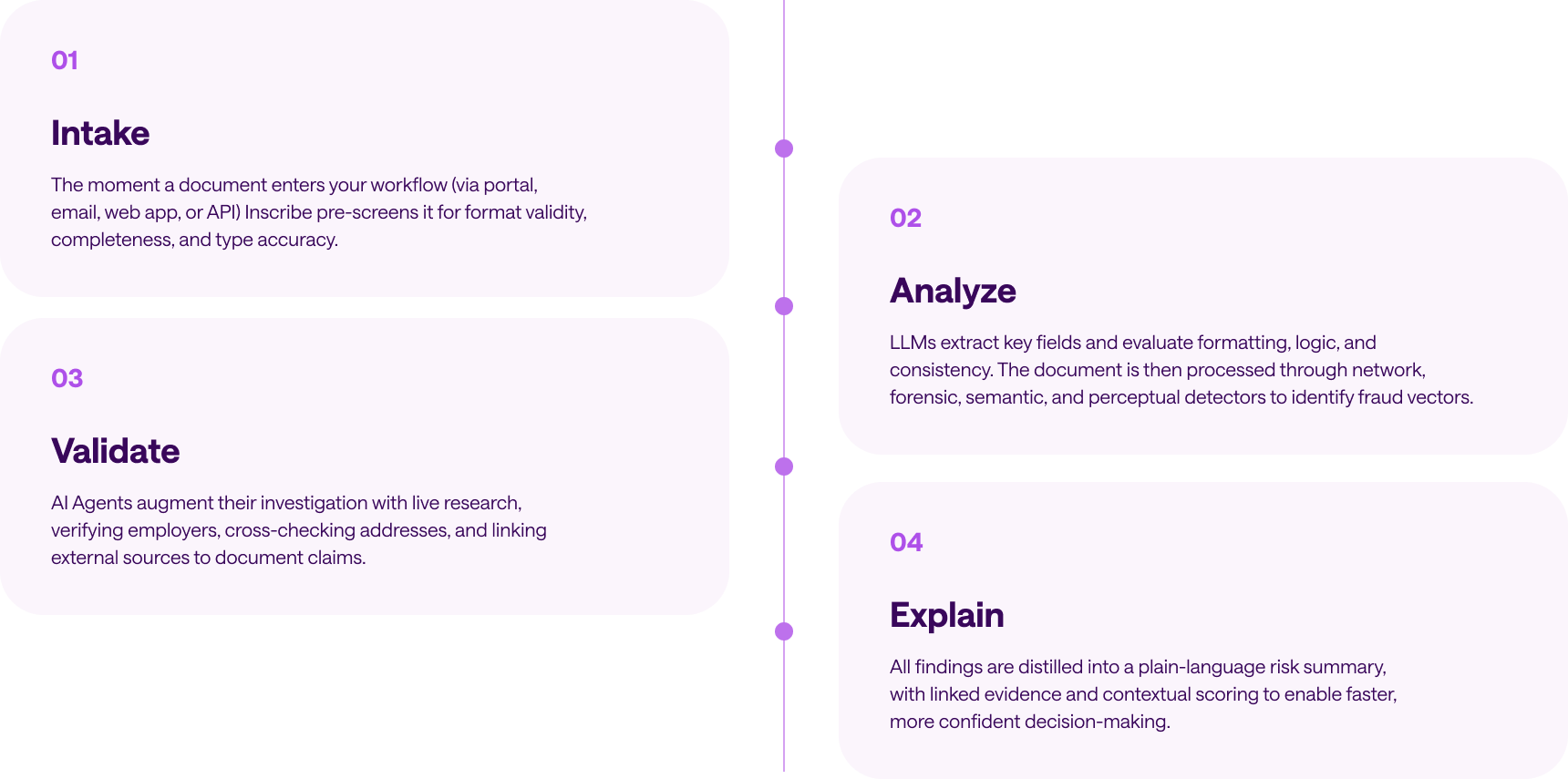
Every document moves through four steps:
- Submit. Documents enter via API, portal, email, or Secure Document Collection. Capture-quality checks flag blur, glare, and missing pages to reduce rework.
- Extract and parse. Optical character recognition (OCR) converts scanned images of text into machine-readable characters. Machine learning then interprets key data from complex financial statements, utility bills, and multi-page layouts, feeding it into tamper detection and fraud analysis so false claims and manipulated values are caught in context.
- Validate and detect. Four detection layers run simultaneously: network comparison, forensic metadata analysis, semantic cross-referencing, and perceptual image manipulation analysis. This step surfaces signs of tampering, fabrication, and other fraud risks.
- Review and decide. Results include a Trust Score (0 to 100), severity levels, visual signals, and plain-language summaries. Average processing time is about 72 seconds per document.
This workflow supports both real-time detection for onboarding and batch processing for large volumes of historical documents.
Detection Layers
Each layer targets a different fraud vector:
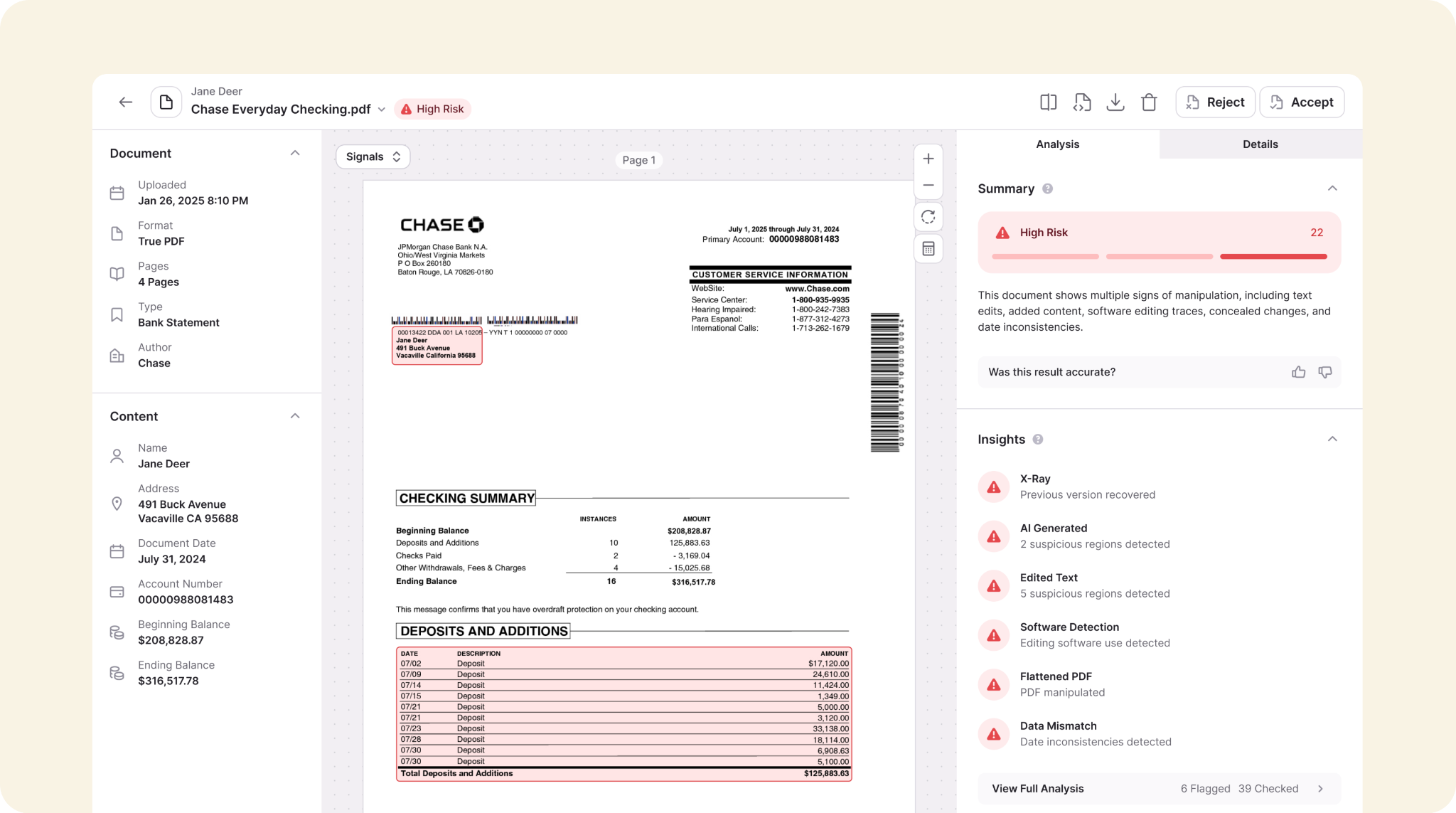
- Tamper detection and image manipulation analysis. Inscribe examines documents at the pixel level to catch altered files created through digital editing, copy-move manipulation, and AI generation. It identifies small details like compression artifacts, seam lines, and pixel inconsistencies that are invisible to the human eye. This layer catches both pre-digital document modification (scanned and re-saved edits) and fully AI-generated documents.
- Metadata analysis and forensic checks. Every digital file carries metadata: creation date, authoring software, edit traces, and revision history. Inscribe validates these fields to surface document alteration and other fraudulent activities. A bank statement created in a consumer image editor rather than a banking system, or a pay stub with mismatched fonts and an unexpected PDF producer, flags as suspicious.
- Document forgery fingerprinting. Inscribe compares incoming documents against patterns across tens of millions of analyzed documents. Network-based detection catches serial fraud by identifying editable templates, recycled layouts, and structural patterns shared across fraudulent documents.
- Automated classification and escalation. Inscribe automatically categorizes incoming documents (invoices, financial statements, IDs, contracts) based on content and applies the appropriate detection rules. Suspicious or manipulated files are escalated automatically, while genuine documents pass through and can trigger downstream workflows like routing invoices for approval.
What Documents Does Inscribe Analyze?
Inscribe covers the document types most commonly targeted by fraudsters in lending, onboarding, and compliance workflows.
Identity documents: Passports, driver's licenses, national IDs, residence permits, and other documents with security features like machine readable zone (MRZ) codes and barcodes. Inscribe catches forged identity documents, fake IDs, and photo substitution. Learn more about document verification.
Financial documents: Bank statements, pay stubs, tax forms, tax returns, invoices, utility bills, employment verification letters, and business financials. These are the document types where fraud is most costly and where identity-only tools leave a blind spot. Inscribe catches altered balances, fabricated deposits, and signs of synthetic identities built on forged paperwork. Synthetic fraud at the document level is especially hard to stop because these schemes often pass identity checks alone.
Bank statements specifically: Inscribe detects altered balances, missing transactions, mismatched fonts, and layout fingerprint deviations across bank statements. When applicants submit multiple months, the system compares them across time series for formatting and balance continuity. Forged bank statements are among the most common forms of document fraud in lending, making this a critical part of any screening workflow.
More context for specific industries: Banks, Lenders, Credit Unions.
Results: Fraud Prevention, Speed, and Document Authenticity
A document detector should help your team catch more fraud, verify documents faster, and prevent losses before they happen. Here is what that looks like with Inscribe.
Fewer fraud losses. Inscribe catches suspicious documents that human reviewers and rules-based systems miss. Logix Federal Credit Union saved $3M+ in fraud losses. BCU prevented $5.6M in financial losses. These results come from catching doctored files, altered submissions, and fabricated documents that would have survived manual review.
Faster processing. Genuine documents clear in about 72 seconds, compared with 10 to 15 minutes of time-consuming manual review. AI-based fraud detection provides higher accuracy at lower cost, while also reducing human error in data entry, indexing, and filing. Faster processing times build customer trust by reducing friction for legitimate applicants.
Explainable scoring. Every analyzed document receives a Trust Score from 0 to 100, reflecting findings across all tamper detection layers. Teams configure thresholds for auto-approval, flagged review, and escalation. Structured outputs, including evidence signals, visual annotations, and plain-language summaries, integrate into dashboards and audit logs. Every decision produces a documented trail. BHG Financial replaced time-consuming manual fraud detection with a scalable, transparent system built on these outputs.
Continuous improvement. Tamper detection accuracy improves through machine learning trained on millions of documents per year and domain-specific judgment from Inscribe's in-house risk analysts and data scientists with 40 years of combined experience. Model updates are tested against the latest fraud attempts and tactics so teams stay ahead of evolving threats and avoid significant financial losses.
Integration, Compliance, and Getting Started
Inscribe is API-first. REST endpoints support document submission, status polling, and result retrieval for individual documents and high-volume batches. Webhook alerting notifies downstream AI systems when documents are processed, flagged, or require escalation. Secure Document Collection replaces email-based intake with secure links for cleaner chain of custody. Integration documentation is at docs.inscribe.ai.
Fraud detection outputs should be consistent and auditable. Inscribe's document fraud detection produces structured evidence that supports KYC, KYB, and AML programs, giving teams a defensible record for every flagged file. Trust Scores, signals, summaries, and timestamps are logged for every decision. The system can also identify sensitive information within documents and apply appropriate security protocols, supporting compliance with regulations like GDPR. Inscribe maintains SOC 2 Type II and ISO 27001 certifications. Read about Inscribe's security posture and legal terms.
Every flagged document comes with a plain-language summary, visual evidence, and severity level so human reviewers can triage quickly. Escalation thresholds route documents to the right reviewers based on Trust Score ranges, signal types, document types, and role or job title. The AI Fraud Analyst demo shows this workflow in action.
Getting started follows a structured rollout: perform a privacy impact assessment, define retention policies, configure API endpoints and webhooks, set Trust Score thresholds, train teams on signals and escalation criteria, and establish audit trail requirements aligned with KYC, KYB, AML, and GDPR.
Get started:
- 👉 Explore the Demo Center
- 👉 Start your free trial
- 👉 Detect fake documents with Inscribe's Agentic Fraud Detection
Next Steps
Deploying a document detector does not require replacing your existing verification process. Most teams start with a focused pilot measuring tamper detection rate, false positive rate, and processing speed against a baseline. After a successful pilot, production rollout follows a phased approach: expand the types of documents covered, increase volume, configure thresholds, and integrate with downstream AI systems.
See the full workflow: Demo Center. Or request a free trial to test Inscribe with your own documents.
Frequently Asked Questions

A document detector is a system that analyzes submitted documents to verify authenticity and surface signs of manipulation. Inscribe applies four detection layers to catch forged, fabricated, and altered files in about 72 seconds, returning a Trust Score, evidence signals, and plain-language summaries.
Most modern systems use a combination of machine learning, metadata analysis, image manipulation detection, and network comparison to verify documents. Inscribe combines all four in a single workflow to screen bank statements, identity documents, driver's licenses, utility bills, and other document types.
Yes. AI-generated fake documents carry specific artifacts: pixel patterns, metadata signatures, and structural characteristics that differ from genuine documents produced by legitimate financial systems. Inscribe's tamper detection layers pick up on these signals even when the documents appear convincing to the human eye.
Inscribe detects a range of forgery types: documents altered with tools like Photoshop or Word, files fabricated from templates or generators, forged identity documents (fake IDs, driver's licenses, photo substitution), spoofed metadata, and misleading submissions where real documents are used out of context or with pages omitted. It also catches patterns of serial fraud, where the same weakness is exploited repeatedly across multiple submissions.
Yes. Inscribe validates bank statements against layout fingerprints for major institutions and compares them to patterns across tens of millions of analyzed files. It catches altered balances, missing transactions, mismatched fonts, and inconsistencies across time-series submissions.
Inscribe integrates into onboarding workflows via API, processing incoming documents in real time. It flags suspicious files before they reach a decision point, helping teams reduce fraud losses without slowing genuine customers.
Identity verification confirms who a person is through selfie-to-ID matching and liveness checks. Document verification confirms that documents are authentic and unaltered. Synthetic identity fraud and identity theft both depend on fraudulent documents making it through the verification process. Both layers matter.
About 72 seconds per document on average. This is significantly faster than time-consuming manual review, which typically takes 10 to 15 minutes. Both real-time and batch processing modes are supported.
About the author
Brianna Valleskey is a B2B marketing leader and Head of Marketing at Inscribe, where she leads the company's full marketing function and go-to-market strategy. She oversees brand, product marketing, demand generation, ABM, content, SEO/AEO, events, partnerships, and marketing operations, with responsibility for marketing pipeline and SQO targets. A former journalist and longtime storyteller, Brianna specializes in translating complex AI, fraud, identity, and fintech topics into clear narratives for enterprise audiences. She is the creator and host of Good Question, Inscribe's podcast on AI and fraud risk, and leads Inscribe's annual State of Document Fraud report.
Learn More
Dive deeper into our Solutions


What will our AI Agents find in your documents?
Start your free trial to catch more fraud, faster.