

Configurable document fraud detection that adapts to your risk strategy
Table of Contents
[ show ]- Loading table of contents...


No two financial institutions evaluate fraud the same way. Every lender has different underwriting policies, document requirements, risk tolerances, and fraud patterns. Yet many document fraud detection solutions apply the same detection logic to every customer.
That one-size-fits-all approach creates unnecessary manual reviews while allowing institution-specific fraud patterns to go unnoticed. Teams end up adapting their processes to the software instead of configuring the software around the way they actually assess risk.
Inscribe's Decision Engine was built to solve that problem. It gives fraud and risk teams the flexibility to configure document fraud detection around their own workflows, allowing the platform to evolve alongside changing fraud patterns and internal policies.
Configure fraud detection around your institution
Inscribe includes a broad set of document fraud detectors out of the box, but every institution has unique requirements. The Decision Engine lets you tailor how those detectors behave while adding your own institution-specific rules. Rather than relying on static detection logic, you can continuously refine how documents are evaluated as your team learns more about the fraud patterns affecting your business.
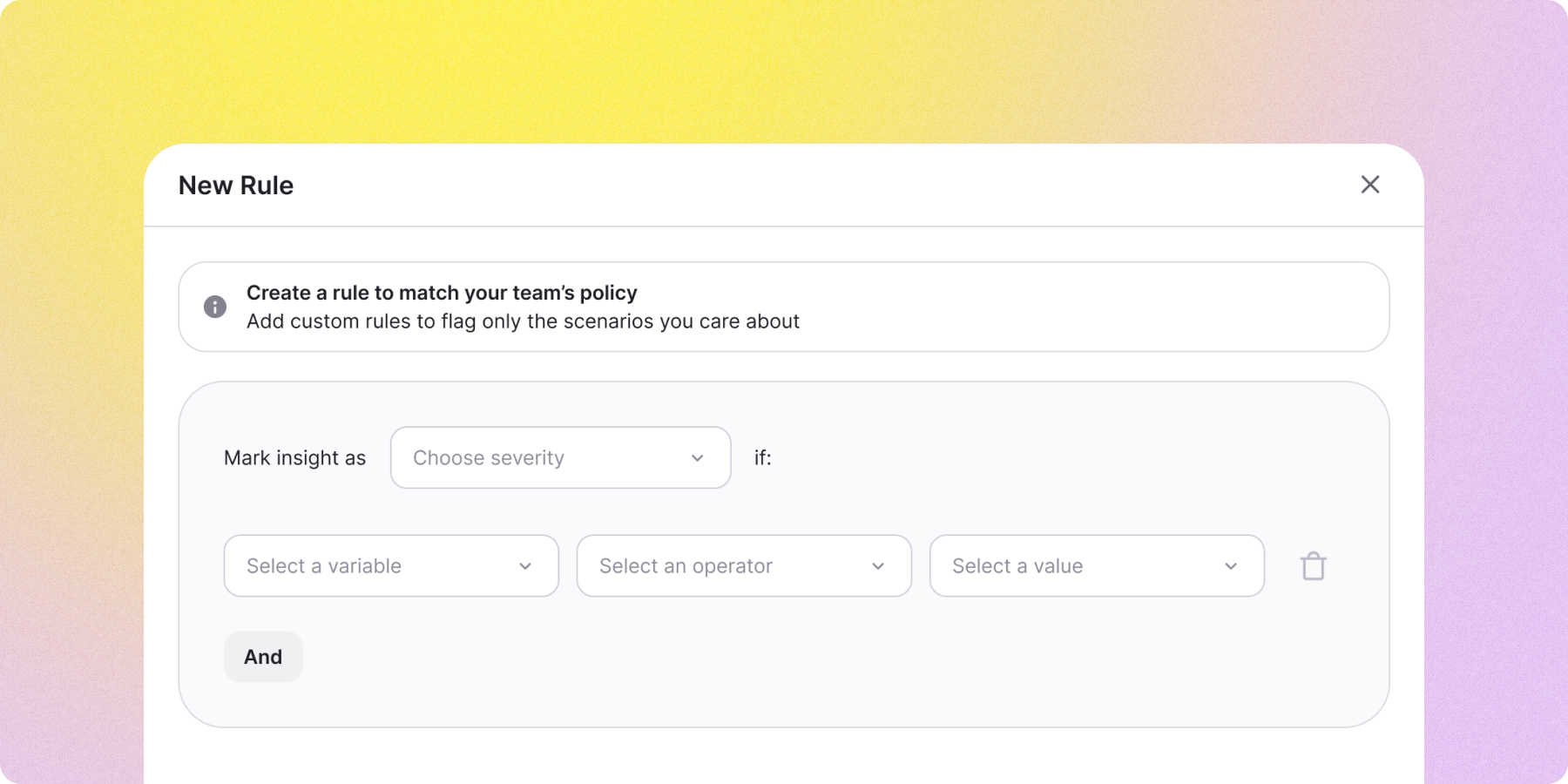
Today, the Decision Engine allows you to:
- Tune detector severities
- Customize decision logic
- Manage software blocklists
- Create Custom Document Insights
- Create Custom Transaction Insights
- Configure document acceptance criteria
Instead of asking reviewers to remember dozens of internal policies, the Decision Engine applies them automatically across every application.
Automate your team's manual document reviews
Every fraud team develops manual checks over time. Some reviewers verify that bank statements were issued within the last 90 days. Others inspect document metadata for editing software, flag stitched statements, or check whether applicants submitted the correct document type.
These reviews are valuable because they reflect your team's experience. They're also repetitive. Custom Document Insights transform those manual checks into automated rules.
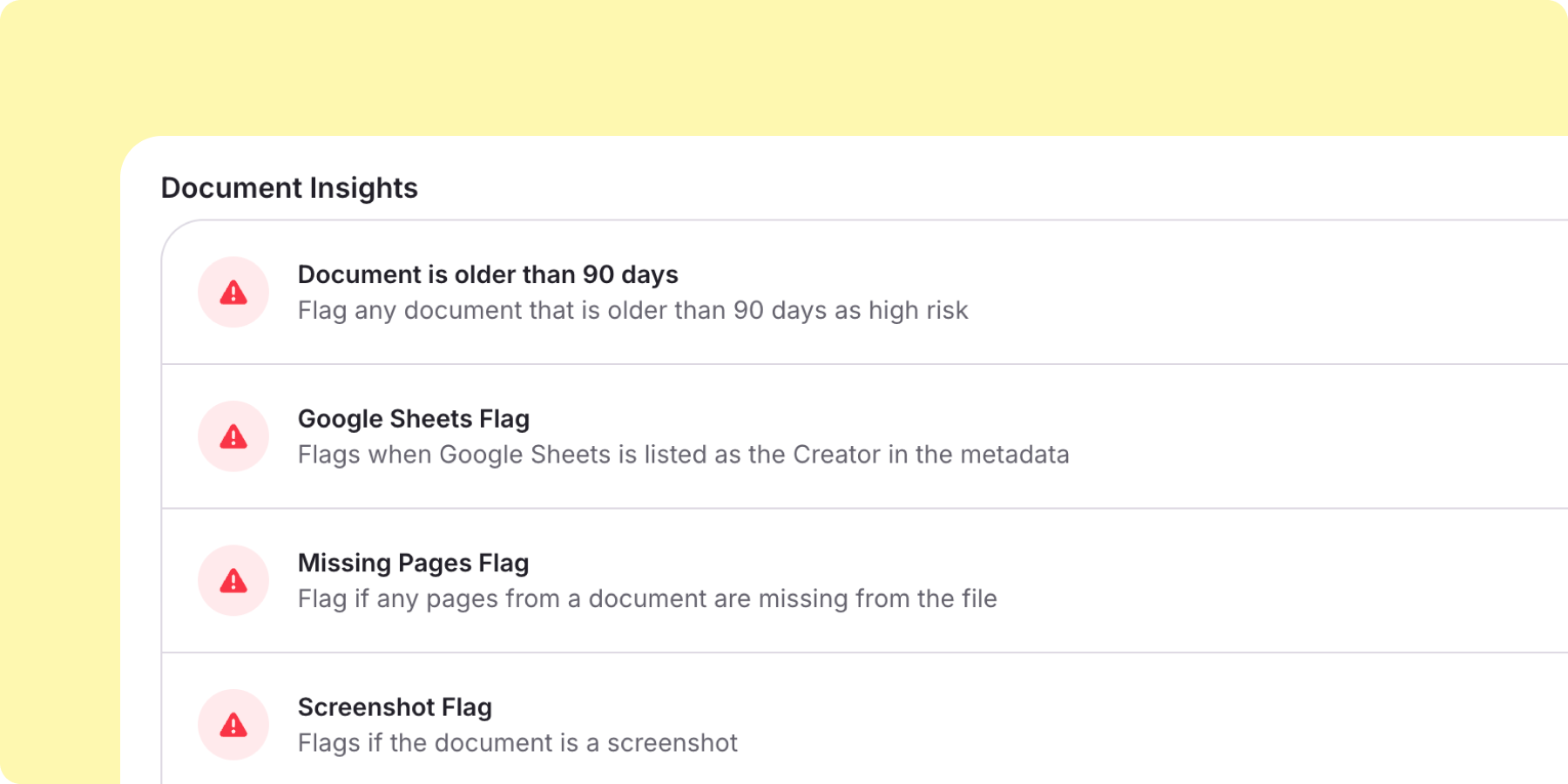
Using plain-language logic, your team can create institution-specific fraud checks that run automatically whenever a document is submitted. Whether you're validating document age, identifying screenshots, detecting metadata anomalies, or enforcing document requirements, those reviews become consistent across every application.
Instead of relying on reviewers to remember every policy, your expertise becomes part of the workflow.
Analyze bank statements using your own risk policies
Bank statements contain far more information than account balances. They reveal spending habits, income stability, cash flow, and financial behavior that often provide stronger indicators of risk than the document itself.
The challenge is that every institution evaluates those behaviors differently. With Custom Transaction Insights, your team defines exactly what should trigger additional review.
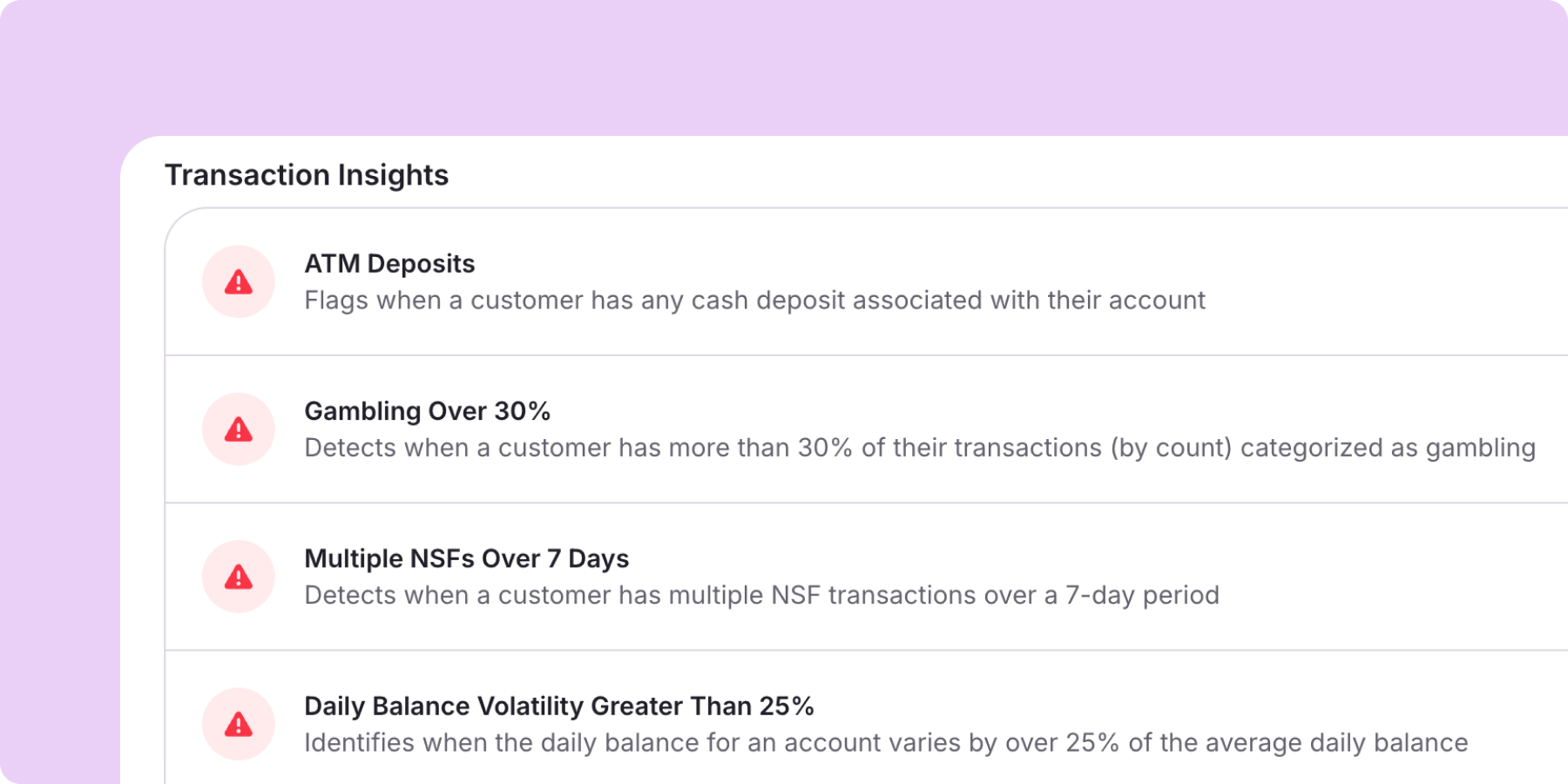
Build insights using transaction:
- Categories
- Merchants
- Payment processors
- Payment methods
- Dollar amounts
- Timeframes
- Counts or percentages
You can also evaluate:
- Average daily balances
- Balance volatility
- Minimum and maximum balances
For example, you might automatically flag applicants who:
- Spend more than 20% of their transactions on gambling or cryptocurrency exchanges.
- Maintain an average daily balance below your underwriting threshold.
- Show unusual balance volatility over a rolling 30-day period.
- Transfer unusually large amounts between personal accounts.
- Exhibit transaction patterns that don't align with your lending policies.
Before deploying a new rule, you can backtest it against historical applicants to understand exactly how often it would trigger and whether it improves detection performance.
Rather than relying on a generic fraud model, every bank statement is evaluated using your institution's own policies.
Put your fraud signals in context
Not every fraud signal should influence a decision the same way. Some indicators are highly predictive of fraud and should contribute directly to a customer's overall risk rating. Others provide useful context but aren't strong enough to affect automated decisioning.
The Decision Engine gives your team control over how every signal is used. You can:
- Adjust detector severities.
- Decide whether custom insights contribute to customer risk ratings or appear as contextual information.
- Apply detectors only to specific document types.
- Configure custom decision logic.
- Maintain blocklists for document editing software that should never appear in your application flow.
This flexibility allows teams to safely test new fraud rules, gradually introduce stricter policies, and continuously improve detection accuracy without disrupting existing workflows.
Detection that evolves with fraud
Fraud changes quickly. AI-generated documents continue to improve. New manipulation techniques appear every month. Your own fraud team constantly uncovers new behaviors that weren't part of your review process six months ago. Your fraud detection platform should be able to adapt just as quickly.
Instead of waiting for product releases or asking engineering teams to build one-off rules, the Decision Engine allows fraud teams to continuously refine how documents are reviewed, how signals are prioritized, and how customer risk is evaluated.
As your institution learns what predicts fraud within your own portfolio, that knowledge becomes part of every future review. The result is document fraud detection that becomes more precise over time — reducing false positives, identifying more true fraud, and reflecting how your organization actually evaluates risk.
If you'd like to see the Decision Engine in action, book a demo to learn how your institution can configure Inscribe around its own fraud strategy.
FAQ

Configurable document fraud detection allows financial institutions to tailor fraud detection around their own underwriting policies, risk tolerances, and review processes instead of relying on fixed rules. Inscribe's Decision Engine gives teams control over detector severities, decision logic, custom fraud rules, and document acceptance criteria so detection reflects how their institution evaluates risk.
Custom Document Insights allow fraud teams to automate institution-specific document checks. Teams can build rules that automatically flag outdated bank statements, screenshots, metadata anomalies, stitched documents, incorrect document types, and other conditions that reviewers would otherwise check manually.
Custom Transaction Insights allow teams to analyze bank statement activity using their own risk policies. Build fraud rules around transaction categories, merchants, payment processors, payment methods, balances, spending patterns, and other financial behaviors that are important to your institution.
Yes. Custom Transaction Insights can be backtested against your existing applicant population before they are enabled. This allows fraud teams to evaluate how often a rule would trigger, measure its effectiveness, and refine detection logic before using it in production.
Yes. The Decision Engine allows you to choose whether a fraud signal contributes to the overall customer risk rating or appears as additional context for reviewers. This gives teams the flexibility to test new rules, phase in policy changes, and fine-tune automated decisioning over time.
Yes. The Decision Engine is designed for fraud and risk teams, allowing them to configure detector severities, create custom document and transaction insights, manage software blocklists, and adjust decision logic without requiring custom development.
Generic fraud rules often generate alerts that aren't meaningful for every institution. By tailoring fraud detection to your own policies, workflows, and historical fraud patterns, the Decision Engine helps prioritize the signals that matter most while reducing unnecessary manual reviews.
Fraud patterns constantly evolve, especially with the rise of AI-generated and manipulated documents. The Decision Engine allows teams to continuously refine fraud rules, update detector settings, and automate new review criteria as they learn more about the fraud affecting their institution, helping document fraud detection become more accurate over time.
About the author
Stephanie Spangler is the Head of Product Marketing at Inscribe, where she covers AI-powered fraud detection, document risk, and how financial institutions are adopting agentic AI. She writes on the intersection of product and practice — translating what fraud detection technology does into what it means for the risk teams using it.
What will our AI Agents find in your documents?
Start your free trial to catch more fraud, faster.