How to evaluate a document fraud detection vendor, from Inscribe’s Co-founder and CTO
Table of Contents
[ show ]- Loading table of contents...


Before Inscribe, I worked at a bank. On a mortgage origination project, I saw firsthand how much time document review took. Reviewers were overwhelmed, and customers were waiting on decisions. And they were missing fraud, because it's often invisible or hiding in details that don't add up once you read the content in context.
That experience led us to build Inscribe.
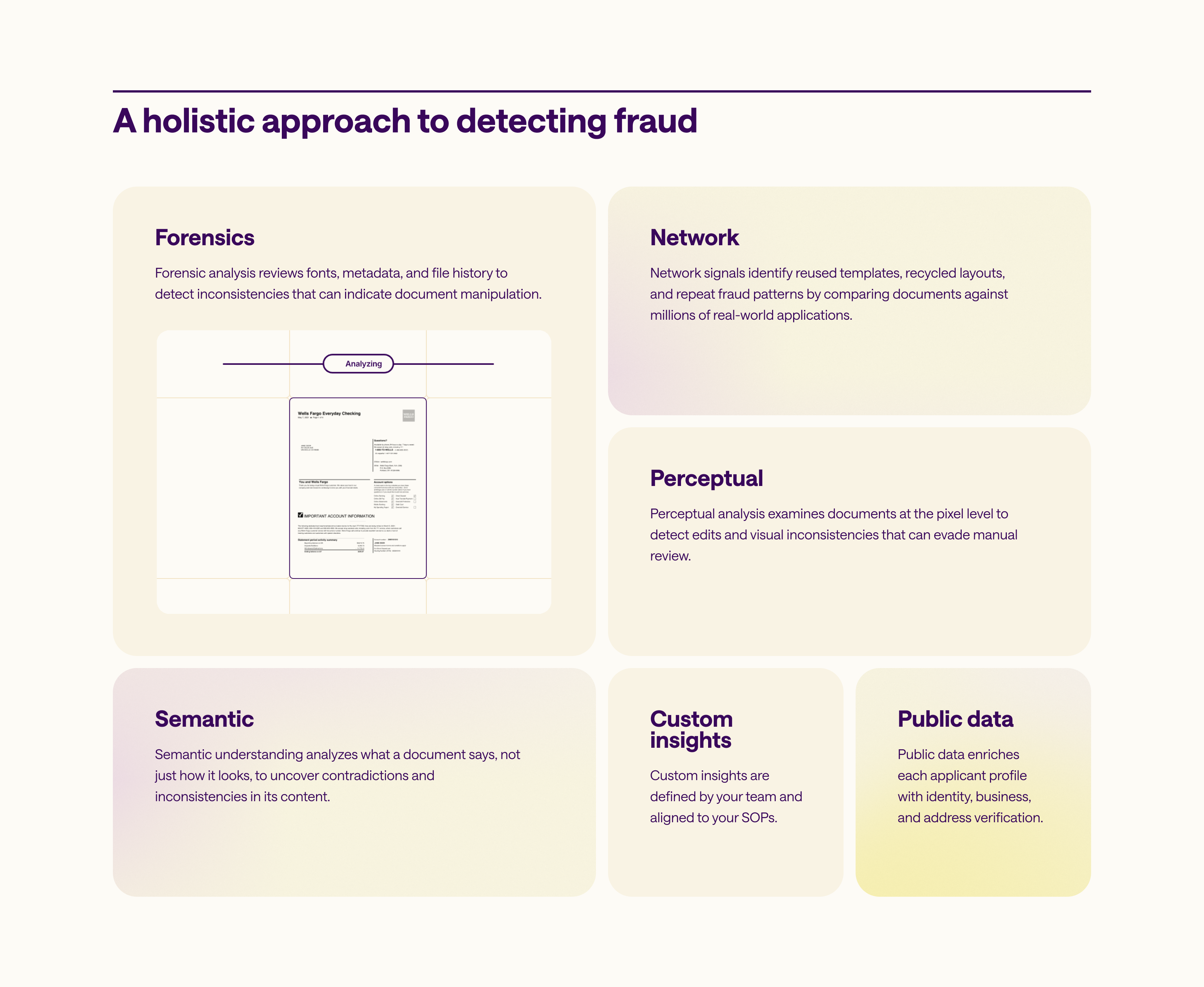
We've spent nine years focused exclusively on document fraud. Inscribe analyzes every document across multiple layers. Forensics examines the file itself. Perceptual analysis looks at the pixels. Semantic analysis checks whether the content makes sense. Network intelligence identifies documents and patterns we've seen before. Public data adds context from outside the document, while custom insights bring in signals tailored to your workflows.
Inscribe brings these signals together, explains what it finds, and gives your team the evidence behind each finding.
Some vendors will tell you they do something similar. Fraud and risk teams usually have a few questions before they decide. Why not keep reviewing by hand? Why Inscribe over other document fraud detection vendors? And more recently, why not build it ourselves with an LLM? Below, I answer each and share a seven-point checklist for comparing vendors.
Why not keep reviewing documents by hand?
"Can’t our reviewers catch this with manual review and reference documents?"
Analysts are good at spotting things that look wrong. But some of the strongest indicators of fraud aren't immediately visible. They can sit in a file's metadata or only show up when you compare information across documents. It's difficult to catch those signals when you're reviewing one PDF at a time.
The tools available to fraudsters have changed, too. What once required some familiarity with tools like Photoshop can now be done with generative AI. Someone can upload a document, tell an LLM what they want to change, and get back something that looks convincing. Templates are also readily available online, making it easier than ever to edit a legitimate document.
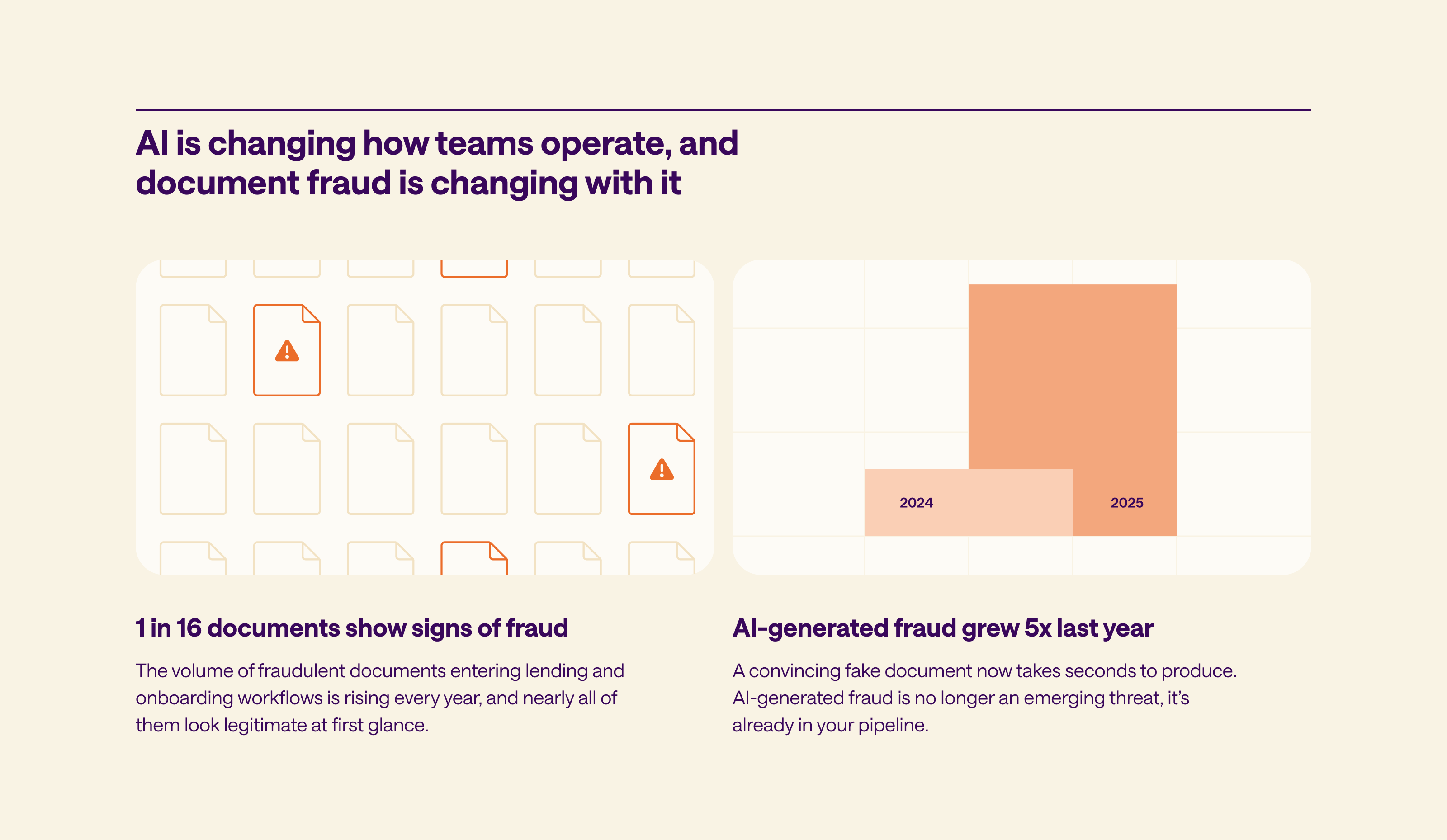
The numbers show how quickly the problem is growing. About 1 in 16 documents across our network showed signs of fraud in 2025. When we got started, it was about 1 in 20. Based on the data we're recording now, we expect that to reach 1 in 14 next year.
AI-generated and template-based fraud together grew 5x in 2026. Looking at AI-generated documents alone, the monthly number we flagged grew 4x from June 2025 to May 2026, with the latest months representing the highest volumes we've recorded.
If your team has never run its documents through a specialized fraud detection tool, you may not know how much fraud you’re missing. When we’ve analyzed past applications from fintechs, lenders, banks, and credit unions, we’ve found fraud they didn’t know about.
Manual review is also slow and inconsistent. A single document can take minutes to review, and two reviewers can look at the same file and reach different conclusions. When someone isn't sure, the safe move is often to decline. That can mean turning away good customers and creating unnecessary friction.
Inscribe checks every document in seconds, applying the same analysis every time. Low-risk documents can move straight through. Your team gets the unusual ones, along with the evidence behind the finding, like which field changed, what it said before, and why something doesn't add up. People still make the decision. They just have better information to work with.
And this goes beyond bank statements. Inscribe analyzes pay stubs, tax forms, invoices, business filings, utility bills, and other financial documents.
Connecting to bank data doesn't solve the problem either. Not everyone will share their login, and connections can fail. And if you automate document reading without checking for fraud, you risk approving fraudulent documents faster.
The quickest way to understand the difference is to try it on your own documents. Send us a sample of past applications and see what comes back.
Why Inscribe over other document fraud vendors?
"Every vendor says they're doing the same checks and using the most advanced AI. How do I know who's actually better at detecting fraud?"
Don't make a decision based on a demo. Run a pilot with every vendor you're seriously considering and test them against the same set of your own documents. That's the only way to understand how well each system actually performs against the fraud targeting your business.
I'd look at seven things in particular.
1. What does it check in the file and on the page?
The starting point for document fraud detection is forensic analysis. It looks at metadata, layering information, previous versions, suspicious software, and inconsistencies in the file itself.
Forensics is also where vendors make broad claims about handling any document, in any language, for any industry. It's easy to say you can do everything. It's harder to demonstrate which capabilities you do really well. Ask each vendor where their strengths are.
There's also visual analysis, which looks at what the document itself looks like to identify signs of manipulation. This is some of the hardest detection work to get right. Traditional techniques, like looking for differences in image compression where something was edited, produced so many false alarms that a person had to review every result. Newer vision and neural network models are changing that. We've invested in this research for years.
2. Does it understand what the document says?
Semantic analysis looks at the content of a document and whether the information makes sense together. For example, someone might change their income on a bank statement but forget to update the summary box. A zip code might not match the address. Tax withholding on a pay stub might not make sense for the state listed in the address.
These inconsistencies can be easy for a person to spot when they're looking for them, but they're difficult to catch consistently at scale. Many tools in the market don't do this today. They stop at the file itself.
We've seen recall, meaning how much of the fraud we catch, improve by 10 to 20% when adding semantic analysis on top of traditional forensic signals. In a pilot, I'd specifically look at how much additional fraud a vendor catches through semantic analysis, beyond what its forensic checks already identify.
We also look beyond the document itself. We search public web data for the applicant's name, address, and business, then check what we find against the information in the document.
3. How quickly does your feedback change the product?
Fraud tactics change constantly. When a new tactic emerges, how long does it take your vendor to respond?
We've built Inscribe around a tight feedback loop with our customers. Customers have told us that with other vendors, it can take up to 12 months for feedback to become a product change. For us, it can take days.
Inscribe also incorporates feedback from analysts' reviews in the app, so your team's judgment helps improve detection over time.
4. Does the network match your business?
Network intelligence is one of the biggest sources of differentiation in document fraud detection.
It lets us look beyond an individual document and identify patterns across institutions. Have we seen this bank account number before under a different identity? Have we seen most of the transactions in this document associated with another identity? Does this document match what we'd expect a legitimate statement from that bank to look like, down to its metadata and fonts?
About 35% of our detections are now network-driven. Five years ago, that figure was fewer than 5%.
To evaluate a vendor's network, I'd run a pilot and measure how many fraud signals come from the network alone, where no other signals were found. That's a good way to understand what the network adds on its own, rather than just looking at the total number of flags.
Then ask how many customers like yours are in the network. Think small business lending, credit cards, consumer lending, and mortgages. How much coverage does the vendor really have? In the US, ours is very strong. It's built from activity across North American banks, credit unions, lenders, and fintechs, so the fraud patterns we see reflect the customers we serve.
5. How many good applicants will it flag?
Every wrong flag is a customer you turned away, or a file someone reviewed for nothing. Ask each vendor how many weak signals it sends you per 100 documents and what your team is supposed to do with them. We focus on the signals that actually predict fraud.
6. Can you adjust it to how your team works?
Every institution has a different risk appetite, customer base, and review process. A fraud detection system needs to account for those differences.
About 80% of the configuration is consistent across customers. The remaining 20% is where you can tailor the system to your business and standard operating procedures. You can adjust how strict the system is and build your own checks across documents and transactions.
7. Can your team act on what it finds?
Inscribe explains the reasons behind every finding in plain language, so reviewers, sales teams, and partners can see what happened without digging through raw data. In a pilot, hand a flagged document to a reviewer who wasn't involved in the setup and see whether they can explain the finding from the output alone.
The bottom line
Compare vendors on how much fraud they catch, how many legitimate documents they flag, and how useful their findings are to your team. Make them prove it with your data.
Why not build it yourself with an LLM?
"We have a great engineering team and access to the most advanced LLMs. Couldn't we just build this?"
We use LLMs ourselves, but there's a big difference between asking a general-purpose model whether a document looks suspicious and building a system that can reliably detect document fraud at scale.
An LLM can tell you whether a document looks plausible, but plausibility isn't the same as authenticity. A convincing fraudulent document is specifically designed to look legitimate. A model needs more than the document's visible contents to determine whether it's real.
It needs to understand how the file was created and edited, whether the information makes sense, and whether the document matches what a legitimate statement from that institution should look like. It also needs to know whether the same document or underlying information has appeared before.
Then there's the data. An institution building its own system primarily sees the fraud targeting its own business. Inscribe learns from fraud patterns across a network of North American financial institutions, lenders, and fintechs.
And the detection model is only one part of the equation. You also need scoring, explanations, review workflows, monitoring, and ongoing tuning as fraud tactics evolve. That requires a team of engineers, data scientists, and fraud analysts working together.
That's what we've built at Inscribe. We use LLMs within our detection system, alongside specialized detectors, network intelligence, and fraud research. Our risk operations team continually updates those capabilities as new tactics emerge.
A year ago, some AI-generated documents were relatively easy to spot. That's no longer the case. As the tools for creating convincing fraudulent documents improve, detection needs to keep pace. Building and maintaining that capability is a much bigger undertaking than writing a prompt.
First to market, still focused on one problem
I started with reviewers who were overwhelmed and customers waiting on decisions. That's still the problem we work on. We were the first vendor to bring document fraud detection to market, and it's still all we do. Being first gave us a head start learning from real fraud, and in this space, how fast detection keeps up matters as much as what it catches today.
What will Inscribe find in your documents?
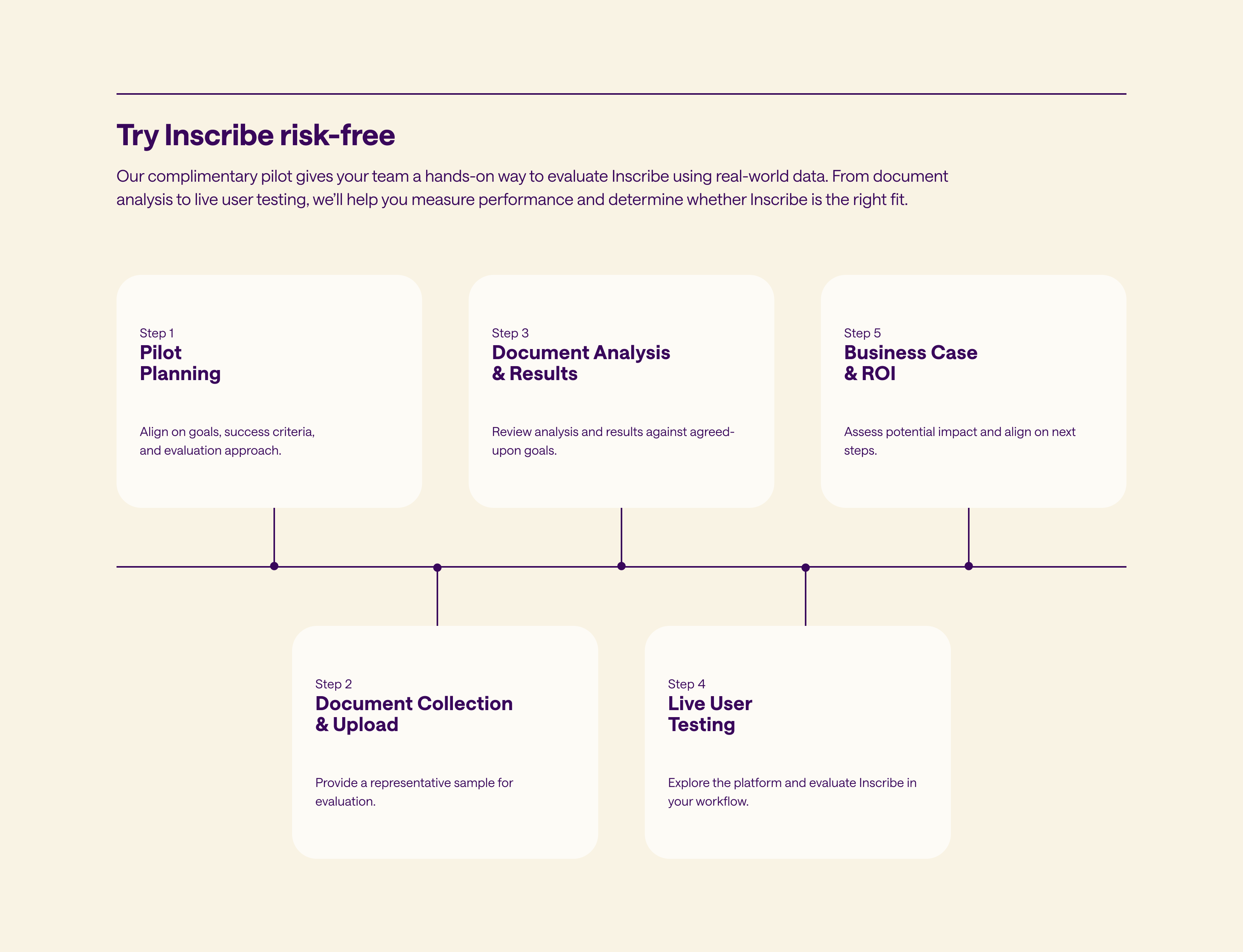
Book a demo and ask about our complimentary document fraud pilot.
Key takeaways
- Manual review misses fraud that hides in file metadata, in the pixels, or in details that only show up when you compare documents. It’s also slow and inconsistent from one reviewer to the next.
- About 1 in 16 documents across our network showed signs of fraud in 2025, and generative AI and templates make convincing fakes easier to produce.
- Evaluate vendors with a pilot on your own documents, not a demo.
- Compare them on seven things: file and page checks, semantic analysis, how fast your feedback changes the product, how well the network matches your business, how many good applicants get flagged, how well it adapts to your team, and how clearly it explains its findings.
- In a pilot, measure how much extra fraud semantic analysis catches beyond forensic checks, how many detections come from the network alone, and how many weak signals you get per 100 documents.
- A general-purpose LLM can tell you whether a document looks plausible. Detecting fraud at scale also takes network data, scoring, explanations, review workflows, and ongoing tuning.
FAQ

Document fraud detection is the process of checking whether a document is genuine before you rely on it. It looks for altered, fabricated, stolen, and reused documents, such as bank statements, pay stubs, and tax forms, and flags the ones that need a closer look.
It combines several kinds of analysis. Forensic analysis checks the file itself, including metadata, editing history, and fonts. Visual analysis looks for signs of manipulation in how the document looks. Semantic analysis reads the content and checks whether the information adds up. Network analysis checks whether the document or its details have appeared before, including under a different identity.
Run a pilot with each vendor on the same set of your own documents. Compare how much fraud each one catches, how many good documents it flags, whether it reads what the document says and not just the file, how strong its network is for your type of business, and how quickly it responds to feedback.
Yes. Inscribe detects both documents created entirely by AI and real documents where AI was used to change a few fields. These documents can look convincing to a reviewer, so detection relies on signals like file history, inconsistencies in the content, and patterns seen across institutions.
A general-purpose LLM can tell you whether a document looks plausible, but a good fraudulent document is designed to look plausible. Reliable detection also needs forensic analysis of the file, knowledge of what a legitimate document from each institution looks like, a network of known fraud, and a team that updates detection as tactics change.
There are four main types. Altered documents are legitimate documents that someone changes, such as an address or an income figure. Fabricated documents are created from scratch, often using templates or AI. Stolen documents are legitimate documents taken through unauthorized access and reused, often under a different identity. Reused documents have already been used in a previous application and are submitted again, hoping a different reviewer or institution approves them.
About 1 in 16 documents across Inscribe's network showed signs of fraud in 2025, up from about 1 in 20 when we got started. Based on the data we are recording now, we expect that to reach 1 in 15 next year. AI-generated and template-based fraud together grew 5x in 2026.
Inscribe analyzes bank statements, pay stubs, tax forms, invoices, business filings, utility bills, and other financial documents. It is built for the documents that banks, credit unions, lenders, and fintechs rely on, especially in underwriting and account opening.
About the author
Conor Burke is the co-founder and CTO of Inscribe, where he leads the AI and engineering systems behind the platform's document fraud detection capabilities. He writes and speaks on the technical mechanics of fraud detection — how LLMs reason, where rules-based systems break down, and what it actually takes to build AI that explains itself.
What will our AI find in your documents?
Book a demo and we'll share more about our complimentary document fraud audit.